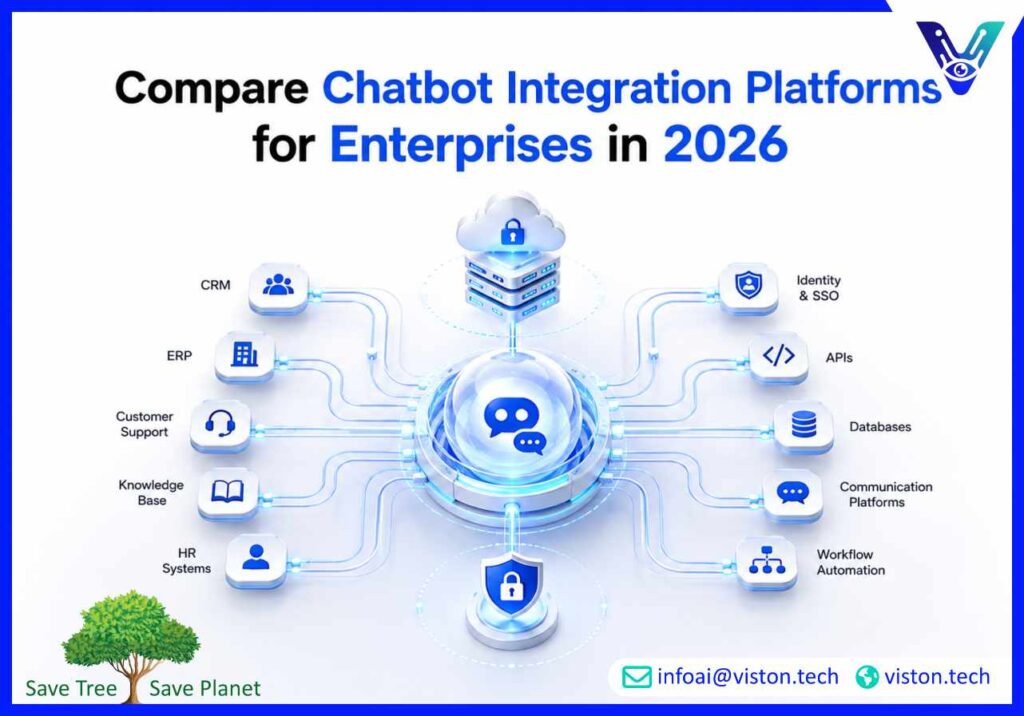
Compare Chatbot Integration Platforms for Enterprises in 2026
Enterprise organizations increasingly rely on AI-powered customer engagement, internal support automation, sales enablement, and operational efficiency initiatives. As adoption grows, selecting the right chatbot integration platform has become a strategic technology decision. The ideal platform must support enterprise-scale integrations, security requirements, automation workflows, and long-term business objectives while connecting seamlessly with existing systems.
What Enterprise Chatbot Integration Platforms Actually Do
A chatbot integration platform serves as the bridge between conversational AI and the business systems enterprises use every day. Rather than operating as a standalone chatbot, these platforms connect AI assistants with customer relationship management systems, enterprise resource planning tools, communication channels, databases, knowledge bases, customer support software, and business applications.For enterprises, chatbot integration is rarely limited to website conversations. Modern implementations often support:
Customer service automation
Sales qualification and lead management
Employee self-service portals
IT help desk support
HR and onboarding assistance
Knowledge management systems
Appointment scheduling workflows
Multi-channel customer engagement
The integration platform determines how effectively the chatbot can access, process, and act on business data across departments.
Key Criteria for Comparing Enterprise Chatbot Integration Platforms
Integration Capabilities
The most important evaluation factor is integration flexibility. Enterprise environments typically contain numerous business applications, legacy systems, cloud platforms, and proprietary databases.Leading platforms offer:
REST API connectivity
Webhook support
CRM integrations
ERP integrations
Customer support platform connections
Data warehouse access
Knowledge base synchronization
Identity and authentication integrations
Organizations should evaluate both native integrations and custom integration capabilities before making a decision.
Security and Compliance
Security remains a major concern for enterprise AI deployments in 2026. Chatbots frequently process customer information, internal documents, employee records, and sensitive business data.Enterprise-grade platforms should provide:
Role-based access controls
Data encryption in transit and at rest
Single Sign-On (SSO)
Audit logging
Compliance support
Data residency controls
Identity management integration
Governance and monitoring capabilities
Industries such as healthcare, finance, insurance, and government sectors often require additional compliance considerations.
Scalability and Performance
Enterprise chatbot deployments can involve thousands of users across multiple departments and regions. The chosen platform must support growing conversation volumes without performance degradation.Important considerations include:
Concurrent user support
Response speed
Global deployment options
High availability architecture
Disaster recovery capabilities
Load balancing support
Enterprise monitoring tools
Comparing Major Enterprise Chatbot Integration Platform Categories
Low-Code Integration Platforms
Low-code chatbot integration platforms focus on simplifying deployment through visual workflows and pre-built connectors.Advantages include:
Faster implementation timelines
Reduced development requirements
Business-user accessibility
Large integration libraries
Lower maintenance overhead
However, organizations with highly customized workflows may encounter limitations when building advanced integrations.
Enterprise Automation Platforms
These platforms combine chatbot capabilities with broader workflow automation and orchestration functionality.Benefits include:
Complex process automation
Cross-system orchestration
Advanced workflow management
Business rule implementation
Department-wide automation initiatives
They are particularly valuable for organizations pursuing enterprise-wide digital transformation programs.
AI-Native Conversational Platforms
AI-native platforms prioritize conversational intelligence, natural language understanding, retrieval capabilities, and generative AI integration.Strengths include:
Advanced language processing
Knowledge retrieval capabilities
Context-aware conversations
Generative AI support
Multi-language interactions
Improved customer experience
The effectiveness of these platforms often depends on integration quality with existing enterprise systems.
Custom Enterprise Integration Frameworks
Large enterprises sometimes develop custom chatbot integration architectures using APIs, middleware platforms, cloud services, and proprietary systems.This approach offers:
Maximum flexibility
Full control over data flows
Custom security requirements
Tailored business logic
Enterprise-specific workflows
However, implementation complexity and maintenance costs are typically much higher than commercial solutions.
How Enterprises Should Evaluate Chatbot Integration Platforms in 2026
Define Business Objectives First
Technology selection should follow business requirements rather than vendor features.Key questions include:
What processes need automation?
Which departments will use the chatbot?
What systems require integration?
What outcomes are expected?
How will success be measured?
Assess Existing Technology Infrastructure
The complexity of current enterprise systems directly affects integration requirements.Organizations should inventory:
CRM platforms
ERP systems
Customer support tools
Communication channels
Knowledge management systems
Authentication providers
Internal databases
The broader the technology landscape, the more important integration flexibility becomes.
Evaluate Long-Term Scalability
Many chatbot projects begin with a single use case but expand rapidly across departments. Enterprises should assess whether a platform can support future growth, additional integrations, new AI capabilities, and increased user adoption.
Prioritize Governance and Control
As AI usage expands, governance becomes increasingly important. Enterprises should select platforms that provide visibility into chatbot performance, integration activity, user access, security controls, and operational metrics.
Successful chatbot deployment depends not only on platform selection but also on integration strategy and execution. Many enterprise projects fail to achieve expected outcomes because integrations are poorly planned, business workflows are not properly mapped, or critical systems remain disconnected.Viston AI specializes in AI Chatbot Integration designed to help organizations connect conversational AI with business-critical platforms, communication channels, customer data systems, and operational workflows. Rather than focusing solely on chatbot deployment, the emphasis is placed on creating practical integrations that enable meaningful automation and measurable business outcomes.For enterprise environments, effective integration often requires consideration of security frameworks, scalability requirements, API architecture, workflow orchestration, user experience, governance controls, and ongoing optimization. Viston AI supports organizations in aligning chatbot capabilities with broader business objectives while ensuring integrations remain reliable, maintainable, and scalable as operational requirements evolve.As enterprise AI adoption continues to grow in 2026, organizations increasingly benefit from integration approaches that connect conversational experiences with the systems employees and customers already use daily.
Frequently Asked Questions
Which chatbot integration platform is best for enterprises?
The best platform depends on business goals, existing systems, security requirements, scalability needs, and integration complexity. Enterprises should evaluate platforms based on their specific operational requirements rather than feature lists alone.
What is the most important factor when comparing chatbot integration platforms?
Integration capability is typically the most critical factor. A chatbot delivers greater business value when it can access and interact with relevant enterprise systems, data sources, and workflows.
How long does enterprise chatbot integration usually take?
Implementation timelines vary depending on the number of integrations, workflow complexity, security requirements, and customization needs. Projects can range from several weeks to several months.
Can chatbot platforms integrate with ERP and CRM systems?
Yes. Most enterprise-grade platforms support integrations with CRM, ERP, customer service, HR, and business intelligence systems through APIs, connectors, and middleware technologies.
Are enterprise chatbot integrations secure?
Enterprise platforms generally provide advanced security controls such as encryption, access management, audit logging, authentication integration, and compliance support. Security requirements should be validated during platform evaluation.
How can Viston AI help with enterprise chatbot integration?
Viston AI helps organizations design and implement AI chatbot integrations that connect conversational experiences with business systems, workflows, and operational processes while supporting scalability, security, and long-term automation objectives.
Conclusion
Comparing chatbot integration platforms for enterprises requires more than evaluating chatbot features. Organizations must assess integration capabilities, security controls, scalability, governance, workflow automation potential, and long-term business alignment. The most effective enterprise chatbot solutions are those that connect seamlessly with existing systems and support measurable operational outcomes. As AI adoption continues to accelerate in 2026, selecting the right AI Chatbot Integration approach can significantly influence customer experience, employee productivity, and organizational efficiency. Businesses seeking reliable implementation strategies can benefit from working with experienced specialists such as Viston AI to ensure integrations deliver practical and sustainable value.