
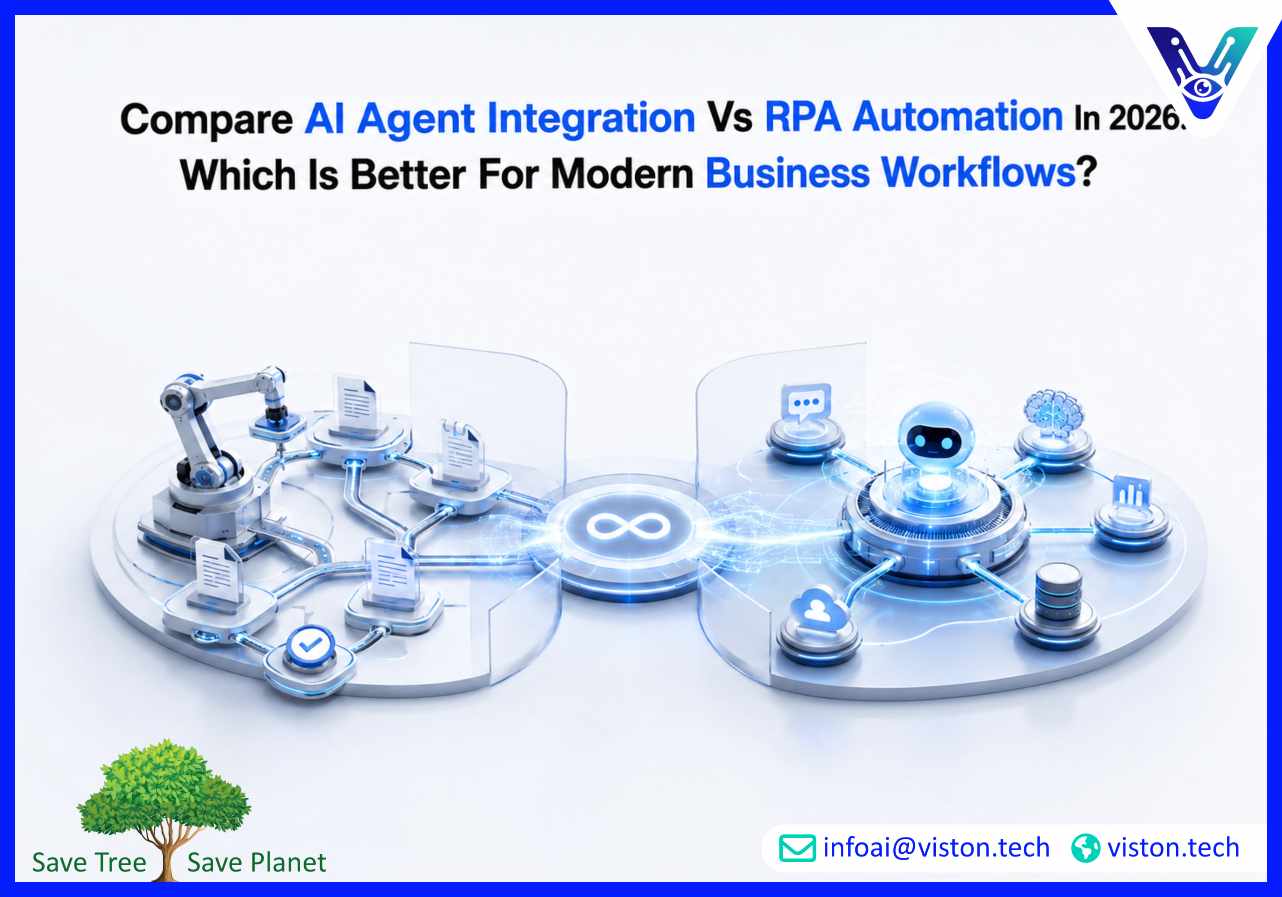
Businesses looking to improve efficiency often evaluate automation technologies before investing in digital transformation initiatives. In 2026, one of the most common questions is whether AI agent integration or traditional RPA automation delivers better business outcomes. While both technologies automate work, they solve different problems and offer different levels of intelligence, flexibility, and scalability.
Before comparing the two approaches, it is important to understand their core purpose.
Robotic Process Automation (RPA) uses software bots to mimic human actions within digital systems. RPA bots follow predefined rules and workflows to complete repetitive tasks such as data entry, invoice processing, report generation, form filling, and system updates.
RPA works best when processes are structured, predictable, and governed by clear business rules.
AI agent integration connects intelligent AI agents with business systems, applications, databases, APIs, communication platforms, and workflows. Unlike RPA bots, AI agents can understand context, retrieve information, reason through tasks, interact with multiple systems, and adapt to changing situations.
AI agent integration allows organizations to automate workflows that require decision-making, communication, analysis, and coordination across multiple business platforms.
Rather than simply executing instructions, AI agents can participate in workflows as intelligent digital workers.
RPA automation follows predefined instructions. If a process changes unexpectedly or data appears in a different format, the bot may fail unless reconfigured.
AI agents can analyze information, interpret context, identify exceptions, and determine the most appropriate next action within approved workflow boundaries.
This makes AI agent integration more suitable for dynamic business environments.
Traditional RPA performs best with structured data such as spreadsheets, databases, and standardized forms.
AI agents can work with:
This capability significantly expands automation opportunities across business functions.
RPA workflows typically require updates whenever interfaces, rules, or business processes change.
AI agents are more adaptable because they can interpret objectives and operate within broader workflow logic. While governance and monitoring remain essential, agent-based systems generally require fewer workflow redesigns when business processes evolve.
RPA bots often operate within specific tasks or applications.
AI agent integration enables agents to collaborate across CRM systems, ERP platforms, customer service tools, communication applications, databases, analytics platforms, and external APIs.
This creates end-to-end workflow automation rather than isolated task automation.
RPA remains highly valuable in many business scenarios. Organizations should not assume AI agents automatically replace RPA.
RPA is often the better choice when:
Common RPA use cases include:
For these use cases, traditional RPA often delivers reliable and cost-effective results.
AI agent integration becomes more valuable when workflows involve complexity, judgment, communication, or coordination.
Organizations increasingly adopt AI agents for:
For example, a customer onboarding process may require reviewing submitted documents, validating information, updating CRM records, communicating with customers, escalating missing information, and generating reports.
While RPA could automate portions of the process, AI agents can coordinate the entire workflow across multiple systems while adapting to exceptions and incomplete information.
As organizations pursue digital transformation initiatives in 2026, AI agent integration increasingly supports workflows that were previously difficult to automate using rules-based approaches alone.
The comparison between AI agent integration and RPA automation is not always an either-or decision.
Many organizations achieve the best outcomes by combining both technologies.
In a hybrid automation environment:
This approach allows businesses to maximize efficiency while maintaining governance and operational control.
Hybrid automation is becoming a preferred enterprise strategy because it leverages the strengths of both technologies rather than forcing a single solution across all workflows.
For organizations comparing AI agent integration and RPA automation, the most important question is not which technology is better overall but which approach best aligns with specific business objectives.
Viston AI specializes in Agent Integration Services that help businesses connect AI agents with existing systems, workflows, applications, and operational processes. This includes identifying opportunities where intelligent agents can enhance automation beyond traditional rules-based execution.
Modern organizations often require workflows that span CRM platforms, ERP systems, customer support environments, knowledge repositories, communication channels, and external applications. AI agent integration focuses on enabling intelligent coordination across these systems while maintaining governance, scalability, and business oversight.
By evaluating workflow complexity, data requirements, integration needs, and operational goals, businesses can determine where traditional automation remains sufficient and where AI agents can create additional value. Viston AI supports this transition by helping organizations design practical, business-focused agent integration strategies that align with real operational requirements.
RPA automation follows predefined rules to execute repetitive tasks, while AI agent integration enables intelligent agents to analyze information, make workflow decisions, and coordinate activities across systems.
No. RPA remains valuable for structured, rules-based processes. Many organizations use both technologies together as part of a broader automation strategy.
AI agent integration is generally more suitable because customer service workflows often involve communication, context interpretation, knowledge retrieval, and exception handling.
Yes. Effective AI agent deployment typically requires integration with business applications, databases, APIs, communication tools, and workflow platforms.
Yes. AI agents are designed to support workflows involving multiple systems, decision points, approvals, communications, and dynamic business conditions.
Yes. Viston AI provides Agent Integration Services that help organizations connect AI agents with business systems, automate workflows, and build scalable agent-driven operations.
When comparing AI agent integration vs RPA automation in 2026, the right choice depends on workflow complexity, business goals, and operational requirements. RPA remains highly effective for structured, repetitive tasks, while AI agent integration enables intelligent automation across dynamic workflows that require reasoning, communication, and cross-system coordination. Many organizations achieve the greatest value through a hybrid approach that combines both technologies. For businesses exploring modern automation strategies, Agent Integration Services provide a practical pathway to creating scalable, intelligent workflows that support long-term operational efficiency and business growth.
