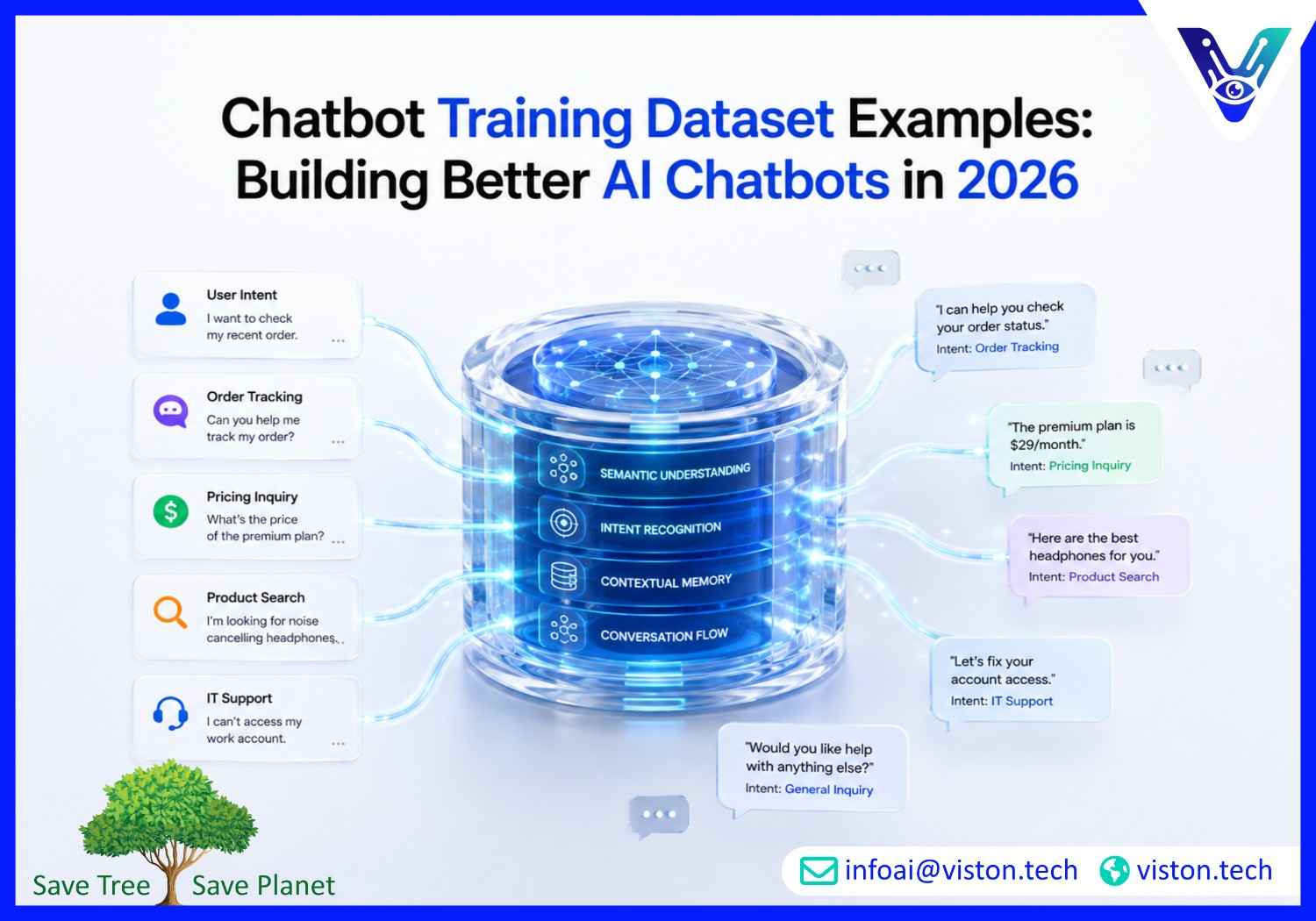
Chatbot Training Dataset Examples: Building Better AI Chatbots in 2026
Behind every effective AI chatbot is a well-structured training dataset. As businesses increasingly rely on conversational AI for customer support, lead generation, sales assistance, and workflow automation, the quality of chatbot training data has become one of the biggest factors influencing chatbot performance. Understanding chatbot training dataset examples helps organizations build more accurate, reliable, and business-ready AI solutions that deliver meaningful customer experiences.
What Is a Chatbot Training Dataset?
A chatbot training dataset is a collection of structured conversational data used to teach an AI chatbot how to understand user intent, interpret language, and generate relevant responses.Training datasets help conversational AI models learn:
User intent recognition
Question-answer relationships
Industry terminology
Business-specific workflows
Customer interaction patterns
Contextual understanding
Conversation management
In 2026, businesses are moving beyond generic chatbot deployments and investing in domain-specific training data that reflects their customers, products, services, and operational processes.The more relevant and accurate the training dataset, the more useful and trustworthy the chatbot becomes.
Why Chatbot Training Data Matters in 2026
Modern AI chatbots are expected to provide fast, accurate, and context-aware responses across multiple communication channels. Poor training data often leads to incorrect answers, customer frustration, and low adoption rates.High-quality training datasets help businesses achieve:
Higher response accuracy
Improved customer satisfaction
Reduced support workloads
Better lead qualification
Stronger automation performance
More personalized interactions
Greater scalability
As AI adoption continues to grow, organizations increasingly recognize that chatbot success depends as much on training data quality as on the underlying AI technology.
Characteristics of Effective Training Datasets
Relevant business-specific content
Diverse user phrasing and language variations
Clear intent labeling
Accurate response mapping
Regular updates and maintenance
Real-world conversational examples
Coverage of edge cases and exceptions
These characteristics help chatbots perform consistently across a wide range of customer interactions.
Common Chatbot Training Dataset Examples
The structure of a training dataset varies depending on the chatbot’s purpose. Different business use cases require different types of conversational training data.
1. Customer Support Dataset Example
Customer service chatbots require datasets containing common customer inquiries and support responses.Intent: Order Tracking
User: “Where is my order?”
User: “Can I track my shipment?”
User: “Has my package been dispatched?”
Response: “Please provide your order number so I can check the latest status.”
Intent: Refund Request
User: “I want a refund.”
User: “Can I return my purchase?”
User: “How do I get my money back?”
Response: “I can help with your refund request. Please share your order details.”
This type of dataset helps support chatbots recognize multiple ways customers may ask the same question.
2. Lead Generation Dataset Example
Sales and marketing chatbots often use datasets focused on qualification and discovery conversations.Intent: Product Inquiry
User: “Tell me about your services.”
User: “What solutions do you offer?”
User: “How can your platform help my business?”
Response: “I’d be happy to help. Can you tell me a bit about your business requirements?”
Intent: Pricing Request
User: “How much does it cost?”
User: “Can I get pricing information?”
User: “What are your plans?”
Response: “Pricing depends on your requirements. Would you like to discuss your project with our team?”
These datasets help chatbots gather information while moving prospects through the sales process.
3. Ecommerce Dataset Example
Ecommerce chatbots require training data that supports product discovery and purchase assistance.Intent: Product Search
User: “I’m looking for running shoes.”
User: “Show me sports footwear.”
User: “Do you sell athletic shoes?”
Response: “I can help with that. Do you have a preferred brand, size, or budget?”
Intent: Delivery Information
User: “How long is shipping?”
User: “What are your delivery times?”
User: “When will my order arrive?”
Response: “Delivery times vary by location. Please provide your postal code for an estimate.”
Well-trained ecommerce chatbots can guide customers through the buying journey while reducing cart abandonment.
4. Internal Employee Support Dataset Example
Organizations increasingly deploy AI chatbots for HR, IT, and operational support.Intent: Leave Policy Inquiry
User: “How many vacation days do I have?”
User: “What’s the annual leave policy?”
User: “Can I check my leave balance?”
Response: “I can help with leave information. Please verify your employee credentials.”
Intent: IT Support
User: “I can’t log in.”
User: “My password isn’t working.”
User: “I’m locked out of my account.”
Response: “Let’s troubleshoot your login issue. Have you recently changed your password?”
Internal support datasets improve employee productivity while reducing manual service requests.
Best Practices for Building Chatbot Training Datasets
Creating an effective training dataset requires more than collecting questions and answers. Businesses must design datasets that reflect real-world conversations and operational requirements.
Collect Real Customer Conversations
Customer support tickets, chat logs, emails, call transcripts, and helpdesk interactions often provide valuable examples of how users naturally communicate.
Include Multiple Variations of User Queries
Customers rarely ask questions in identical ways. Training datasets should include different phrasings, abbreviations, spelling variations, and conversational styles.
Label Intents Clearly
Accurate intent classification improves chatbot understanding and helps AI models deliver appropriate responses.
Account for Industry-Specific Terminology
Every industry has unique language, product names, technical terms, and customer expectations. Training data should reflect these nuances.
Continuously Update Training Data
Business processes, products, customer needs, and regulations evolve over time. Regular dataset maintenance ensures chatbot performance remains accurate and relevant.
Test Against Real-World Scenarios
Before deployment, datasets should be validated using realistic user interactions to identify gaps and improve coverage.
Common Training Dataset Mistakes Businesses Should Avoid
Many chatbot projects underperform because organizations underestimate the importance of training data quality.Common mistakes include:
Using too little training data
Relying on generic datasets
Ignoring industry terminology
Failing to update training content
Poor intent categorization
Limited language variation
Not accounting for complex customer journeys
A chatbot can only perform as well as the information it has been trained to understand and process.
How Viston AI Develops Business-Focused Chatbot Training Data
Effective AI chatbot development requires more than selecting a chatbot platform. Training data strategy plays a critical role in ensuring chatbots understand business requirements, customer needs, and operational workflows.Viston AI helps organizations develop AI chatbot solutions using structured training datasets tailored to specific industries, customer journeys, and business objectives. This includes identifying user intents, organizing knowledge sources, designing conversational workflows, integrating business systems, and continuously improving chatbot performance through ongoing optimization.For businesses implementing customer support automation, lead generation chatbots, employee self-service assistants, or industry-specific AI solutions, relevant training data is essential for delivering accurate and reliable interactions. By aligning chatbot training datasets with real business processes, Viston AI supports organizations in building conversational AI systems that provide measurable operational value while maintaining scalability and user satisfaction.As AI-powered customer engagement continues to expand in 2026, businesses increasingly benefit from chatbot development strategies that prioritize data quality, contextual understanding, and long-term performance improvement.
Frequently Asked Questions
What is a chatbot training dataset?
A chatbot training dataset is a collection of structured conversational examples used to teach an AI chatbot how to understand user requests, identify intents, and provide relevant responses.
How much training data does a chatbot need?
The amount varies depending on complexity, industry, and use case. More diverse and relevant data generally improves chatbot accuracy and performance.
Can businesses use existing customer conversations as training data?
Yes. Support tickets, chat transcripts, emails, and customer service interactions often provide valuable real-world training examples when handled according to applicable privacy requirements.
Why do chatbot training datasets require ongoing updates?
Customer behavior, products, services, regulations, and business processes change over time. Regular updates help maintain chatbot accuracy and relevance.
Can Viston AI help create custom chatbot training datasets?
Yes. Viston AI develops customized chatbot training frameworks as part of its AI chatbot development services, helping businesses align conversational AI with operational goals, customer interactions, and industry requirements.
Conclusion
Understanding chatbot training dataset examples is essential for organizations seeking successful AI chatbot development. High-quality training data enables chatbots to understand customer intent, deliver accurate responses, and support meaningful business outcomes across customer service, sales, ecommerce, and internal operations. As conversational AI becomes more sophisticated in 2026, businesses that invest in structured, relevant, and continuously optimized training datasets will achieve stronger automation performance and better user experiences. For organizations implementing AI chatbot development initiatives, working with experienced specialists such as Viston AI can help ensure chatbot training strategies align with long-term business objectives and operational requirements.