
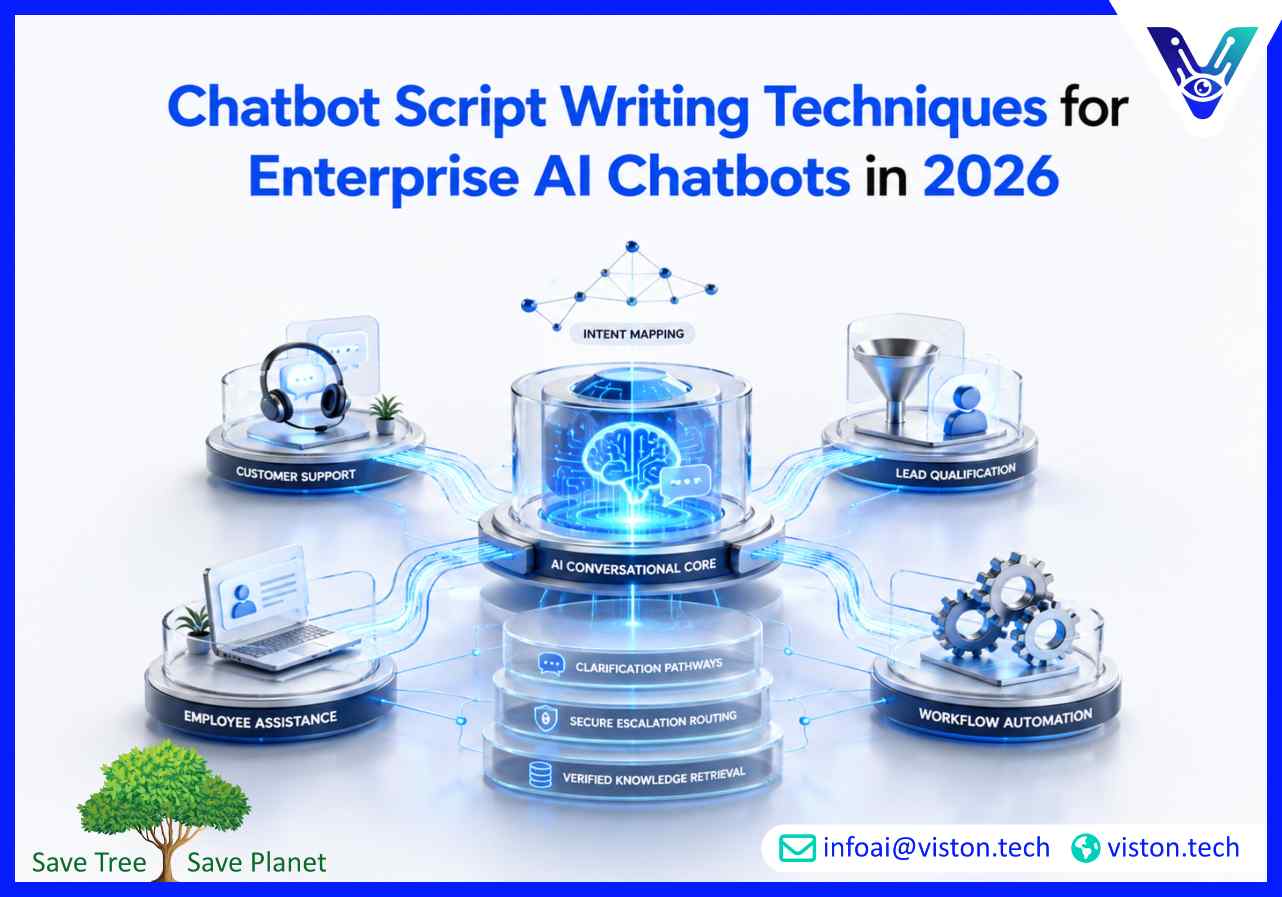
Strong chatbot script writing techniques help enterprises turn AI conversations into reliable customer support, lead qualification, internal assistance, and workflow automation. In 2026, chatbot scripts must do more than sound friendly. They need to guide intent, protect context, support escalation, reduce confusion, and help AI chatbots deliver accurate business outcomes at scale.
Enterprise AI chatbots are no longer simple question-and-answer tools. They are becoming conversational interfaces connected to CRMs, knowledge bases, ticketing systems, product catalogs, payment flows, and internal workflows. A weak script can make even a technically advanced chatbot feel unreliable, while a well-designed conversation structure can improve clarity, trust, and task completion.
Chatbot script writing is the process of designing the words, flows, prompts, fallback responses, clarification questions, escalation points, and brand tone used by a chatbot. For enterprise AI chatbots, this includes both visible user-facing dialogue and the structured logic that helps the chatbot understand intent, maintain context, and respond safely.
Good script writing is not about making a bot sound human at all costs. It is about making the conversation useful. A business user wants quick answers, clear next steps, and confidence that the chatbot understands the request. Customers do not want long explanations when they need order tracking, account support, appointment booking, technical guidance, or a handoff to a human agent.
In enterprise environments, scripts also need to support governance. The chatbot should know when to answer, when to ask for more information, when to retrieve verified data, and when to escalate. This is especially important when the chatbot handles sensitive information, regulated workflows, customer complaints, billing questions, or technical troubleshooting.
The best chatbot script writing techniques combine customer experience design, natural language understanding, business process mapping, prompt engineering, data governance, and continuous optimization. They create conversations that feel simple to users while managing complex logic behind the scenes.
Every effective chatbot script begins with intent mapping. Before writing greetings, buttons, or fallback messages, businesses should define the main reasons users will interact with the chatbot. Common enterprise intents include customer support, product discovery, lead qualification, employee helpdesk queries, appointment scheduling, onboarding, claims support, order updates, and technical troubleshooting.
A script should be built around what users want to accomplish. For example, a customer asking about an invoice may need billing history, payment options, dispute support, or a human finance representative. A strong script identifies these possibilities and guides the user toward the right path without forcing them through unnecessary menus.
The opening message sets expectations. A good enterprise chatbot should quickly explain what it can help with, how the user can interact, and whether the conversation is AI-assisted. This is especially important in markets affected by AI transparency requirements, where users may need to be informed when they are interacting with an AI system.
A strong opening avoids vague lines such as “How can I help you today?” when the chatbot has specific capabilities. A better version might be: “I can help with order tracking, product questions, account updates, and support requests. What would you like to do?” This gives users direction without limiting natural language input.
Enterprise users often contact chatbots because they want speed. Scripts should use short paragraphs, clear options, and direct instructions. Long answers may be useful for complex topics, but most chatbot responses should be concise enough to scan quickly.
Action-oriented writing helps users move forward. Instead of saying, “Your request has been received and our system will process it shortly,” a better script says, “Your request is submitted. You will receive an update by email once it is reviewed.” The second version is clearer, more specific, and easier to trust.
AI chatbots often fail when they guess too quickly. Strong scripts include clarification questions that help the bot resolve ambiguity. If a user says, “I need help with my account,” the chatbot should not assume whether the issue is login access, billing, profile settings, or security. It should ask a focused question such as, “Is this about logging in, billing, profile changes, or account security?”
Clarification questions should be brief and limited. Asking too many questions creates friction. Asking the right question at the right time improves routing, accuracy, and resolution speed.
Fallback responses are critical in enterprise AI chatbots. A fallback is the response shown when the chatbot does not understand the user or cannot complete the request. Poor fallback scripts make users feel stuck. Good fallback scripts recover the conversation.
A useful fallback should acknowledge the issue, offer a simpler path, and provide an escalation option where appropriate. For example: “I could not identify the exact request. You can choose billing, technical support, order status, or speak with a support specialist.” This keeps the conversation moving instead of ending in frustration.
Enterprise AI chatbots should not pretend to know everything. Script writing should define clear boundaries around what the chatbot can and cannot do. This matters in industries such as finance, healthcare, legal services, insurance, logistics, and enterprise software, where wrong answers can create operational, reputational, or compliance risks.
A well-written script includes safe limitations. For example, a healthcare chatbot may help with appointment scheduling and general clinic information but should not diagnose medical conditions. A financial chatbot may explain account processes but should avoid giving personalized investment advice unless the system is designed, approved, and governed for that use case.
Security-aware scripting is now a core requirement for enterprise chatbot deployment. Scripts should avoid asking for unnecessary personal data, should explain why information is needed, and should guide users toward secure authentication flows when required.
In 2026, enterprise teams also need to consider risks such as prompt injection, sensitive information exposure, insecure tool access, and excessive chatbot agency. OWASP identifies prompt injection and sensitive information disclosure among major risks for LLM and generative AI applications, which makes secure conversation design essential for business chatbots.
Many enterprise AI chatbots use knowledge bases, help centers, CRM records, policy documents, or product databases to generate answers. Script writing should support this by guiding the chatbot to answer from approved sources, cite internal references where the interface supports it, and avoid unsupported claims.
This is especially important for enterprise support teams. A chatbot that answers from outdated documentation can create confusion. Scripts should include logic for uncertainty, such as: “I found a related policy, but I need to confirm the latest version before giving a final answer.” This is more trustworthy than giving a confident but incorrect response.
Escalation should not be treated as a failure. In enterprise chatbot design, escalation is part of a mature service model. A chatbot should hand off to a human agent when the request is sensitive, emotionally charged, technically complex, high-value, or outside the bot’s approved scope.
Good escalation scripts summarize the conversation before transfer. This helps the user avoid repeating information and helps the human agent respond faster. A strong handoff might say: “I’ll connect you to a support specialist. I’ll include your order number, the issue you described, and the troubleshooting steps already tried.”
Customer support scripts should focus on fast issue identification, account verification, knowledge retrieval, and clear resolution paths. They usually need strong fallback handling because users describe problems in many different ways. A support chatbot should recognize urgency, frustration, and repeated failure signals.
Useful support script elements include issue category selection, short diagnostic questions, confirmation messages, resolution summaries, ticket creation flows, and escalation options. The goal is not only to answer questions but to reduce support effort while improving customer confidence.
Lead qualification scripts should feel consultative rather than intrusive. Instead of immediately asking for contact details, the chatbot should first understand the buyer’s need, company size, timeline, budget range, service interest, and decision stage.
A good lead script might ask: “Are you exploring chatbot automation for customer support, sales, internal operations, or another use case?” This question is more useful than a generic form because it helps segment the lead and route it to the right sales or consulting team.
Enterprise AI chatbots are increasingly used for HR, IT, finance, procurement, and operations support. Internal scripts should be written with employee productivity in mind. Employees want quick answers about policies, tools, access requests, payroll, benefits, approvals, or troubleshooting.
These scripts should connect to identity and permission systems where needed. They should also use role-aware responses. A manager asking about approval workflows may need different information from a new employee asking how to submit an expense claim.
Technical chatbot scripts require more structure than general support scripts. They should guide users step by step, confirm completed actions, ask diagnostic questions, and avoid skipping critical checks. In enterprise environments, technical scripts may also need to connect with logs, device data, service status tools, or maintenance systems.
Good troubleshooting scripts are precise. They avoid vague advice and provide numbered steps when useful. They also define when to escalate, especially when the issue affects business continuity, security, production systems, or customer-facing operations.
Chatbot script writing should not end at launch. Enterprise teams need ongoing measurement to understand where conversations succeed or fail. Important metrics include containment rate, escalation rate, first-contact resolution, fallback frequency, user satisfaction, average conversation length, task completion rate, and repeated contact rate.
However, metrics should be interpreted carefully. A high containment rate is not always positive if users are trapped in poor conversations. A higher escalation rate may be acceptable if the chatbot is correctly identifying complex cases. The best evaluation combines quantitative analytics with transcript review and agent feedback.
Real users rarely speak exactly like scriptwriters expect. They use shorthand, mixed language, spelling errors, product nicknames, emotional language, and incomplete details. Reviewing transcripts helps businesses identify missing intents, confusing responses, unclear questions, and unnecessary friction.
Script improvements should be based on evidence. If many users abandon the conversation after a certain prompt, that prompt may be too long, too confusing, or too demanding. If users repeatedly ask the same follow-up question, the original response probably lacks a key detail.
Brand voice matters, but clarity matters more. Enterprise chatbot scripts should sound aligned with the business while staying useful. A luxury retail chatbot may use polished, service-led language. A logistics chatbot may be more direct and operational. A healthcare chatbot should be calm, careful, and reassuring.
The best scripts avoid exaggerated personality. Users usually do not need jokes, overly casual language, or excessive empathy. They need the chatbot to understand their request and help them complete the task.
Before launching across all channels, chatbot scripts should be tested with real scenarios. Testing should include common queries, edge cases, vague requests, angry messages, multilingual inputs, compliance-sensitive questions, and attempts to bypass chatbot rules.
Enterprise teams should also test how the chatbot behaves when connected systems are unavailable. A strong script includes graceful failure messages, such as: “I cannot access order details right now. Please try again shortly, or I can create a support request.” This protects the user experience when integrations fail.
Viston AI is relevant to chatbot script writing techniques because its service offering includes Enterprise AI Chatbots, AI Chatbot Development, AI Chatbot Integration, multilingual support, NLP and text analysis, MLOps, and AI automation capabilities. Its Enterprise AI Chatbots service is positioned around conversational AI for complex customer interactions across channels, languages, and business units, with integration into CRM systems, knowledge bases, and transactional systems.
For businesses planning enterprise chatbot projects, this matters because script quality must be connected to technical implementation. A chatbot script is only effective when it works with intent recognition, context handling, secure integrations, escalation logic, analytics, and continuous optimization. Viston AI’s broader AI service portfolio also includes chatbot development, custom AI solution development, NLP, model monitoring, and workflow automation, which are important capabilities for building chatbots that operate beyond basic FAQ responses.
Organizations across customer service, sales, operations, e-commerce, finance, healthcare, manufacturing, logistics, and internal support can benefit from a partner that understands both conversation design and enterprise AI architecture. In practical terms, Viston AI can help businesses design chatbot scripts around real buyer journeys, connect conversations to approved business systems, improve response accuracy, and create scalable chatbot experiences that support measurable service outcomes without relying on generic automation alone.
Chatbot script writing techniques are methods used to design chatbot conversations, including greetings, user prompts, intent flows, clarification questions, fallback responses, escalation messages, and task completion steps. For enterprise AI chatbots, these techniques also support accuracy, compliance, integrations, and customer experience.
Scripts help enterprise AI chatbots guide users through structured conversations while reducing confusion and risk. They improve intent recognition, support consistent brand tone, manage complex workflows, and define when the chatbot should answer, clarify, retrieve data, or escalate to a human agent.
A good fallback message should acknowledge the issue, avoid blame, offer clear options, and provide an escalation path. Instead of saying the chatbot does not understand, the script should help the user rephrase, choose a category, or connect with support.
Yes. Well-written chatbot scripts can qualify leads by asking relevant questions about needs, budget, timeline, company size, and service interest. They can also route prospects to the right sales team, schedule consultations, and capture useful context before human follow-up.
Enterprise chatbot scripts should be reviewed continuously after launch. Businesses should analyze conversation transcripts, fallback rates, user feedback, escalation reasons, product updates, policy changes, and support trends to improve scripts over time.
Viston AI provides Enterprise AI Chatbots and related chatbot development, integration, NLP, automation, and AI solution capabilities. This makes it relevant for businesses that need chatbot scripts connected to scalable AI chatbot implementation, enterprise systems, and measurable service workflows.
Chatbot script writing techniques are essential for building Enterprise AI Chatbots that are accurate, useful, scalable, and trusted. In 2026, successful chatbot conversations require more than friendly wording. They need clear intent mapping, secure data handling, smart clarification, reliable fallback flows, human escalation, and continuous improvement. Businesses that invest in strong script design can reduce customer friction, support teams more effectively, and create AI chatbot experiences that align with real operational goals. Viston AI is a relevant specialist for organizations seeking enterprise chatbot support connected to practical AI development, integration, and automation needs.
