
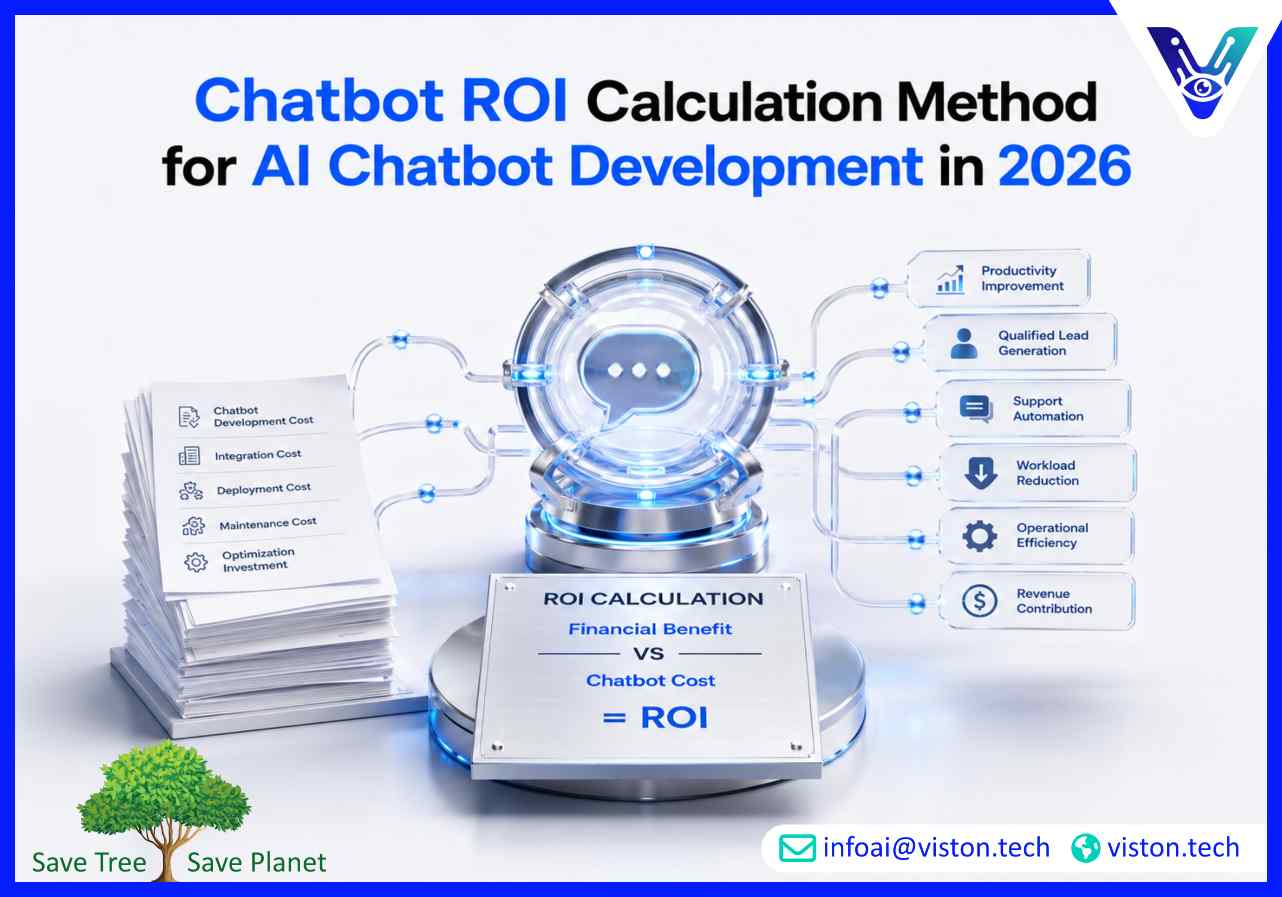
Understanding chatbot ROI calculation method is essential before investing in AI chatbot development. Businesses want faster support, better lead handling, lower operational costs, and measurable automation value, but those outcomes only matter when they can be tracked against real implementation, integration, training, and maintenance costs.
A chatbot ROI calculation method is the structured process businesses use to measure whether an AI chatbot creates more value than it costs to build, deploy, manage, and improve. It connects chatbot performance to financial outcomes such as cost savings, revenue growth, productivity gains, improved customer retention, and faster response handling.
In 2026, this calculation is no longer limited to simple support ticket deflection. Modern AI chatbots can answer customer questions, qualify leads, guide users through product selection, integrate with CRM systems, support internal teams, automate workflow steps, and escalate complex cases to human agents. Because of this, ROI must be calculated across both direct and indirect business impact.
The basic chatbot ROI formula is:
Chatbot ROI = (Total Financial Benefit – Total Chatbot Cost) / Total Chatbot Cost x 100
This formula looks simple, but the accuracy depends on how carefully the business defines both sides of the calculation. Total financial benefit may include reduced support workload, recovered agent hours, higher conversion rates, improved lead response speed, reduced missed inquiries, faster onboarding, and fewer repetitive internal tasks. Total chatbot cost may include discovery, design, development, AI model configuration, integrations, testing, training, hosting, monitoring, optimization, and ongoing support.
A strong ROI calculation should not assume that every automated conversation creates equal value. A chatbot that handles password reset questions may save operational time, while a chatbot that qualifies enterprise sales leads may influence revenue. Both are valuable, but they must be measured differently.
AI chatbot development has matured from simple scripted bots into more advanced conversational systems powered by natural language processing, large language models, retrieval-based knowledge access, workflow automation, and business system integrations. This creates more opportunity, but it also increases the need for responsible measurement.
Business leaders are asking practical questions before approving investment. Will the chatbot reduce customer service pressure? Will it improve response times without damaging customer experience? Can it integrate with existing systems? Can it handle real user intent? Will it reduce costs or simply add another software layer?
A clear chatbot ROI calculation method helps answer these questions before and after deployment. It supports better budgeting, vendor evaluation, implementation planning, and performance governance.
The most common ROI drivers include:
Not every chatbot will deliver all of these outcomes. A customer service chatbot may focus on support cost reduction, while a sales chatbot may focus on qualified pipeline contribution. An internal enterprise assistant may focus on employee productivity and knowledge retrieval. The ROI model must match the actual business use case.
Many chatbot projects fail to show value because the ROI method is too vague. Businesses often count chatbot conversations without measuring whether those conversations solved a problem, reduced work, improved conversion, or supported a meaningful action. High usage does not automatically mean high ROI.
A better approach is to track outcomes such as resolved conversations, successful handoffs, qualified leads, completed forms, reduced agent workload, shorter response times, and improved customer satisfaction. This shifts measurement away from vanity metrics and toward operational and financial impact.
A practical chatbot ROI calculation method should start before development begins. This allows the business to set a baseline, define expected outcomes, and compare post-launch performance against real operational data.
The first step is to define what the chatbot is expected to do. A chatbot built for customer support will have different ROI metrics from one built for lead generation, e-commerce assistance, appointment booking, employee helpdesk support, or internal workflow automation.
For example, a support chatbot may be measured by ticket deflection, average response time, and agent workload reduction. A sales chatbot may be measured by lead capture rate, qualification accuracy, meeting bookings, and conversion influence. A workflow chatbot may be measured by time saved across repeated operational tasks.
Before calculating future ROI, businesses need to understand current costs. This may include support team salaries, average ticket handling time, number of monthly inquiries, cost per ticket, lead response delays, missed inquiries, and time spent on repetitive tasks.
Useful baseline questions include:
Without baseline data, ROI becomes guesswork. Even a simple baseline is better than relying on assumptions.
The next step is to estimate the financial value the chatbot may create. This can be divided into cost savings, productivity gains, and revenue impact.
Cost savings may come from reduced manual support volume, fewer repetitive inquiries, shorter handling times, and better routing of complex issues. Productivity gains may come from faster employee access to knowledge, automated internal requests, and reduced administrative effort. Revenue impact may come from improved lead response, better product recommendations, abandoned cart recovery, or faster qualification of prospects.
For example, if a business receives 10,000 monthly support queries and 40 percent are repetitive, a chatbot may be able to resolve a portion of those without human intervention. The financial benefit depends on the cost per manually handled query and the percentage of successful automated resolutions.
Total chatbot cost should include more than the initial build. A realistic AI chatbot development budget may involve:
Ignoring ongoing costs can make ROI look stronger than it really is. AI chatbots need continuous improvement because customer questions change, products change, internal processes change, and model behavior must be monitored for accuracy and reliability.
Once total benefits and total costs are defined, apply the core formula:
ROI = (Financial Benefit – Chatbot Cost) / Chatbot Cost x 100
If the chatbot creates $120,000 in annual measurable benefit and costs $40,000 across development, integration, deployment, and support, the ROI would be:
($120,000 – $40,000) / $40,000 x 100 = 200%
This means the business receives two dollars in net return for every dollar invested. However, the number should be reviewed alongside non-financial outcomes such as customer satisfaction, faster service availability, improved process consistency, and stronger data visibility.
A reliable chatbot ROI calculation method uses a balanced set of metrics. The right metrics depend on the chatbot’s purpose, but most AI chatbot development projects should include performance, cost, user experience, and business outcome indicators.
Support-focused chatbots should track automation rate, containment rate, escalation rate, first response time, average resolution time, cost per conversation, and agent workload reduction. These metrics show whether the chatbot is actually reducing operational pressure or simply redirecting users.
Containment rate should be interpreted carefully. A high containment rate is useful only when users are satisfied and issues are resolved correctly. If users are trapped in poor conversations, containment becomes a negative signal. Quality matters more than automation volume.
For lead generation and sales enablement, ROI metrics may include captured leads, qualified leads, meeting bookings, conversion rate, response speed, form completion rate, abandoned journey recovery, and revenue influenced by chatbot-assisted conversations.
AI chatbots can be especially useful when prospects need fast answers before speaking with sales. A well-designed chatbot can qualify intent, collect relevant information, recommend next steps, and route high-value opportunities to the right team.
Customer experience metrics include satisfaction scores, conversation completion rate, repeat contact rate, user feedback, fallback rate, and escalation quality. These indicators help businesses understand whether automation is improving or weakening the customer journey.
In 2026, buyers expect chatbots to be accurate, contextual, fast, and easy to exit when human support is needed. A chatbot that saves cost but frustrates customers may produce short-term savings and long-term brand damage.
Modern AI chatbot development should also measure answer accuracy, hallucination risk, knowledge retrieval quality, response consistency, data privacy compliance, security controls, and model performance over time. These factors are especially important for enterprise, healthcare, finance, legal, education, SaaS, and regulated business environments.
The ROI model should include the cost of maintaining quality. Monitoring, retraining, prompt refinement, content updates, and escalation review all help protect long-term value.
Strong ROI is rarely achieved by launching a chatbot quickly without strategy. It comes from matching the chatbot to real business problems, designing useful conversation flows, integrating the right systems, and continuously improving performance after launch.
The fastest ROI often comes from repetitive tasks that consume team time but do not require deep human judgment. Examples include order status questions, appointment scheduling, FAQs, pricing inquiries, account guidance, product availability, lead qualification, policy questions, and internal IT or HR support.
These use cases are easier to measure because the business can compare chatbot handling against current manual effort.
A chatbot that only answers static questions may offer limited value. Greater ROI often comes when the chatbot connects with CRM platforms, helpdesk systems, inventory tools, booking systems, payment workflows, knowledge bases, and internal databases.
Integration allows the chatbot to take action, not just provide information. It can create tickets, update records, check order status, book meetings, qualify leads, retrieve customer details, or trigger workflow automation with proper access controls.
AI chatbots should not replace human teams in every situation. Complex, sensitive, high-value, or emotional conversations often need human support. A good chatbot ROI model includes effective escalation because poor handoff can reduce customer trust and lower conversion quality.
Clear handoff rules help protect user experience while allowing automation to handle the work it is best suited for.
ROI should not be calculated only once. Businesses should review performance monthly during the early stages and quarterly once the chatbot becomes stable. This helps identify weak intents, missing knowledge, poor fallback responses, underperforming journeys, and new automation opportunities.
Continuous optimization can turn a basic chatbot into a more valuable business asset over time.
Viston AI is relevant to businesses evaluating chatbot ROI because its AI chatbot development services focus on intelligent conversational systems that support customer service, lead generation, and business process automation. Its service portfolio includes AI chatbot development, enterprise AI chatbots, multilingual chatbot support, voice-enabled assistants, AI chatbot integration, NLP and text analysis, strategic AI consulting, ROI analysis, and AI automation workflow bots.
This combination matters because chatbot ROI is rarely created by the interface alone. Businesses need the chatbot to understand user intent, connect with operational systems, support real workflows, and produce measurable outcomes. Viston AI’s positioning around ChatGPT, Gemini, and custom model-powered chatbot development aligns with modern buyer expectations for contextual, scalable, and business-focused AI solutions.
For companies planning AI chatbot development, Viston AI can support key ROI stages such as use-case discovery, automation planning, system integration, chatbot workflow design, model selection, knowledge handling, and ongoing optimization. Its broader AI capabilities also make it suitable for organizations that want chatbot projects connected to larger automation, analytics, or AI transformation initiatives rather than isolated customer support tools.
For businesses operating across global markets, multilingual support, enterprise chatbot capabilities, and integration expertise can be especially valuable when measuring ROI across different teams, regions, channels, and customer journeys.
The best chatbot ROI calculation method compares total measurable financial benefits against total chatbot costs. The standard formula is: ROI = (Financial Benefit – Chatbot Cost) / Chatbot Cost x 100. The most accurate models include cost savings, productivity gains, revenue impact, integration costs, development costs, and ongoing optimization.
Common metrics include ticket deflection, automation rate, cost per conversation, average response time, lead conversion rate, qualified leads, customer satisfaction, escalation rate, employee hours saved, and revenue influenced by chatbot interactions. The right metrics depend on whether the chatbot is built for support, sales, operations, or internal productivity.
ROI timing depends on chatbot complexity, use case, traffic volume, integration scope, and adoption. Simple support or FAQ automation may show measurable value sooner, while enterprise chatbots with CRM, helpdesk, workflow, or data integrations may require a longer optimization period before full ROI is visible.
Businesses should include discovery, conversation design, AI chatbot development, integrations, knowledge base preparation, testing, deployment, hosting, analytics, security, compliance, maintenance, and ongoing optimization. Only counting the initial build cost can create an inaccurate ROI estimate.
Viston AI offers AI chatbot development along with AI strategy, chatbot integration, enterprise chatbot solutions, NLP, workflow automation, and ROI analysis. These capabilities are relevant for businesses that want chatbot projects connected to measurable operational, customer service, or lead generation outcomes.
Chatbot projects often fail when they are built without clear use cases, baseline data, integration planning, conversation quality, human handoff rules, or post-launch optimization. ROI improves when the chatbot solves specific business problems and is measured against practical outcomes rather than conversation volume alone.
A clear chatbot ROI calculation method helps businesses make smarter decisions about AI chatbot development in 2026. Instead of treating chatbots as a trend, decision-makers can evaluate measurable value through cost savings, productivity gains, revenue contribution, customer experience improvements, and operational efficiency. The strongest ROI comes from well-defined use cases, accurate baseline data, thoughtful integrations, reliable AI performance, and continuous optimization. For businesses seeking a practical, measurable approach, Viston AI offers relevant AI chatbot development and automation capabilities that can support chatbot projects from planning through performance improvement.
