
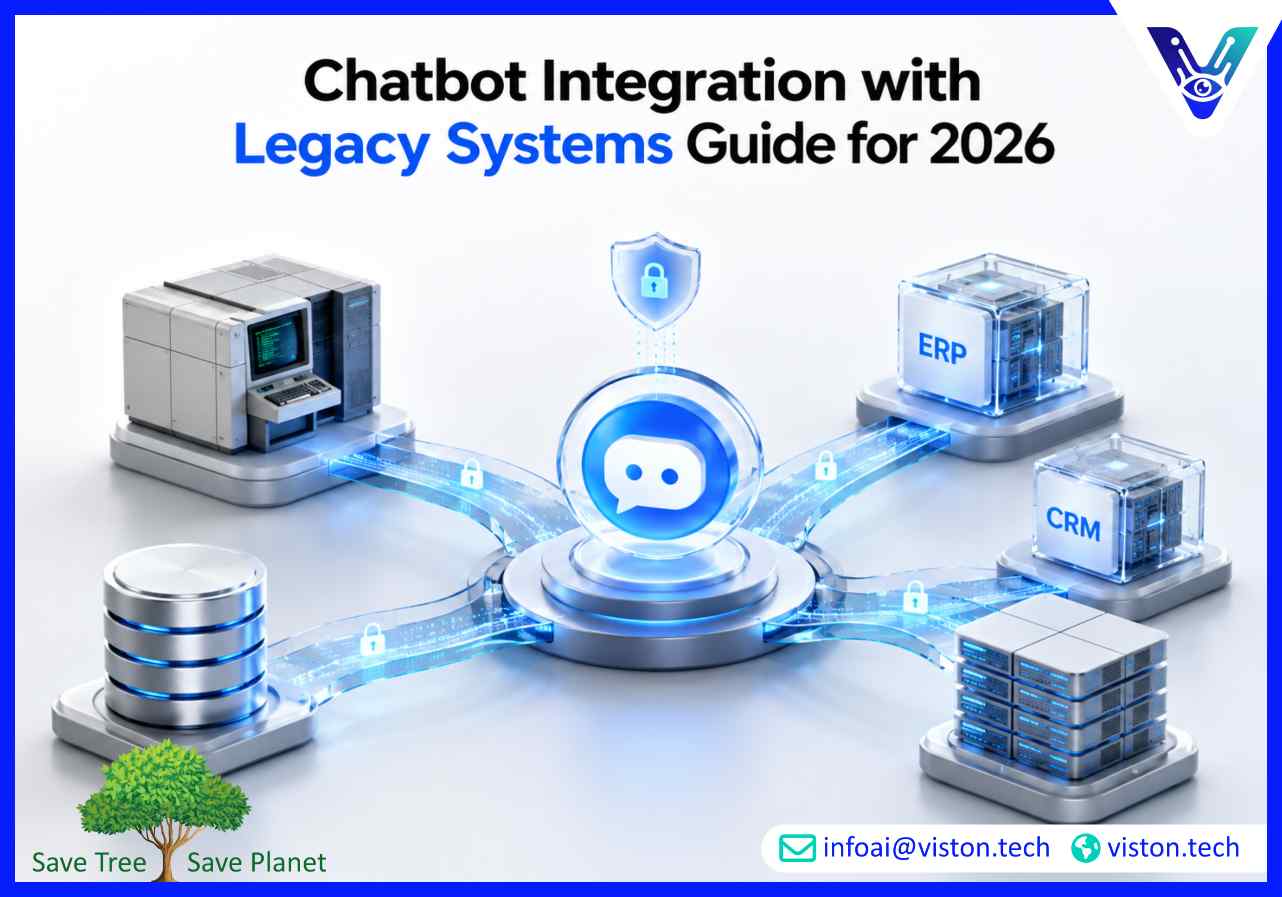
Chatbot integration with legacy systems helps businesses modernize customer service, internal support, sales workflows, and operational access without replacing every existing platform. In 2026, the real challenge is not simply building a chatbot, but connecting it securely and reliably to older systems that still run critical business processes.
Legacy systems are older software platforms, databases, applications, or infrastructure that continue to support important business operations. They may include ERP systems, CRM platforms, mainframes, custom internal portals, accounting systems, inventory databases, ticketing tools, HR systems, or industry-specific applications built years ago.
Many of these systems were not designed for modern conversational AI. They may have limited APIs, outdated authentication methods, complex data structures, slow response times, or heavy dependency on manual workflows. Yet they often contain the information employees, customers, and support teams need every day.
Chatbot integration with legacy systems means creating a secure connection between a conversational interface and these existing business platforms. Instead of forcing users to search across multiple systems, submit manual requests, or wait for support teams, the chatbot can retrieve information, guide workflows, trigger actions, and update records through controlled integrations.
For example, a customer may ask about an order status, and the chatbot can retrieve the latest update from an older order management system. An employee may request leave balance, and the chatbot can pull the relevant data from an HR platform. A support agent may need account history, and the chatbot can summarize information from CRM, ticketing, and billing records.
The goal is not to make legacy systems disappear overnight. The goal is to create a modern, usable, and intelligent access layer that improves experience while preserving stable business infrastructure.
A basic chatbot can answer FAQs or collect form information. A legacy-integrated chatbot must work with real business data, system permissions, workflow rules, and operational constraints. This requires stronger planning around APIs, middleware, security, data mapping, authentication, error handling, monitoring, and escalation.
Businesses should treat legacy chatbot integration as a transformation project, not a plug-in installation. The chatbot becomes part of the enterprise architecture, which means accuracy, reliability, governance, and system compatibility matter from the beginning.
In 2026, many organizations are under pressure to improve digital service delivery while still relying on older systems that cannot be replaced quickly. Full system modernization can be expensive, risky, and disruptive. Chatbot integration offers a practical bridge between legacy infrastructure and modern user expectations.
Customers now expect fast answers, self-service options, personalized support, and consistent experiences across websites, mobile apps, messaging channels, and service portals. Employees expect the same level of convenience inside the workplace. They do not want to log into five systems to find one answer or wait for another team to process a routine request.
AI chatbot integration helps close this gap by turning fragmented system access into a guided conversation. When planned correctly, the chatbot can help users complete tasks faster while reducing pressure on support, operations, IT, HR, finance, and customer service teams.
Legacy systems often create operational friction. Teams may depend on manual lookups, duplicate data entry, email-based approvals, spreadsheet tracking, or repeated internal requests. These issues slow down response times and increase the risk of errors.
A well-integrated chatbot can help reduce these problems by connecting users to the right data and workflows through a single conversational entry point. It can support routine tasks such as checking order status, creating tickets, retrieving policy information, updating customer records, searching knowledge bases, scheduling service requests, or routing approvals.
This matters especially for businesses with high support volume, distributed teams, complex customer journeys, or multiple disconnected platforms. The chatbot can act as a coordination layer that improves access without forcing immediate replacement of every legacy application.
Replacing a legacy system may eventually be necessary, but it is not always the best first move. Some older systems are deeply customized, stable, compliance-sensitive, or tightly connected to business operations. Replacing them too quickly can disrupt workflows, increase cost, and create migration risk.
Chatbot integration allows businesses to modernize the user experience first. This approach can extend the usefulness of existing systems while giving leadership more time to plan larger modernization projects. It also helps identify which workflows truly need replacement, automation, API development, or process redesign.
Successful AI chatbot integration depends on understanding how the chatbot will access data, perform actions, protect sensitive information, and handle exceptions. The technical approach should match the condition of the legacy environment, the business process being automated, and the level of risk involved.
The first step is to understand the legacy systems involved. This includes reviewing available APIs, database structures, authentication methods, data ownership, business rules, user roles, workflow dependencies, and known limitations. Teams should identify which processes are suitable for chatbot automation and which require human review.
This stage is important because not every legacy workflow should be automated immediately. High-risk actions, incomplete records, unclear permissions, or unstable system behavior may require phased integration rather than direct automation.
The chatbot should not connect casually to core systems. Businesses usually need an integration layer such as APIs, middleware, secure connectors, robotic process automation, event-based workflows, or a controlled data access service. This layer protects the legacy system from unnecessary load and gives IT teams better control over security, logging, and performance.
For systems with modern APIs, integration may be relatively direct. For older platforms, the architecture may require database views, file exchange, SOAP services, custom connectors, API gateways, or workflow automation tools. The right architecture depends on system maturity, transaction volume, data sensitivity, and long-term modernization plans.
Legacy systems often store data in formats that are not easy for conversational AI to use. Field names may be outdated, records may be duplicated, and business logic may exist outside the system in team knowledge. Data mapping converts this complexity into chatbot-ready workflows.
For example, a user may ask, “Where is my order?” The chatbot may need to identify the customer, validate permissions, locate the order, interpret status codes, check shipping data, and provide a clear answer in plain language. This requires both technical mapping and business process understanding.
Security is one of the most important parts of chatbot integration with legacy systems. The chatbot may handle customer records, employee information, financial data, account details, service history, or operational data. Businesses need strong controls around authentication, authorization, encryption, audit trails, data retention, and role-based access.
Modern chatbot integrations should support secure login methods, permission checks, session controls, masked sensitive data, human escalation rules, and clear audit logs. The chatbot should only access what the user is allowed to see or change. This is especially important for regulated industries, enterprise environments, and organizations with strict internal governance.
Legacy environments can behave unpredictably, so testing must cover more than conversation quality. Businesses should test API response times, failed system calls, incorrect data, duplicate records, permission errors, timeout handling, fallback responses, and escalation to human teams.
After deployment, monitoring should track completion rate, fallback rate, integration failures, system latency, user satisfaction, escalation quality, and workflow success. This helps teams improve both the chatbot and the connected business process over time.
Businesses get better results when they approach AI chatbot integration with clear priorities, realistic scope, and strong governance. The best integrations are not the most complex ones. They are the ones that solve meaningful business problems safely and consistently.
Begin with workflows that are frequent, repetitive, and clearly defined. Good starting points include order status checks, appointment updates, ticket creation, account lookup, policy search, employee FAQs, basic HR requests, inventory availability, and customer onboarding guidance.
These use cases deliver visible value without exposing the organization to unnecessary risk. Once the chatbot performs reliably, businesses can expand into more complex workflows such as approvals, claims handling, quote generation, account updates, or multi-system task automation.
A legacy-integrated chatbot should not remove human judgment from processes that require review, exception handling, negotiation, compliance approval, or sensitive decision-making. Instead, it should collect context, prepare records, summarize issues, and route the request to the right person.
Strong human handover is essential. When escalation happens, agents should receive the conversation history, user identity, detected intent, system lookup results, and attempted resolution. This prevents users from repeating information and improves service quality.
Legacy systems may have slow response times, maintenance windows, limited transaction capacity, or inconsistent data quality. The chatbot experience should be designed around these realities. It should provide clear status messages, avoid repeated calls, cache safe information where appropriate, and explain when a task requires follow-up.
Good integration design respects the limits of the existing environment while improving usability. This is often the difference between a chatbot that feels helpful and one that creates frustration.
Conversation volume alone does not prove success. Businesses should measure whether chatbot integration reduces manual workload, improves response time, increases task completion, lowers support tickets, improves data accuracy, and creates better customer or employee experiences.
Useful metrics include self-service resolution rate, workflow success rate, integration error rate, average handling time reduction, escalation quality, customer satisfaction, employee adoption, and cost per resolved request. These indicators show whether the chatbot is genuinely improving operations.
Viston AI is relevant to chatbot integration with legacy systems because its AI Chatbot Integration service focuses on connecting conversational AI with existing business platforms, workflows, and enterprise data environments. For organizations that rely on older systems but want a modern user experience, this type of integration support can help bridge the gap between stable infrastructure and faster digital service delivery.
Viston AI’s broader AI service portfolio includes AI chatbot development, AI chatbot integration, business system integration, automation workflows, multilingual support, voice-enabled assistants, AI strategy, readiness assessment, and AI consulting. These capabilities are useful when a business needs more than a standalone chatbot and requires structured planning around systems, data, workflows, security, and measurable outcomes.
For companies using legacy CRM, ERP, helpdesk, internal portals, or custom operational platforms, Viston AI can support chatbot integration planning around practical business goals such as better self-service, improved support routing, reduced manual lookup work, cleaner workflow automation, and more consistent access to enterprise information. Its approach is especially relevant for businesses that want AI chatbot integration to fit into existing operations rather than disrupt them. The value lies in creating chatbot experiences that are usable, secure, scalable, and connected to real business processes.
Chatbot integration with legacy systems means connecting a chatbot to older business software, databases, or platforms so users can retrieve information, complete tasks, trigger workflows, or update records through a conversational interface.
Yes, AI chatbots can work with older ERP or CRM systems if the integration is planned properly. Depending on the system, this may require APIs, middleware, custom connectors, secure database access, or workflow automation tools.
It can be safe when the integration includes authentication, role-based access control, encryption, audit logs, data masking, permission checks, and strong monitoring. Security planning is essential before connecting any chatbot to sensitive enterprise data.
Common use cases include order status checks, customer account lookup, ticket creation, HR self-service, inventory queries, appointment updates, policy search, internal knowledge access, and routine workflow automation.
No. Many businesses use chatbot integration as a practical bridge between legacy systems and modern user expectations. This allows teams to improve access and automation while planning broader system modernization at a controlled pace.
Viston AI’s AI Chatbot Integration service aligns with legacy system integration needs because it focuses on connecting chatbots with business systems, workflows, enterprise data, and automation processes in a structured and business-focused way.
Chatbot integration with legacy systems is one of the most practical ways for businesses to modernize service delivery without immediately replacing core infrastructure. When supported by strong AI Chatbot Integration planning, a chatbot can improve access to information, reduce repetitive work, support self-service, and connect users with business workflows more efficiently. The key is to integrate carefully, protect sensitive data, respect legacy system limitations, and measure outcomes that matter. For organizations that depend on older platforms, a well-designed chatbot can become a reliable bridge between existing operations and modern digital expectations.
