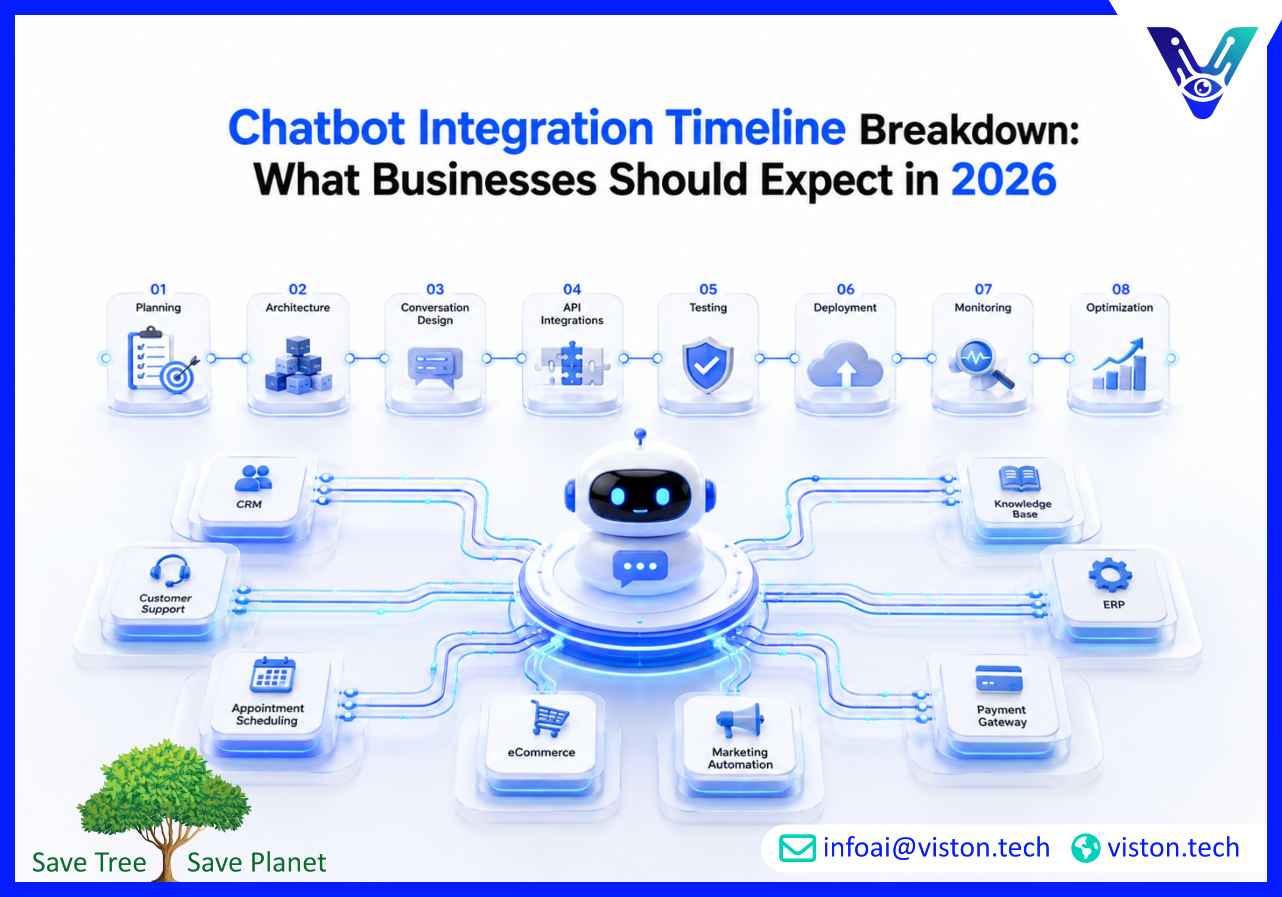
Chatbot Integration Timeline Breakdown: What Businesses Should Expect in 2026
Implementing an AI chatbot is no longer simply about adding a conversational tool to a website. Modern chatbot integration involves planning, system connectivity, testing, automation workflows, security considerations, and ongoing optimization. Understanding a realistic chatbot integration timeline helps businesses set expectations, allocate resources effectively, and achieve faster returns on their AI investments.
Understanding the Typical Chatbot Integration Timeline
A chatbot integration timeline varies depending on business goals, system complexity, required integrations, and customization needs. While basic deployments can be completed within days, enterprise-level chatbot integrations often require several weeks of planning, implementation, and testing.In 2026, organizations increasingly expect chatbots to connect with CRM platforms, customer support systems, appointment booking tools, eCommerce platforms, marketing automation software, and knowledge bases. These requirements directly influence project duration.A typical AI chatbot integration project can generally be divided into the following phases:
Phase 1: Discovery and Requirements Gathering (1–2 Weeks)
The first stage focuses on understanding business objectives and defining chatbot requirements.Key activities typically include:
Identifying business goals
Mapping customer journeys
Defining chatbot use cases
Determining required integrations
Establishing KPIs and success metrics
Reviewing compliance and security requirements
Organizations that skip this phase often face scope changes, delays, and poor chatbot performance after launch.
Phase 2: Solution Design and Planning (1 Week)
Once requirements are documented, the technical architecture is created.This stage involves:
Selecting chatbot platforms
Defining integration methods
Designing conversation architecture
Creating escalation workflows
Planning analytics and reporting
Defining AI training requirements
Proper planning reduces implementation risks and ensures scalability as chatbot usage grows.
Phase 3: Conversation Flow Development (1–3 Weeks)
Building effective conversational experiences requires more than writing chatbot responses.Development teams typically create:
User intent mapping
Decision trees
Lead qualification workflows
Support automation paths
Multilingual conversation structures
Fallback and escalation scenarios
The complexity of these workflows significantly affects project timelines. Customer service bots often require more extensive conversation design than simple lead-generation bots.
Phase 4: Integration with Business Systems (1–4 Weeks)
This is often the most time-intensive part of the chatbot integration process.Modern businesses expect chatbots to interact with multiple systems, including:
CRM platforms
Help desk software
ERP systems
Marketing automation tools
Appointment scheduling platforms
Payment gateways
Knowledge management systems
Customer databases
The timeline depends on:
API availability
Data quality
Authentication requirements
Custom development needs
Security approvals
Third-party vendor dependencies
Businesses with well-documented APIs generally experience faster implementation cycles.
Factors That Can Extend or Shorten Integration Timelines
Factors That Accelerate Deployment
Clear project requirements
Prebuilt integrations
Well-structured knowledge bases
Existing automation workflows
Dedicated internal stakeholders
Cloud-based systems with open APIs
Factors That Cause Delays
Legacy systems
Poor documentation
Frequent scope changes
Complex approval processes
Data migration issues
Security and compliance reviews
Custom integration requirements
Understanding these factors early helps organizations create realistic implementation plans.
Testing, Launch, and Optimization Timeline
Quality Assurance and Testing (1–2 Weeks)
Before deployment, businesses should validate both functionality and user experience.Testing typically includes:
Intent recognition validation
Integration testing
User acceptance testing
Security testing
Load testing
Conversation flow validation
Error handling verification
Comprehensive testing reduces customer-facing issues and improves adoption rates.
Deployment and Go-Live (1–3 Days)
Once testing is complete, the chatbot can be deployed across designated channels such as:
Company websites
Mobile applications
WhatsApp
Facebook Messenger
Customer portals
Internal support environments
Modern cloud-based chatbot platforms typically allow rapid deployment once integrations and testing are completed.
Post-Launch Optimization (Ongoing)
The launch is not the end of the integration journey.Successful organizations continuously monitor:
Conversation completion rates
Lead generation metrics
Customer satisfaction scores
Escalation frequency
Intent accuracy
Response effectiveness
Automation performance
Continuous improvement helps maximize chatbot ROI and user satisfaction over time.
What Timeline Should Businesses Expect in 2026?
While every project differs, the following estimates are common:
Basic chatbot integration: 1–2 weeks
Lead generation chatbot: 2–4 weeks
Customer support chatbot: 4–8 weeks
CRM-integrated chatbot: 4–8 weeks
Multi-system enterprise chatbot: 8–16 weeks
Highly customized AI assistant: 3–6 months
Organizations should prioritize quality, integration reliability, and user experience over rushing deployment timelines.
How Viston AI Supports Efficient Chatbot Integration Projects
For businesses seeking professional AI Chatbot Integration services, Viston AI helps organizations implement chatbot solutions that align with operational goals, customer engagement strategies, and automation requirements.Rather than focusing solely on chatbot deployment, successful integration projects require careful planning, workflow design, system connectivity, testing, and optimization. Viston AI supports businesses through these critical stages by helping integrate chatbots with existing business systems, customer communication channels, CRM platforms, and automation tools.Organizations often face challenges related to fragmented customer data, disconnected workflows, inconsistent customer experiences, and scaling support operations. Through structured AI Chatbot Integration approaches, businesses can streamline interactions, improve response times, automate routine tasks, and enhance customer engagement.As AI adoption continues to expand across industries in 2026, businesses increasingly require chatbot solutions that are scalable, secure, and adaptable to evolving customer expectations. Effective integration ensures that chatbots become a meaningful part of business operations rather than isolated communication tools.For companies looking to modernize customer interactions and automate repetitive processes, a well-executed chatbot integration strategy can deliver long-term operational and customer experience benefits.
Frequently Asked Questions
How long does a typical chatbot integration take?
Most chatbot integrations take between 2 and 8 weeks, depending on the number of integrations, customization requirements, and business processes involved.
What is usually the longest phase of chatbot integration?
System integration is often the most time-consuming phase because it involves connecting APIs, validating data flows, and ensuring secure communication between platforms.
Can chatbot integrations be completed without coding?
Many modern chatbot platforms offer low-code or no-code capabilities, but complex integrations often require technical expertise and API development.
How important is testing before chatbot deployment?
Testing is critical for identifying conversation issues, integration failures, security concerns, and user experience problems before customers interact with the chatbot.
Can Viston AI help businesses manage chatbot integration projects?
Businesses seeking AI Chatbot Integration support can work with Viston AI to plan, implement, connect, and optimize chatbot solutions that align with operational and customer engagement goals.
Conclusion
A successful chatbot integration timeline involves much more than deploying conversational software. From discovery and workflow design to system integrations, testing, and ongoing optimization, each phase contributes to long-term chatbot effectiveness. Businesses investing in AI Chatbot Integration should focus on strategic planning, reliable integrations, and continuous improvement to maximize outcomes. As customer expectations continue to evolve in 2026, organizations that approach chatbot implementation with a structured timeline and expert execution will be better positioned to improve engagement, efficiency, and business performance.