Chatbot Integration Services for Business: A 2026 Guide to Connected Conversational AI
Introduction
Chatbot integration services for business are no longer just about adding a chat window to a website. In 2026, companies need conversational AI that connects with CRM, ERP, helpdesk, e-commerce, payment, analytics, and internal workflow systems so every customer or employee interaction can trigger useful action.
What Chatbot Integration Services for Business Really Mean
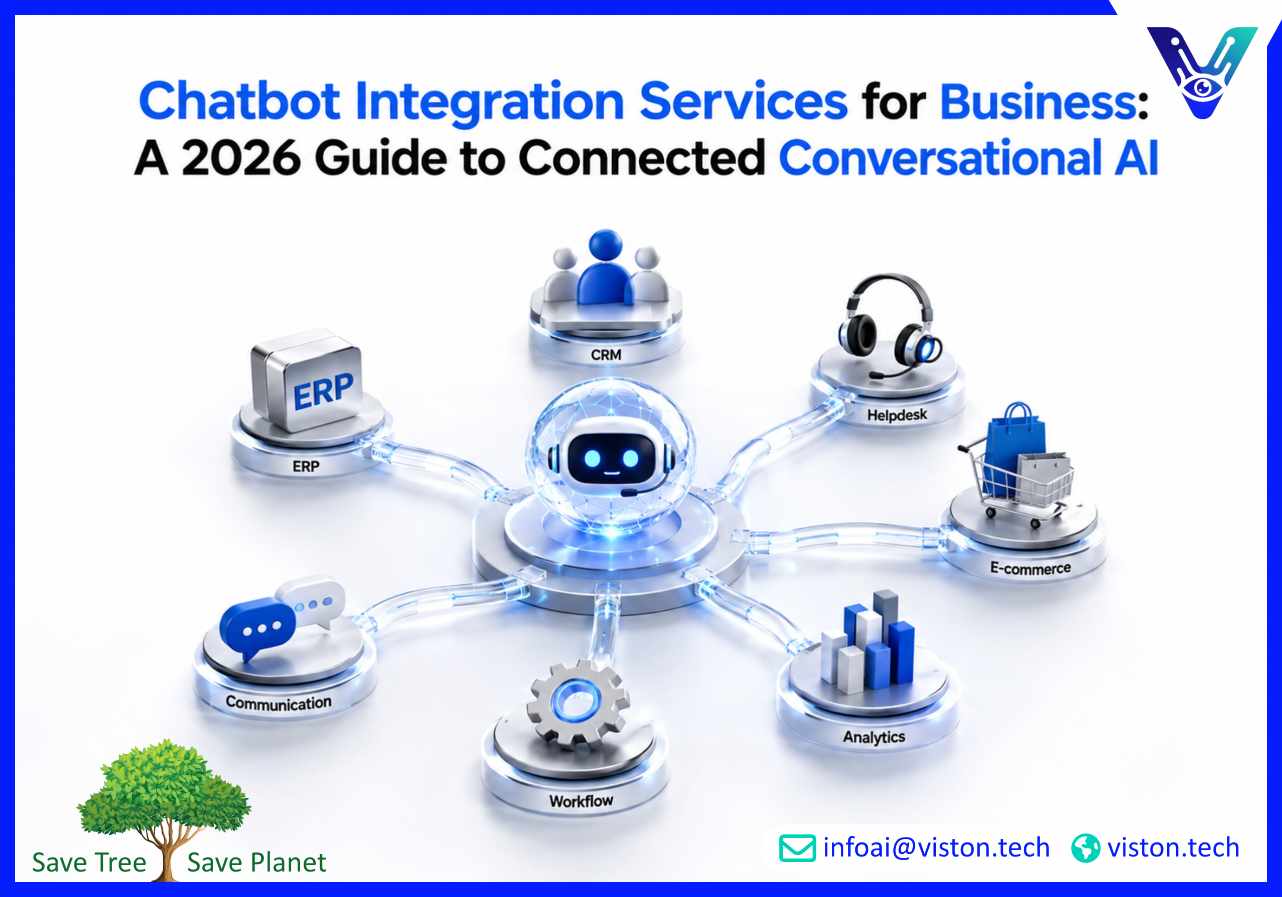
Chatbot integration services for business involve connecting AI chatbots and virtual assistants with the software, data, channels, and workflows that already power an organization. A standalone chatbot can answer basic questions. An integrated chatbot can check order status, create support tickets, qualify leads, update CRM records, schedule appointments, route requests, retrieve policy details, escalate issues, and support teams across multiple departments.This is the difference between conversational automation and simple scripted messaging. Businesses do not only want a bot that responds. They want a chatbot that understands intent, uses approved business data, follows workflow rules, protects sensitive information, and hands over to human teams when needed.For business leaders, chatbot integration is valuable because it connects customer experience with operational execution. A buyer asking about pricing can be routed into a sales workflow. A customer asking about delivery can receive real-time order data. An employee asking about HR policy can get information from an internal knowledge base. A support request can be logged in ServiceNow, Zendesk, Freshdesk, HubSpot, Salesforce, or another platform without manual copying.Modern chatbot integration usually includes:
CRM integration for lead capture, customer history, sales follow-up, and account updates.
Helpdesk integration for ticket creation, routing, status updates, and escalation.
ERP integration for inventory, invoices, orders, supply chain data, and finance workflows.
E-commerce integration for product discovery, cart recovery, order tracking, returns, and recommendations.
Communication channel integration across website chat, WhatsApp, mobile apps, SMS, email, Slack, Microsoft Teams, and social messaging platforms.
Knowledge base integration for accurate, governed responses from approved documentation.
Analytics integration for reporting on automation rate, response time, resolution rate, satisfaction, and conversion impact.
The goal is not to replace every human interaction. The goal is to reduce repetitive work, improve response consistency, speed up service, and give teams better visibility into what customers and employees need.
Why Chatbot Integration Matters More in 2026
In 2026, businesses are under pressure to deliver faster digital service without increasing operational complexity. Customers expect instant answers, but they also expect accuracy, privacy, and continuity across channels. Employees expect internal tools to be easier to use, especially when they need information from multiple systems. This makes chatbot integration services for business a practical investment for organizations that want scalable communication without disconnected automation.Many early chatbot projects failed because they were built as isolated FAQ tools. They could answer common questions, but they could not complete tasks. When customers needed account-specific information, order updates, policy details, or technical support, the chatbot reached a dead end. That created frustration and pushed work back to human teams.Integrated AI chatbots solve this problem by connecting conversation with action. They can identify the user’s intent, retrieve relevant data, apply business rules, and either complete the task or escalate it with full context. This matters for companies handling high volumes of customer inquiries, sales leads, service requests, internal support tickets, or operational workflows.
From Basic Chatbots to Business Workflow Assistants
The biggest shift in 2026 is that businesses are moving from “answer bots” to workflow-connected virtual assistants. A virtual assistant can support multiple steps in a process, not just one response. For example, a customer service assistant can verify the issue, check account details, suggest a solution, open a ticket, notify the right team, and update the customer when the status changes.For sales teams, an integrated chatbot can qualify leads, capture budget and timeline, sync details to the CRM, assign ownership, and trigger follow-up sequences. For HR teams, it can answer policy questions, guide onboarding, and route sensitive issues to the right department. For operations teams, it can surface order, inventory, logistics, or procurement information through a simple conversational interface.
Security, Governance, and Responsible AI Expectations
As AI chatbots become more connected to business systems, governance becomes more important. A chatbot that can access customer records or trigger workflows must be designed with authentication, role-based access, audit logs, data minimization, escalation controls, and secure API handling.Businesses also need to manage risks such as prompt injection, inaccurate responses, sensitive data exposure, poor handoff design, and over-automation. Responsible chatbot integration should include approved knowledge sources, guardrails, human review paths, monitoring, conversation logs, and clear rules for what the chatbot can and cannot do.This is especially important for regulated or data-sensitive environments such as finance, healthcare, insurance, legal services, education, retail, logistics, and enterprise SaaS. In these settings, chatbot performance is not only measured by speed. It is measured by accuracy, reliability, compliance readiness, traceability, and user trust.
Key Business Use Cases for Integrated AI Chatbots
Chatbot integration services for business are most effective when they are designed around real operational pain points. The strongest use cases usually involve repeated questions, high-volume interactions, slow manual handoffs, fragmented systems, or service processes that depend on structured data.
Customer Support Automation
Customer support is one of the most common use cases for AI chatbot and virtual assistant development. Integrated chatbots can answer common questions, check order status, troubleshoot issues, create tickets, update customers, and route complex cases to human agents. When connected to CRM and helpdesk systems, they reduce repeated questions and give agents better context before they engage.
Lead Qualification and Sales Assistance
For marketing and sales teams, an integrated chatbot can turn website traffic into structured sales opportunities. It can ask qualification questions, recommend relevant services, collect contact details, sync information with the CRM, and notify the right sales representative. This helps businesses respond faster while maintaining better lead data quality.
E-Commerce and Retail Operations
In e-commerce, chatbots can integrate with product catalogs, inventory systems, payment flows, shipping platforms, and return management tools. This allows customers to ask natural questions about products, availability, order tracking, delivery timelines, refunds, and exchanges. The result is a smoother buying experience and fewer repetitive support requests.
Internal Employee Support
Businesses can also use virtual assistants internally. HR, IT, finance, and operations teams often receive repetitive questions that slow down productivity. An integrated employee assistant can connect with internal knowledge bases, ticketing systems, identity tools, and workflow platforms to help staff find information, submit requests, and complete routine tasks more quickly.
Appointment Scheduling and Service Booking
For service businesses, healthcare providers, consultants, education providers, and field service teams, chatbot integration can simplify booking workflows. The chatbot can check calendar availability, capture requirements, send confirmations, update CRM records, and trigger reminders. This reduces manual coordination and improves response speed.
Data Collection and Business Intelligence
Every chatbot conversation contains useful signals. Integrated analytics can help businesses understand customer intent, product issues, service gaps, common objections, satisfaction trends, and escalation patterns. When this data is structured and connected to reporting tools, leaders can make better decisions about service quality, content, product improvements, and automation priorities.
How to Plan a Successful Chatbot Integration Project
A successful chatbot integration project starts with business clarity, not technology selection. Before choosing a model, platform, or connector, companies should define what the chatbot must achieve, which users it will serve, which systems it must access, and what outcomes will prove success.
Start with the Right Processes
Not every workflow should be automated first. The best starting points are processes with clear intent patterns, high volume, measurable impact, and manageable risk. Common examples include customer FAQs, order tracking, lead qualification, ticket creation, appointment scheduling, onboarding support, and knowledge base search.Businesses should avoid launching an overly broad chatbot with vague responsibilities. A focused assistant that solves five important workflows well is usually more valuable than a general chatbot that performs inconsistently across too many areas.
Map Data Sources and System Connections
Chatbot performance depends heavily on data quality. Integration planning should identify where the chatbot will retrieve information, which systems it can update, how permissions will be managed, and what data should never be exposed. This includes CRM records, product databases, helpdesk tickets, ERP data, documents, policies, APIs, and third-party tools.For enterprise environments, this stage should include API review, authentication requirements, data retention rules, audit logging, failover planning, and role-based access. Integration architecture should be designed for reliability, not just a quick launch.
Design Conversations Around Real User Intent
Strong chatbot integration is not only technical. Conversation design matters. The chatbot must understand how users actually ask questions, what information is needed to complete a task, when to ask follow-up questions, and when to escalate. A well-designed assistant feels efficient because it guides the user toward resolution without unnecessary steps.Conversation flows should include fallback handling, confidence thresholds, escalation triggers, multilingual requirements, and user feedback loops. For business-critical use cases, the chatbot should also provide clear boundaries when it cannot complete a request.
Measure Performance After Launch
Deployment is not the end of chatbot integration. Businesses should monitor conversation quality, automation rate, escalation rate, resolution time, user satisfaction, lead conversion, cost reduction, and system errors. These metrics show whether the chatbot is delivering business value and where it needs improvement.Ongoing optimization may include updating knowledge sources, refining prompts, improving intent recognition, expanding integrations, retraining models, adding workflow automations, and adjusting human handoff rules. The best chatbot programs improve continuously based on real interaction data.
How Viston AI Supports Business Chatbot Integration Services
Viston AI is relevant to chatbot integration services for business because its service portfolio includes AI Chatbot & Virtual Assistant Development, AI Chatbot Integration, Enterprise AI Chatbots, AI Automation & Workflow Bots, NLP & Text Analysis, and Custom AI Solution Development. These capabilities align closely with businesses that need conversational AI connected to real workflows rather than isolated chatbot scripts.For organizations planning chatbot integration, Viston AI can support the design and development of virtual assistants that connect with CRM, ERP, helpdesk, knowledge base, e-commerce, and communication platforms. Its approach is especially useful when businesses need chatbots to automate customer service, qualify leads, synchronize data, support multi-channel conversations, and trigger operational workflows from natural language interactions.Viston AI’s broader AI development capability also matters for companies with industry-specific requirements. Businesses in finance, healthcare, retail, manufacturing, logistics, SaaS, education, and professional services often need more than a generic chatbot. They need domain-aware conversation design, secure integration architecture, scalable deployment, analytics, and ongoing optimization. Viston AI’s focus on enterprise AI chatbots, integration with business systems, workflow automation, multilingual support, and model monitoring makes it a practical partner for companies that want chatbot integration to produce measurable operational outcomes.For global businesses, the value lies in building conversational systems that are secure, connected, adaptable, and aligned with real business processes.
Frequently Asked Questions
What are chatbot integration services for business?
Chatbot integration services for business connect AI chatbots with company systems such as CRM, ERP, helpdesk, e-commerce platforms, calendars, knowledge bases, and workflow tools. This allows the chatbot to answer questions, retrieve real-time data, update records, create tickets, qualify leads, and complete business tasks.
How is an integrated chatbot different from a basic chatbot?
A basic chatbot usually answers predefined questions. An integrated chatbot connects with business systems and can perform actions, such as checking order status, updating a CRM, creating a support ticket, booking an appointment, or escalating a case with full conversation history.
Which business systems can AI chatbots integrate with?
AI chatbots can integrate with platforms such as Salesforce, HubSpot, Microsoft Dynamics, SAP, Oracle, NetSuite, Zendesk, Freshdesk, ServiceNow, Shopify, WooCommerce, Slack, Microsoft Teams, WhatsApp, payment gateways, internal databases, and custom APIs.
Are chatbot integration services secure for business data?
They can be secure when properly designed. A reliable integration should include authentication, encryption, access controls, audit logs, secure API handling, data minimization, human escalation, and clear rules for sensitive information. Security must be planned from the start, not added after launch.
Can chatbot integration help reduce customer support workload?
Yes. Integrated chatbots can handle repetitive inquiries, collect required information, create tickets, provide real-time updates, and route complex issues to human agents. This helps support teams focus on higher-value conversations while improving response speed for routine requests.
Does Viston AI provide chatbot integration services for business?
Yes. Viston AI offers AI Chatbot & Virtual Assistant Development and related chatbot integration capabilities, including enterprise chatbot development, business system integration, workflow automation, NLP-driven conversations, and multi-channel conversational AI support.
Conclusion
Chatbot integration services for business are becoming essential for companies that want conversational AI to do more than answer simple questions. When connected to CRM, ERP, helpdesk, e-commerce, analytics, and internal workflow systems, chatbots can improve response speed, reduce manual tasks, strengthen customer experience, and support better operational visibility. The most successful projects are built around clear use cases, secure architecture, accurate data, practical conversation design, and continuous optimization. For businesses exploring AI Chatbot & Virtual Assistant Development, Viston AI offers relevant expertise in building connected, scalable, and business-focused chatbot solutions.