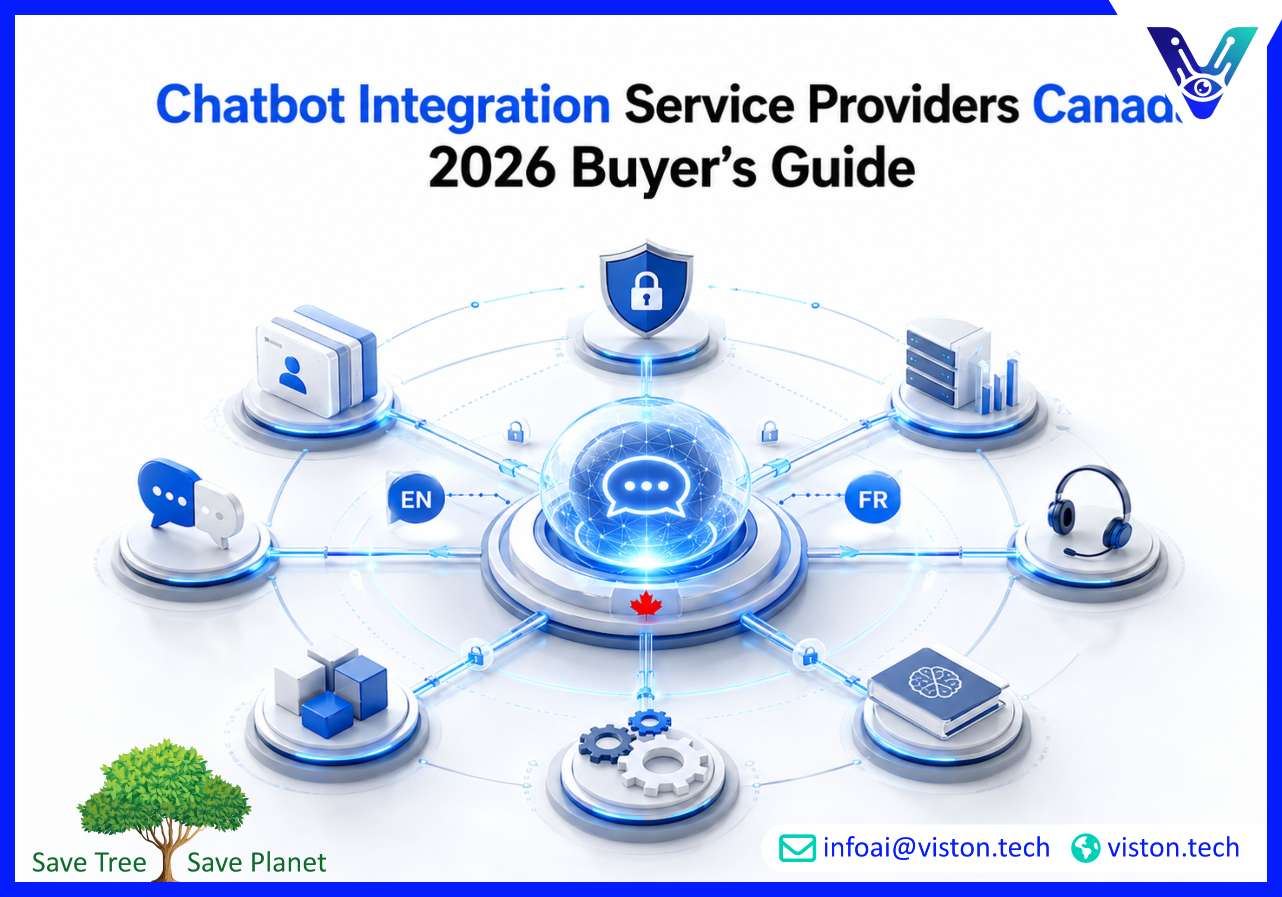
Chatbot Integration Service Providers Canada: 2026 Buyer’s Guide
Businesses researching chatbot integration service providers Canada need more than a vendor that can place a chat window on a website. A reliable provider must connect conversational AI with business data, customer workflows, security controls, human support teams, and measurable operational goals.
What Chatbot Integration Service Providers in Canada Actually Deliver
Chatbot integration is the process of connecting a conversational interface with the systems, data, channels, and workflows a business already uses. The chatbot may communicate with customers or employees, but its practical value comes from what it can retrieve, update, trigger, and complete behind the conversation.A standalone chatbot may answer frequently asked questions. An integrated chatbot can check an order, create a support ticket, qualify a lead, schedule an appointment, update a CRM record, retrieve account information, route a request, or initiate an approval workflow.
Business system integration
Experienced providers should be able to connect chatbots with platforms such as Salesforce, HubSpot, Microsoft Dynamics, ServiceNow, Shopify, SAP, Oracle, NetSuite, Microsoft Teams, Slack, ecommerce platforms, helpdesk software, internal databases, and custom applications.These connections may use native connectors, APIs, webhooks, middleware, robotic process automation, or custom integration services. The correct approach depends on the organization’s existing architecture, data volumes, security requirements, and process complexity.
Conversation and knowledge design
Integration providers should also define how the chatbot understands users and retrieves trusted information. This may involve intent classification, retrieval-augmented generation, approved knowledge bases, structured workflows, prompt design, terminology mapping, confidence thresholds, and human escalation rules.The objective is not to make the chatbot answer every possible question. It should give accurate answers within an approved scope, ask for clarification when necessary, and transfer the conversation when human judgment is required.
Workflow automation
Well-designed chatbot integration can automate actions across several systems. A sales chatbot might capture a prospect’s requirements, create a CRM lead, assign an owner, book a meeting, and send a confirmation. A support chatbot might authenticate a customer, retrieve account details, resolve a routine issue, and open a ticket when the problem remains unresolved.These workflows require validation, error handling, access controls, logging, retry mechanisms, and fallback procedures. A provider that focuses only on conversation design may not have the technical depth needed for reliable operational integration.
Deployment across customer and employee channels
Canadian organizations may need chatbots across websites, mobile applications, customer portals, WhatsApp, SMS, Microsoft Teams, Slack, social messaging, or contact-centre environments. Providers should preserve conversation context and system data across relevant channels rather than building disconnected experiences.
Canadian Requirements That Matter in 2026
Canadian businesses should evaluate chatbot providers against local privacy expectations, bilingual customer needs, data governance practices, accessibility requirements, and sector-specific obligations. A technically capable chatbot can still create risk if it collects unnecessary information, provides unclear disclosures, or makes sensitive decisions without appropriate oversight.
Privacy and personal information
PIPEDA applies to the collection, use, and disclosure of personal information by many private-sector organizations engaged in commercial activity. Alberta, British Columbia, and Quebec also have private-sector privacy legislation considered substantially similar in important contexts. The exact obligations depend on the organization, province, sector, and intended chatbot use.A chatbot integration provider should help the business identify what personal information the chatbot collects, why it is required, where it is stored, which systems receive it, how long it is retained, and who can access it.Practical privacy controls may include:
Data minimization and purpose limitation
Clear consent and privacy notices
Encryption in transit and at rest
Role-based access controls
Retention and deletion policies
Audit logs and incident procedures
Redaction of sensitive information
Vendor and subprocesser assessment
Canadian privacy regulators advise organizations using generative AI to be transparent about its use, establish legal authority for processing personal information, assess accuracy, maintain safeguards, and consider privacy or algorithmic impact assessments where appropriate. They also emphasize that accountability remains with the organization deploying the system.
Transparency and human escalation
Users should understand when they are interacting with an AI system. The chatbot should explain relevant limitations and provide a practical route to a person when the issue is sensitive, complex, disputed, or likely to affect an individual significantly.Human escalation is particularly important for complaints, account restrictions, credit decisions, employment matters, healthcare questions, legal requests, financial issues, and other high-impact situations. The handover should include conversation history, detected intent, collected information, attempted resolutions, and appropriate priority tagging.
English and French service delivery
Not every private company is legally required to provide every chatbot experience in both English and French. However, bilingual capability can be commercially important for businesses serving customers across Canada, operating in Quebec, working with government organizations, or building a national customer experience.A bilingual chatbot requires more than automatic translation. Providers should test terminology, tone, workflows, knowledge retrieval, fallback responses, and escalation performance separately in each language. French content should be localized and reviewed rather than treated as a secondary copy of the English experience.
Security and operational resilience
A chatbot connected to CRM, ERP, payment, healthcare, or employee systems becomes part of the organization’s attack surface. Providers should address authentication, authorization, API protection, prompt injection, data leakage, rate limits, session security, monitoring, and business continuity.Procurement teams should request architecture documentation, access-control details, incident-response procedures, hosting information, model-provider terms, backup processes, and a clear division of security responsibilities.
How to Evaluate Chatbot Integration Service Providers Canada Businesses Can Trust
The strongest provider is not necessarily the company offering the longest feature list. Buyers should look for evidence that the provider understands the intended workflow, can integrate with the existing technology stack, and has a practical approach to security, testing, governance, and optimization.
Start with integration depth
Ask providers to explain how they will connect the chatbot to each required system. A credible proposal should identify APIs, authentication methods, data fields, workflow triggers, dependencies, error conditions, and system ownership.Providers should also distinguish between reading information and updating it. Retrieving an order status is different from cancelling an order. Creating a CRM lead is different from changing an existing customer record. Each action requires appropriate permissions, validation, and auditability.
Assess knowledge and response accuracy
Ask how the chatbot will access approved business knowledge and what happens when information is missing, outdated, or conflicting. Reliable implementations normally include source control, content ownership, review schedules, retrieval testing, and confidence-based fallback behaviour.The provider should test the chatbot with real customer language, spelling variations, incomplete questions, multilingual inputs, ambiguous requests, and adversarial prompts. A polished demonstration using ideal questions does not prove production readiness.
Review security and privacy capabilities
Providers should be able to describe data flows from the user interface through the AI model, integration layer, business systems, analytics tools, and storage environment. They should clarify whether conversation data is retained or used to improve third-party models.Important evaluation questions include:
Where will chatbot and transcript data be processed and stored?
Can sensitive fields be masked before model processing?
How are users authenticated before account information is disclosed?
Which employees and vendors can access conversation records?
How are prompt injection and unauthorized actions controlled?
What logs are available for investigations and audits?
How are data deletion and access requests handled?
Demand measurable success criteria
A provider should connect technical delivery with business outcomes. Relevant measures may include self-service resolution rate, lead qualification rate, workflow completion, ticket deflection, response time, fallback rate, escalation quality, customer satisfaction, API reliability, CRM update accuracy, and cost per resolved interaction.Metrics should be agreed before development begins. This prevents the project from being judged only by whether the chatbot launched on time.
Evaluate ongoing support
Chatbots require regular review after deployment. Products, prices, policies, customer language, integrations, and internal processes change. Buyers should understand who will monitor failed conversations, update knowledge sources, refine prompts, test workflows, manage model changes, and respond to incidents.A provider offering only initial development may leave the internal team responsible for maintaining a system it was not prepared to operate.
Planning a Successful Chatbot Integration Project
A reliable project usually begins with a narrow, commercially useful scope. Trying to automate every customer request at once increases risk, complicates testing, and makes it harder to determine whether the chatbot is producing value.
Define the business objective
Start with a measurable problem, such as reducing repetitive support tickets, improving after-hours lead capture, accelerating employee knowledge access, automating appointment booking, or helping customers complete account tasks.The objective should determine the required channels, systems, knowledge sources, integrations, security controls, and KPIs.
Map the workflow and data
Document what happens from the first user message to the final outcome. Identify which information must be collected, which system is the source of truth, which actions require authentication, where approvals are needed, and when the conversation should be escalated.This process often reveals data-quality problems or workflow inconsistencies that must be corrected before automation.
Build and test a controlled release
A pilot should focus on selected intents, user groups, or channels. Testing should cover expected conversations, edge cases, system failures, unauthorized requests, bilingual interactions, slow APIs, incorrect data, and handover scenarios.Production access should be introduced gradually. High-risk actions may initially require human confirmation until accuracy and reliability are demonstrated.
Understand the main cost factors
Chatbot integration pricing varies according to the number of systems, API availability, workflow complexity, channel coverage, knowledge volume, authentication requirements, language support, model usage, hosting, security controls, testing, analytics, and ongoing optimization.A low-cost chatbot may be adequate for basic FAQs. A chatbot that accesses customer records, completes transactions, or operates across regulated workflows requires more architecture, testing, governance, and support.Buyers should request a breakdown of implementation fees, platform licences, model consumption, connector costs, hosting, maintenance, monitoring, and future change requests. Total cost of ownership is more useful than comparing only the initial development quote.
Why Viston AI Is Relevant to Canadian Chatbot Integration Projects
Viston AI provides AI Chatbot Integration services focused on connecting conversational systems with CRM, ERP, customer-service, communication, and operational platforms. Its published capabilities include bidirectional data synchronization, workflow automation, custom API integration, multichannel orchestration, role-based access, audit logging, and integration with platforms such as Salesforce, HubSpot, Microsoft Dynamics, ServiceNow, SAP, Oracle, and NetSuite.This integration-led approach is relevant to Canadian businesses that need a chatbot to perform useful work rather than operate as an isolated question-and-answer tool. Potential use cases include customer support automation, lead qualification, order enquiries, appointment scheduling, employee assistance, ticket creation, CRM updates, and internal knowledge access.Viston AI also presents related capabilities in enterprise chatbot development, multilingual support, natural language processing, workflow automation, AI strategy, and model monitoring. Its broader service portfolio is designed to connect AI solutions with existing enterprise systems instead of requiring businesses to replace their established technology stack.For Canadian organizations, the practical value lies in combining conversation design with system integration, security planning, workflow logic, testing, and ongoing performance review. Businesses should still evaluate every proposed deployment against their own privacy obligations, architecture, industry requirements, and operational goals.
Frequently Asked Questions
What do chatbot integration service providers do?
They connect chatbots with CRM, ERP, helpdesk, ecommerce, scheduling, communication, knowledge, and internal business systems. They may also design conversations, automate workflows, configure security controls, test responses, deploy channels, and monitor performance.
How should a Canadian business choose a chatbot integration provider?
Evaluate system integration experience, privacy practices, security architecture, multilingual capability, workflow design, knowledge accuracy, testing methods, analytics, human escalation, and post-launch support. The provider should understand the business process, not only the chatbot interface.
Does chatbot data need to remain in Canada?
Requirements depend on the organization, sector, contracts, provincial rules, and type of information involved. Businesses should identify where data is processed, stored, backed up, and accessed, then assess whether the proposed arrangement meets their privacy, security, and procurement obligations.
How long does chatbot integration take?
A focused integration with one or two systems may be delivered relatively quickly, while enterprise projects involving multiple channels, legacy platforms, authentication, multilingual content, and regulated data require more discovery, development, testing, and governance. Scope and system readiness are the main factors.
What systems can an AI chatbot integrate with?
Common integrations include Salesforce, HubSpot, Microsoft Dynamics, ServiceNow, Shopify, SAP, Oracle, NetSuite, Zendesk, Microsoft Teams, Slack, scheduling platforms, payment systems, databases, knowledge bases, and custom applications with accessible APIs.
Can Viston AI support chatbot integration for Canadian businesses?
Viston AI’s published AI Chatbot Integration capabilities include CRM and ERP connectivity, workflow automation, multichannel deployment, enterprise security controls, custom APIs, and ongoing optimization. These services are relevant to Canadian organizations seeking connected conversational AI solutions.
Conclusion
Selecting among chatbot integration service providers Canada businesses can consider requires careful attention to integration depth, privacy, security, bilingual delivery, workflow reliability, and measurable outcomes. The right AI Chatbot Integration partner should understand how conversations connect with real systems and operational responsibilities. Businesses should begin with a clearly defined use case, verify every data flow, test realistic user scenarios, and plan for continuous improvement. Viston AI offers relevant chatbot, integration, automation, and multilingual capabilities for organizations seeking a structured and business-focused implementation approach.