Chatbot Integration Pricing in 2026: Costs, Models, and Budget Factors
Chatbot integration pricing varies widely because businesses are not buying the same solution. A simple website assistant may answer approved questions, while an enterprise chatbot may authenticate users, retrieve live records, update CRM data, trigger workflows, and operate across several channels. Understanding the full cost structure helps buyers compare proposals fairly and avoid underbudgeting.
What Chatbot Integration Pricing Actually Covers
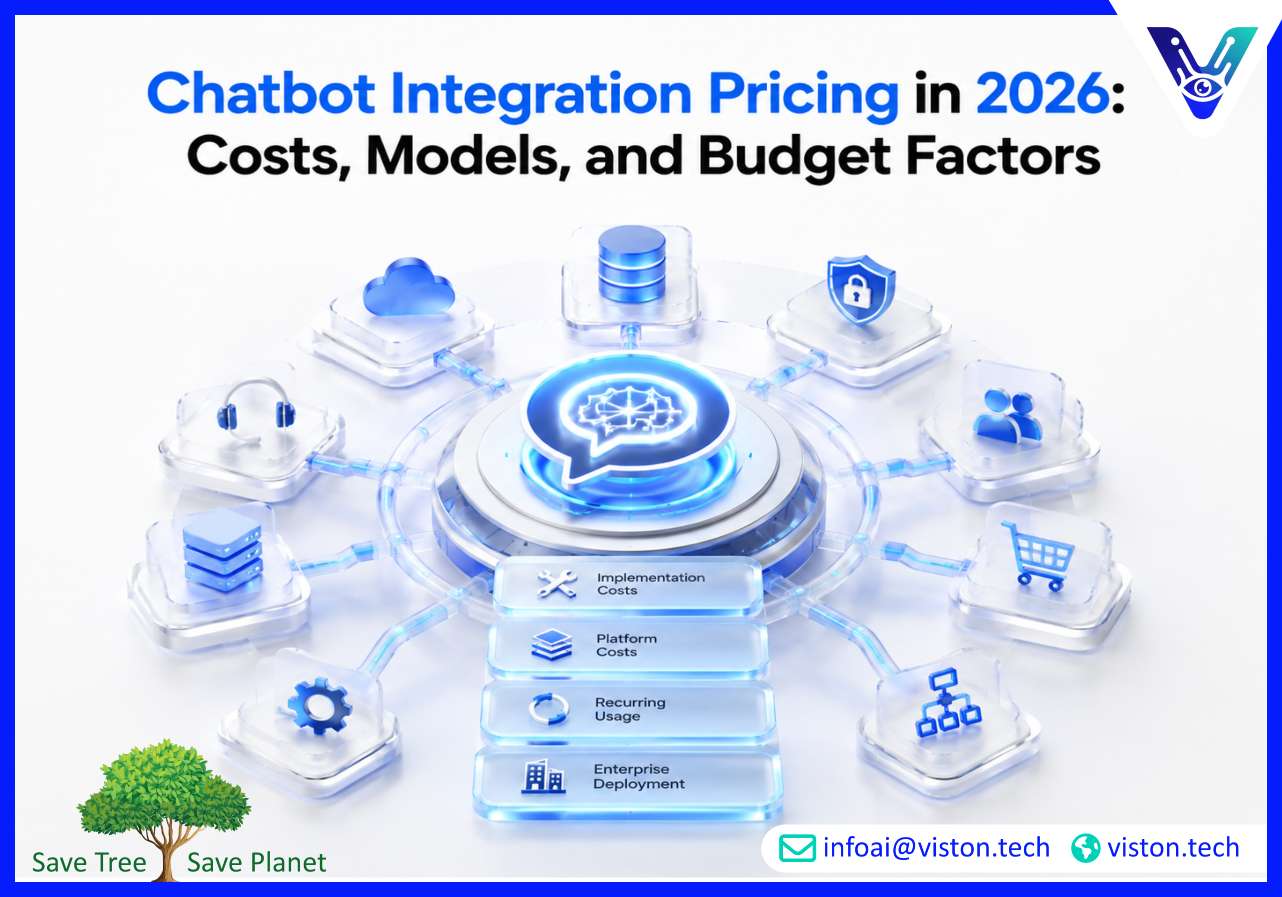
Chatbot integration pricing is the cost of connecting a conversational AI system with the platforms, data, workflows, and controls required for it to perform useful business tasks. It is different from purchasing a basic chatbot subscription. A software plan may provide the chat interface and model access, but integration work makes the chatbot operational within a company’s existing technology environment.A complete project may include discovery, conversation design, knowledge preparation, model configuration, API development, authentication, testing, deployment, training, and post-launch optimization. The price therefore reflects both software consumption and specialist implementation effort.
Platform cost versus implementation cost
Platform cost covers items such as chatbot software licences, model usage, hosting, messaging channels, vector databases, monitoring tools, and third-party APIs. Implementation cost covers the work required to design, connect, secure, test, and maintain the solution.A low monthly platform fee does not necessarily mean a low total project cost. Retrieving account information, creating tickets, updating orders, qualifying leads, or routing approvals may require substantial integration engineering.
One-time and recurring expenses
Most budgets contain one-time costs for architecture, data preparation, development, testing, and deployment, plus recurring costs for licences, model usage, hosting, messaging, monitoring, maintenance, and improvement.Modern model providers commonly charge according to usage, including input and output tokens or tool activity. This means operating cost can change with conversation volume, response length, model choice, retrieval size, and the number of actions performed during a chat.
What Determines the Cost of AI Chatbot Integration?
The strongest pricing factor is not usually the number of screens in the chatbot. It is the amount of business complexity behind each conversation. Two chatbots can look similar to users while having very different architecture, security, integration, and testing requirements.
Integration depth and number of systems
A chatbot connected to one well-documented cloud application is generally easier to implement than one connected to several CRM, ERP, ecommerce, helpdesk, identity, payment, and legacy systems. Costs rise when APIs are incomplete, data structures conflict, records must be synchronized bidirectionally, or custom middleware is required.Read-only access is usually simpler than allowing the chatbot to create or change records. A bot that checks an order status has less operational risk than one that cancels an order, issues a refund request, changes an appointment, or modifies a customer account. Action-based integrations require validation, permissions, error handling, transaction logging, and rollback procedures.
AI capability and knowledge design
A rule-based chatbot with fixed options is less complex than an AI assistant that understands natural language, retrieves approved knowledge, preserves context, and handles varied user phrasing. Retrieval-augmented generation, multilingual support, sentiment detection, structured data extraction, voice interaction, and agentic workflows add design and testing effort.Knowledge quality also affects cost. Documents may need cleaning, classification, access tags, and clear ownership. Conflicting policies or product information must be resolved before the chatbot can answer reliably.
Security, privacy, and governance
Chatbots that handle customer, employee, financial, health, or contractual information need stronger controls. Typical requirements include authentication, role-based access, encryption, audit logs, data retention rules, sensitive-data filtering, prompt-injection safeguards, approval controls, and human escalation.Security becomes more involved when the bot serves multiple user groups or regions. It may need different access rules for customers, partners, agents, and administrators, plus a traceable record of automated actions.
Channels, languages, and scale
A website-only chatbot is usually less expensive than an omnichannel deployment across web, mobile, WhatsApp, Microsoft Teams, Slack, SMS, and social messaging. Each channel can introduce different authentication methods, message formats, conversation limits, templates, and third-party charges.Multilingual delivery may require localized knowledge, terminology control, language-specific testing, and regional escalation. At scale, the architecture must also support peak traffic, failover, usage controls, and monitoring.
Common Chatbot Integration Pricing Models and Budget Levels
Providers normally use one or a combination of fixed-project, time-and-materials, subscription, usage-based, or managed-service pricing. The right model depends on how clearly the scope is defined and how much the chatbot is expected to evolve.
Fixed-project pricing
A fixed price works when use cases, systems, channels, deliverables, and acceptance criteria are clearly defined. It offers budget certainty, but out-of-scope changes usually cost extra. Buyers should confirm whether data preparation, licences, model usage, testing, and support are included.
Time-and-materials pricing
Time-and-materials pricing suits uncertain requirements, legacy-system investigation, or iterative delivery. It offers flexibility but requires transparent reporting, backlog control, and regular budget reviews.
Subscription and usage-based pricing
Some projects combine a recurring platform or support fee with variable usage charges. Pricing may be linked to monthly conversations, active users, messages, AI tokens, knowledge volume, channels, integrations, or automated actions. Buyers should model normal demand, seasonal peaks, and growth rather than comparing only the entry-level subscription.
Managed-service pricing
A managed service may include monitoring, content updates, analytics, prompt refinement, incident support, and optimization. It can suit organizations without an internal conversational AI team because it covers ongoing operational responsibility.
Indicative 2026 budget bands
Public 2026 market guidance shows broad variation, but practical project bands can help with early planning. A focused pilot or simple integration may fall around $5,000 to $20,000. A production chatbot with custom workflows and several business-system connections may require roughly $20,000 to $80,000. Complex enterprise programmes involving multiple systems, channels, user roles, security controls, and high availability can range from about $80,000 to $300,000 or more. These are planning ranges rather than universal rates because scope and regional delivery costs differ substantially.Recurring costs should be budgeted separately. A low initial build cost can become expensive if the solution uses inefficient prompts, retrieves excessive context, relies on premium models for every request, or requires frequent manual intervention.
How to Plan a Realistic Chatbot Integration Budget
The most reliable budget starts with a narrow business objective rather than a long feature list. A company should define which users the chatbot serves, which tasks it must complete, which systems it needs, and what successful performance looks like.
Begin with high-value, controlled use cases
Good starting points are repetitive, measurable processes with clear rules and dependable data. Examples include answering approved product questions, checking order status, booking meetings, collecting support details, qualifying leads, retrieving internal policies, or creating a service ticket.A phased launch limits risk and produces usage data before the business expands into additional workflows, channels, languages, or departments.
Request a detailed cost breakdown
A credible proposal should separate discovery, design, development, integrations, data preparation, testing, deployment, licences, usage, support, and optional enhancements. It should also state assumptions about API availability, content quality, conversation volume, user numbers, channels, languages, environments, and response times.Buyers should also identify exclusions such as messaging charges, model usage, infrastructure, security testing, monitoring, knowledge maintenance, training, and third-party system changes.
Evaluate total cost of ownership
Compare total cost over at least the first year, including software, usage, maintenance, internal staff time, content governance, incident handling, and future integration changes.Cost should also be reviewed against business outcomes. Useful measures include cost per resolved conversation, ticket deflection with confirmed resolution, lead qualification rate, workflow completion, average handling time, escalation quality, customer satisfaction, and system-update accuracy. A cheaper chatbot that creates poor records or frequent manual corrections may cost more operationally.
Build cost controls into the architecture
Teams can manage operating cost through model routing, response-length limits, prompt caching, smaller models for routine tasks, controlled retrieval, usage quotas, duplicate-request prevention, and escalation rules. Monitoring should show cost by channel, intent, customer segment, model, and completed workflow so unexpected increases can be investigated quickly.
How Viston AI Approaches Chatbot Integration Pricing and Delivery
Viston AI provides AI Chatbot Integration focused on connecting conversational interfaces with CRM, ERP, service platforms, communication channels, and custom business applications. Its published capabilities include bidirectional data synchronization, workflow automation, multi-channel orchestration, structured data extraction, business-rule validation, and integration with both established enterprise platforms and custom APIs.This integration-first approach is relevant to pricing because the required business outcome determines the technical scope. A chatbot that only retrieves approved knowledge has a different cost profile from one that authenticates users, updates customer records, creates tickets, checks inventory, or coordinates multi-step workflows.A practical engagement should begin with discovery and system assessment. This identifies priority use cases, APIs, data issues, security requirements, traffic, channels, and operational ownership before estimation.Viston AI’s broader capabilities in enterprise chatbots, AI automation, multilingual support, NLP, model monitoring, and custom AI development can support projects that require more than a standalone chat widget. The value of this approach is strongest when a business needs a secure, scalable chatbot that works with existing systems and can be measured through real workflow outcomes.
Frequently Asked Questions
How much does chatbot integration cost in 2026?
A focused integration may start around $5,000 to $20,000, while a production solution with custom workflows can cost $20,000 to $80,000. Enterprise programmes involving multiple platforms, channels, security controls, and high availability may exceed $80,000 and can reach $300,000 or more.
Why is chatbot integration more expensive than a chatbot subscription?
A subscription usually provides software access. Integration pricing covers architecture, data preparation, API connections, authentication, workflow logic, testing, deployment, monitoring, and support. These activities allow the chatbot to use business data and complete tasks safely.
What recurring chatbot costs should businesses expect?
Recurring costs may include platform licences, AI model usage, cloud hosting, messaging fees, database services, monitoring, maintenance, content updates, security reviews, and continuous optimization. Costs normally increase with usage volume, channel count, response complexity, and support requirements.
Can a business reduce chatbot integration costs?
Yes. Start with a limited set of high-value use cases, use existing APIs where possible, clean knowledge before development, avoid unnecessary channels, and phase advanced features. Model routing, controlled retrieval, caching, and clear escalation rules can also reduce ongoing usage costs.
What should be included in a chatbot integration quote?
The quote should define discovery, conversation design, integrations, data preparation, AI configuration, security, testing, deployment, licences, usage assumptions, training, documentation, support, and change-request terms. It should clearly identify third-party charges and exclusions.
Does Viston AI offer fixed chatbot integration pricing?
Pricing depends on the required systems, workflows, channels, data, security, and scale. Viston AI’s integration service is best assessed through a defined scope so the estimate reflects the actual business process rather than a generic chatbot package.
Conclusion
Chatbot integration pricing in 2026 depends on what the chatbot must know, access, change, and automate. Integration depth, data readiness, AI capability, security, channels, usage, and ongoing support shape both the initial budget and total cost of ownership. Businesses should compare detailed scopes rather than headline subscription prices and begin with controlled use cases tied to measurable outcomes. For organizations that need conversational AI connected to CRM, ERP, service platforms, or custom workflows, Viston AI offers relevant AI Chatbot Integration capabilities built around connected, operational business use.