Chatbot Integration Development Cost in 2026: A Practical Budget Guide
Chatbot integration development cost depends on far more than adding a chat window to a website. Businesses must budget for system connectivity, workflow design, data access, security, testing, monitoring, and ongoing optimization. Understanding these cost components helps decision-makers compare proposals accurately and avoid underfunded implementations that fail after launch.
What Chatbot Integration Development Cost Actually Includes
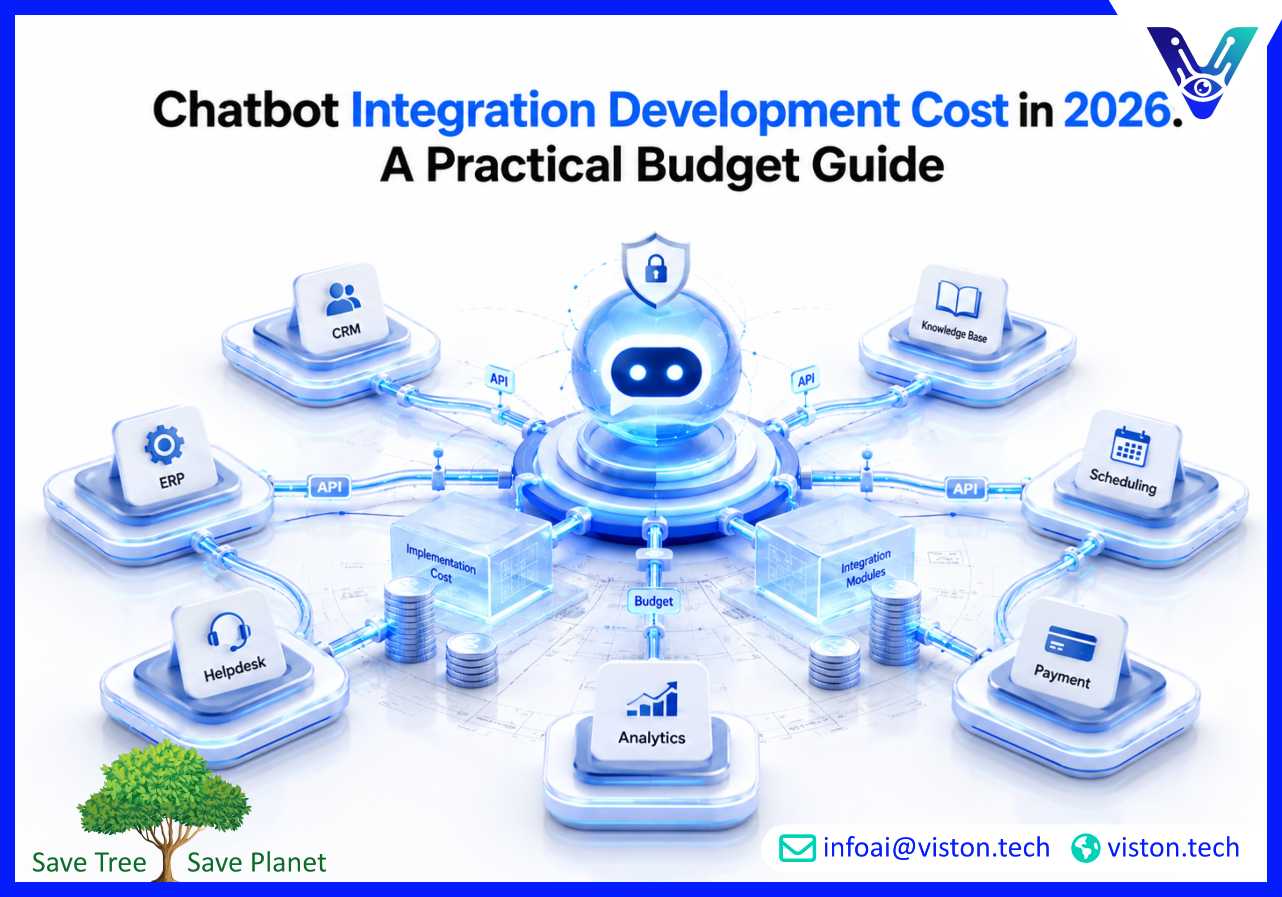
Chatbot integration connects a conversational interface with the systems a business already uses. These may include CRM platforms, helpdesk software, ecommerce systems, enterprise resource planning tools, knowledge bases, scheduling applications, payment services, analytics platforms, and internal databases.The integration allows the chatbot to do more than provide static answers. It may retrieve an order status, create a support ticket, qualify a lead, update a customer record, schedule an appointment, check inventory, authenticate an employee, or trigger a multi-step workflow.The total cost therefore includes business analysis, software engineering, data mapping, API development, security controls, conversation design, quality assurance, deployment, and operational support.
Requirements and workflow discovery
A reliable estimate begins with understanding what the chatbot must accomplish. The development team needs to document user journeys, business rules, escalation conditions, data sources, permissions, channels, expected conversation volumes, and success metrics.A narrowly defined chatbot that captures leads and sends them to a CRM costs less than a support assistant that must identify customers, retrieve account information, update tickets, process requests, and coordinate several backend systems.
API and connector development
Many modern platforms provide APIs or pre-built connectors. These can reduce implementation effort, but they rarely eliminate configuration work. Developers still need to map fields, handle authentication, validate inputs, manage errors, prevent duplicate records, and test synchronization.Costs increase when a system has incomplete documentation, restrictive API limits, older protocols, custom data structures, or no usable integration interface. In these cases, the team may need to build middleware, create custom endpoints, or work with legacy databases.
Knowledge and data preparation
An AI chatbot needs accurate, approved, and well-structured information. Preparing product documentation, support articles, policy content, historical tickets, and internal procedures can become a significant part of the project.Data preparation may involve removing duplicates, correcting outdated content, assigning document owners, defining access permissions, and separating public information from restricted records. Poor knowledge quality can make an expensive chatbot unreliable, even when the technical integration works correctly.
Testing, security, and deployment
Testing must cover more than conversational accuracy. Teams need to verify authentication, API responses, record updates, error handling, fallback behavior, human handover, data permissions, and performance under expected traffic.Security work may include encryption, role-based access, audit logging, consent management, data retention controls, API gateway configuration, and protection against unauthorized actions. Regulated or high-risk workflows usually require additional review and documentation.
Typical Chatbot Integration Development Cost Ranges in 2026
There is no universal chatbot integration price because projects differ in scope, architecture, data sensitivity, and operational responsibility. However, practical budget bands can help businesses decide whether a proposal is realistic.
Basic integration: approximately $5,000 to $15,000
This range may be suitable when a business already has a chatbot or chatbot platform and needs a focused connection to one modern system. Examples include sending website leads to HubSpot, creating Zendesk tickets, connecting an FAQ bot to an approved knowledge source, or enabling basic appointment booking.Projects in this range typically use documented APIs, limited data fields, straightforward workflows, one communication channel, and standard security requirements.
Mid-level integration: approximately $15,000 to $50,000
A mid-level project may involve one or two business systems, custom workflow logic, customer identification, knowledge retrieval, analytics, escalation rules, and bidirectional synchronization.Examples include a sales chatbot that qualifies leads, updates CRM records, checks representative availability, and schedules meetings, or a service chatbot that retrieves customer information and creates contextual support cases.The higher end of this range generally reflects custom API work, several user journeys, more extensive testing, or integration across website, mobile, WhatsApp, or other channels.
Advanced enterprise integration: approximately $50,000 to $150,000 or more
Enterprise projects commonly connect conversational AI with CRM, ERP, customer service, identity, analytics, and workflow platforms. They may support several departments, brands, countries, languages, and user roles.These deployments require stronger architecture, observability, load testing, access controls, audit trails, business continuity planning, and structured release management. They may also include middleware, custom orchestration, human approval steps, and complex data transformations.
Complex regulated or legacy projects: $100,000 to $250,000 or more
Costs can move beyond standard enterprise ranges when the chatbot must work with legacy infrastructure, restricted data, high transaction volumes, specialist compliance controls, or mission-critical operations.A financial, healthcare, insurance, government, or multinational deployment may require formal security assessment, regional hosting, detailed auditability, penetration testing, data-residency controls, and extensive stakeholder approval.Published 2026 pricing research places broader custom AI chatbot development across wide ranges, from several thousand dollars for focused implementations to $250,000 or more for advanced enterprise systems. Integration depth, model selection, security, and backend engineering consistently appear among the most important cost drivers.These figures are planning ranges rather than fixed quotations. A detailed estimate should be based on documented workflows, systems, interfaces, data requirements, and service levels.
What Factors Increase Chatbot Integration Development Cost?
Two chatbots that look similar to users may require very different engineering effort. The following factors usually have the greatest effect on the final budget.
Number and condition of connected systems
Each additional CRM, ERP, helpdesk, database, payment service, or internal application adds mapping, authentication, testing, monitoring, and failure-handling requirements.Modern SaaS platforms with stable APIs are normally easier to integrate than older applications with undocumented fields or limited access. The condition of the technology stack can be more important than the number of chatbot features.
Workflow complexity
Retrieving information is generally simpler than changing it. A chatbot that only displays order status has lower risk than one that modifies an order, approves a refund, updates a contract, or initiates a payment.Multi-step workflows also require transaction management. The integration must know what to do when one system succeeds and another fails, when information is incomplete, or when human authorization is required.
AI model and knowledge architecture
A rules-based flow can be inexpensive for predictable questions. A generative AI assistant that interprets natural language, searches enterprise knowledge, remembers context, and produces grounded responses requires more architecture and testing.Retrieval-augmented generation, document processing, intent classification, model routing, response validation, and guardrails can increase development cost. They may also improve accuracy and make the chatbot useful across a wider range of questions.
Channels, languages, and user groups
Deploying across a website, mobile application, WhatsApp, Microsoft Teams, Slack, SMS, or social channels requires channel-specific design and testing. Each platform has different authentication methods, message formats, limits, and user expectations.Multilingual support adds terminology management, localized knowledge, language-level testing, and escalation procedures. Employee, customer, supplier, and partner chatbots may also require different access policies and workflows.
Security and compliance requirements
Security costs increase when the chatbot handles personal, financial, medical, contractual, or confidential company information. The integration may require single sign-on, multi-factor authentication, encryption, data masking, consent capture, audit logs, and regional data controls.Compliance should be included in the architecture from the beginning. Adding it after development often causes expensive rework.
Scale and reliability expectations
A pilot serving a few hundred conversations has different infrastructure needs from a customer-facing system handling continuous global traffic. High-volume chatbots may require caching, load balancing, asynchronous processing, rate-limit management, redundancy, failover, and detailed performance monitoring.Stronger uptime guarantees and faster response targets also increase engineering and support requirements.
How to Control Chatbot Integration Cost and Improve ROI
The cheapest proposal is not always the lowest-cost solution. A limited integration may create manual work, unreliable data, and customer frustration that eventually require rebuilding. Cost control should focus on delivering the smallest production-ready system that can produce a measurable outcome.
Begin with one valuable use case
Start with a workflow that has sufficient volume, clear business rules, and an identifiable outcome. Good initial use cases include lead qualification, support ticket creation, order tracking, appointment booking, account guidance, and internal knowledge retrieval.A focused first phase reduces integration risk and creates real usage data before the business expands to more channels or systems.
Separate essential and optional requirements
Divide requirements into launch essentials, near-term improvements, and later-stage capabilities. Voice interaction, advanced personalization, additional languages, predictive recommendations, and complex analytics may be valuable, but they do not always belong in the first release.This approach makes vendor proposals easier to compare and prevents optional features from obscuring the cost of the core integration.
Assess existing APIs before choosing an architecture
A technical discovery exercise should review API availability, documentation, authentication, webhooks, rate limits, data ownership, and vendor restrictions. This work can reveal hidden constraints before the budget and delivery schedule are committed.
Budget for ongoing ownership
Deployment is not the end of the expense. Businesses should plan for model or API usage, cloud hosting, messaging fees, chatbot platform licenses, monitoring, security updates, knowledge maintenance, performance optimization, and technical support.Conversation volume, message length, model choice, channel pricing, and data-processing requirements influence monthly operating cost. A proposal should clearly separate one-time implementation fees from recurring charges.
Measure outcomes instead of conversation volume
Return on investment should be connected to the chatbot’s purpose. Relevant measures may include resolved enquiries, qualified leads, booked appointments, reduced handling time, lower ticket volume, faster response, successful workflow completion, and improved data accuracy.A strong business case also considers avoided cost. Reliable integration can reduce duplicate entry, missed follow-ups, incorrect routing, and time spent moving information between systems.
How Viston AI Approaches Cost-Effective AI Chatbot Integration
Viston AI provides AI Chatbot Integration services for organizations that need conversational systems connected to operational platforms rather than isolated chat interfaces. Its published capabilities include integration with CRM, ERP, customer service, knowledge, and custom business applications.The company supports bidirectional data synchronization, allowing chatbots to retrieve current information and update connected records after an interaction. Relevant use cases include lead creation, customer record updates, order and inventory enquiries, ticket generation, workflow routing, and multi-system process automation.Viston AI also describes support for platforms such as Salesforce, HubSpot, Microsoft Dynamics, SAP, Oracle, NetSuite, and ServiceNow, alongside custom API and legacy integration requirements. Its integration architecture covers REST, SOAP, GraphQL, authentication controls, API gateways, encrypted communication, role-based permissions, and audit logging.This breadth is relevant when estimating chatbot integration development cost because the appropriate solution depends on the condition of the existing technology stack. A business using standard cloud platforms may benefit from reusable connectors, while an organization with custom or older infrastructure may require detailed data mapping and middleware.By connecting chatbot delivery with workflow analysis, system integration, security, and operational testing, Viston AI can support businesses seeking a phased implementation that is practical at launch and capable of expanding as adoption grows.
Frequently Asked Questions
How much does chatbot integration development cost in 2026?
A focused integration may cost approximately $5,000 to $15,000. Mid-level projects commonly require $15,000 to $50,000, while multi-system enterprise implementations may cost $50,000 to $150,000 or more. Legacy systems, regulated data, and complex workflows can push the budget above $250,000.
Is chatbot integration cheaper than building a chatbot from scratch?
It can be cheaper when the business already has a suitable chatbot platform and only needs system connectivity. However, extensive workflow customization, knowledge preparation, security, or legacy integration can make the integration itself a substantial engineering project.
What information is needed for an accurate chatbot integration quote?
A provider needs the required use cases, connected systems, available APIs, user roles, channels, data fields, security requirements, conversation volumes, workflow rules, escalation process, expected service levels, and ongoing support needs.
What recurring costs should be included in the budget?
Recurring costs may include chatbot platform subscriptions, AI model usage, hosting, messaging-channel fees, monitoring, integration maintenance, security updates, knowledge-base management, analytics, and technical support.
How can a business reduce chatbot integration cost?
Begin with one high-value workflow, use existing APIs where practical, limit the first release to essential capabilities, prepare clean knowledge content, define success metrics, and expand only after the initial integration has been tested with real users.
Can Viston AI integrate a chatbot with existing CRM and ERP systems?
Viston AI’s published AI Chatbot Integration capabilities include CRM, ERP, helpdesk, workflow, and custom application connectivity. The final scope and cost depend on the systems, APIs, data model, security requirements, and business processes involved.
Conclusion
Chatbot integration development cost should be evaluated against the operational responsibility the chatbot will carry. A simple connector may require a modest budget, while secure, multi-system automation demands deeper engineering and governance. Businesses should define priority workflows, assess their current APIs, separate implementation from recurring costs, and measure results through completed business outcomes. A phased AI Chatbot Integration strategy can control risk without limiting future scale. Viston AI offers relevant integration capabilities for organizations that need conversational AI connected to CRM, ERP, service, data, and workflow platforms.