
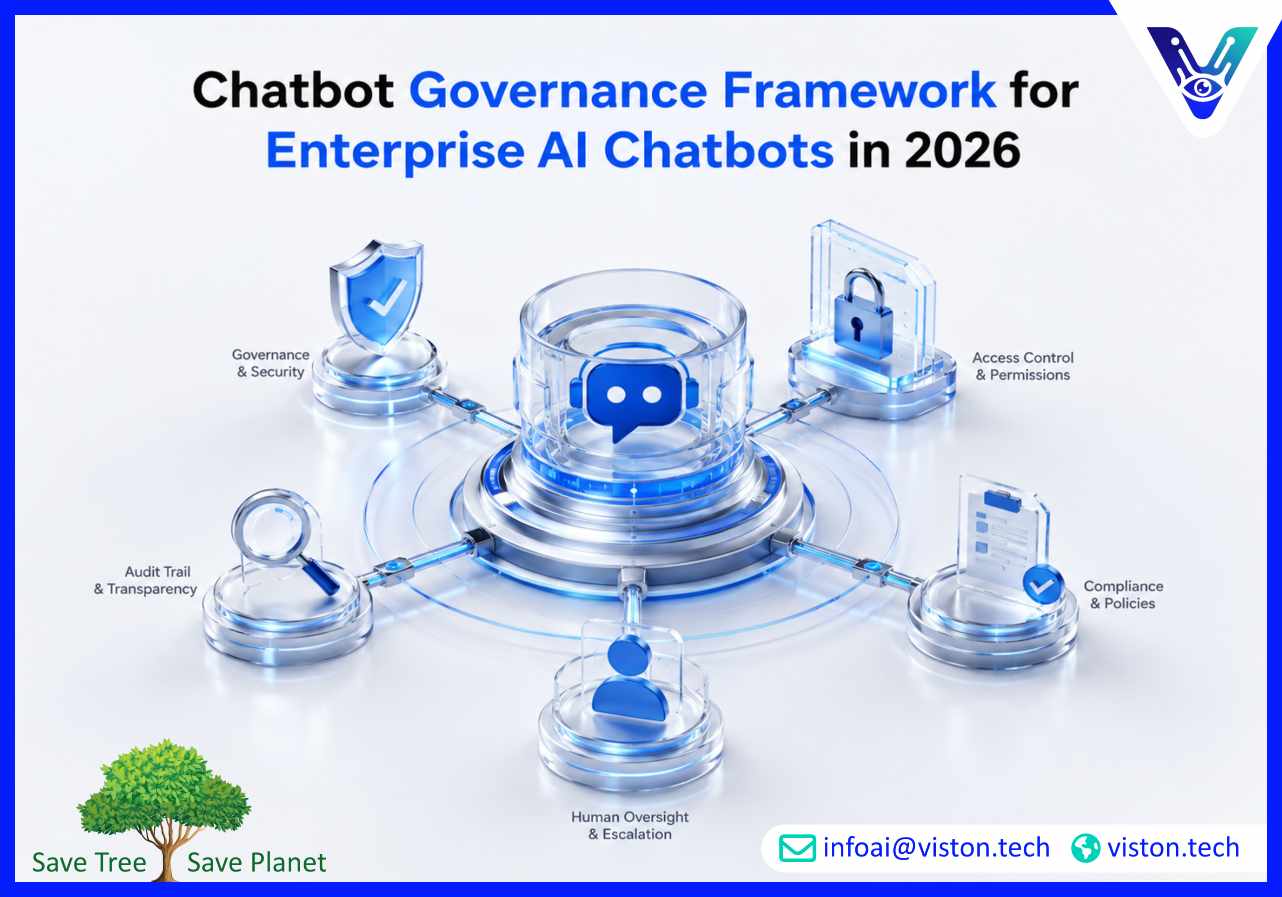
A chatbot governance framework enterprise leaders can trust is no longer optional. As AI chatbots move into customer service, sales, HR, IT, finance, and internal knowledge workflows, businesses need clear controls for accuracy, privacy, escalation, security, accountability, and measurable performance.
An enterprise chatbot governance framework is a structured set of policies, controls, workflows, roles, and monitoring practices that guide how AI chatbots are designed, deployed, used, reviewed, and improved. It helps businesses prevent chatbot adoption from becoming a disconnected technology experiment with unclear ownership and unmanaged risk.
For enterprise AI chatbots, governance covers more than legal approval or a one-time security checklist. It defines what the chatbot is allowed to do, what data it can access, which systems it can connect with, how answers are validated, when human escalation is required, how incidents are handled, and how performance is measured over time.
This matters because modern chatbots are no longer simple FAQ tools. They can retrieve enterprise knowledge, summarize documents, qualify leads, update CRM records, create support tickets, guide employees through policies, and interact with backend systems. Without governance, these capabilities can create inaccurate responses, privacy exposure, inconsistent customer experiences, weak auditability, and poor internal trust.
In 2026, governance also needs to reflect recognized AI risk practices. NIST’s AI Risk Management Framework is designed to help organizations manage AI risks to individuals, organizations, and society, while ISO/IEC 42001 provides requirements for establishing, implementing, maintaining, and continually improving an AI management system.
Enterprise AI chatbot adoption is expanding because businesses want faster service, lower support pressure, better knowledge access, and more scalable customer engagement. However, the same capabilities that make chatbots valuable also increase governance expectations. A chatbot that gives a wrong answer, exposes confidential information, mishandles a complaint, or performs an unauthorized workflow can quickly become a business risk.
Regulation and standards are also raising expectations. The EU AI Act uses a risk-based approach and includes transparency obligations for chatbots, requiring users to be informed when they are interacting with a machine where appropriate. Its transparency rules are scheduled to come into effect in August 2026.
For global enterprises, this does not mean every chatbot is high-risk. Many customer service and internal support bots may be lower-risk when properly scoped. But every enterprise chatbot should still have documented controls around data access, user disclosure, answer sources, escalation paths, security testing, and post-launch monitoring.
A practical governance framework should manage risks that appear across the chatbot lifecycle. These include inaccurate answers, outdated knowledge, prompt injection, unauthorized system access, sensitive information disclosure, weak role-based permissions, poor handover to human agents, unsupported languages, biased responses, and lack of audit evidence.
OWASP’s guidance for large language model applications identifies risks such as prompt injection, insecure output handling, sensitive information disclosure, excessive agency, overreliance, and model theft. These risks are directly relevant to enterprise chatbot design because chatbots often sit between users, data, workflows, and business systems.
Governance also improves business confidence. Procurement teams want evidence that the chatbot is secure. Compliance teams want accountability. Support leaders want escalation quality. Sales teams want clean CRM data. Executives want measurable outcomes. A governance framework connects these expectations into one operating model.
A strong chatbot governance framework should be practical enough for delivery teams to follow and detailed enough for enterprise stakeholders to trust. It should not slow every chatbot decision with excessive bureaucracy, but it should create clear controls for use cases where accuracy, privacy, compliance, or business impact matters.
Start by classifying chatbot use cases by business function, user type, data sensitivity, workflow authority, and potential impact. A website lead qualification bot has different risks from an HR policy assistant, a banking support chatbot, or a healthcare appointment bot. Classifying use cases helps teams decide which controls are required before launch.
Every enterprise chatbot needs named owners. Business teams should own the use case and user experience. Technology teams should own architecture, integration, and reliability. Security teams should review access controls and threat exposure. Legal or compliance teams should review regulatory obligations. Operations teams should own performance monitoring and escalation workflows.
Governance should define which data sources the chatbot can access, how permissions are enforced, how personally identifiable information is handled, how data is logged, and how long conversation records are retained. For internal chatbots, role-based access is critical because employees in different departments should not receive the same level of information.
Enterprise chatbots should answer from approved, current, and traceable sources. A governance framework should define how knowledge bases are updated, who approves content, how outdated information is removed, and how source retrieval is tested. This is especially important for policy, product, compliance, pricing, technical support, and internal process content.
Not every conversation should be automated. Governance should define when the chatbot must escalate to a human. Examples include complaints, legal questions, medical or financial sensitivity, unresolved frustration, authentication failure, repeated fallback responses, low confidence answers, high-value sales opportunities, and workflow exceptions.
Before launch, enterprise chatbots should be tested for prompt injection, unsafe output, data leakage, unauthorized actions, access bypass, and misuse of connected tools. Testing should continue after deployment because user behavior, data sources, model behavior, and integrations can change over time.
Governance should require dashboards that track chatbot accuracy, fallback rate, escalation quality, resolution rate, user satisfaction, policy exceptions, security alerts, and workflow success. Audit trails should show what the chatbot answered, what source was used, what action was taken, and when a human became involved.
The best governance frameworks support responsible speed. They help teams launch useful enterprise AI chatbots faster because requirements are clear from the beginning. Instead of discovering security, compliance, or data issues late in development, teams can design around them early.
Create a simple catalog of approved chatbot types, such as customer support, sales qualification, employee knowledge search, IT helpdesk, onboarding, procurement support, and operations assistance. For each category, define allowed data sources, required approvals, escalation rules, and performance metrics.
Low-risk chatbots should not require the same review depth as high-impact chatbots. A chatbot that answers public product FAQs may need content approval and basic monitoring. A chatbot that accesses customer records, creates tickets, recommends next steps, or supports regulated workflows needs deeper privacy, security, integration, and audit controls.
Governance works best when it is part of chatbot development, not a final review gate. Conversation design should include fallback handling, disclosure wording, escalation prompts, prohibited answer rules, and confidence thresholds. Integration design should include API permissions, logging, access controls, and failure handling.
Employees should understand what the chatbot can and cannot do. Support agents need to know how escalations are transferred. Content owners need to know how to update approved answers. Business leaders need to understand chatbot metrics. Users should be given clear guidance when chatbot answers are informational rather than final decisions.
Enterprise AI chatbots change after launch. New content is added, user behavior shifts, integrations expand, and models may be updated. A governance framework should include scheduled reviews, incident analysis, red-team testing, user feedback loops, and documentation updates.
Viston AI is relevant to chatbot governance because its Enterprise AI Chatbots service is positioned around enterprise-grade conversational AI, business system integration, contextual understanding, workflow automation, security, compliance, and responsible AI controls. Its service page highlights capabilities such as natural language understanding, contextual memory, multi-turn dialogue management, CRM and knowledge base integration, audit trails, escalation protocols, role-based access, and compliance-oriented deployment features.
For organizations building a chatbot governance framework, these capabilities matter because governance must be implemented inside the chatbot architecture, not only written in policy documents. A governed chatbot needs controlled access to knowledge sources, secure integration with CRM or ERP systems, reliable workflow routing, clear human handover, and monitoring that shows whether the system is performing safely and accurately.
Viston AI’s broader AI service portfolio also includes AI chatbot integration, AI readiness assessment, AI strategy development, MLOps and model monitoring, multilingual chatbot support, and automation workflow bots. This makes it relevant for enterprises that need chatbot delivery aligned with security, operational scalability, user experience, and measurable business outcomes. For teams adopting enterprise AI chatbots across customer support, sales, internal operations, healthcare, finance, retail, manufacturing, or logistics, a governance-aware implementation approach can reduce risk while improving reliability and adoption.
A chatbot governance framework is a structured operating model for managing AI chatbot design, deployment, data access, security, accuracy, escalation, monitoring, and accountability. It ensures enterprise AI chatbots are useful, controlled, compliant, and continuously improved.
Enterprises need chatbot governance because AI chatbots can access sensitive data, influence customer experience, automate workflows, and interact with business systems. Governance reduces risks such as inaccurate answers, data exposure, poor escalation, unauthorized actions, and weak auditability.
A strong framework should include use case classification, ownership, approved data sources, privacy controls, security testing, knowledge management, human escalation rules, audit logging, performance metrics, incident handling, and continuous improvement processes.
Chatbot governance supports compliance by documenting chatbot purpose, data flows, controls, user disclosures, human oversight, access permissions, logs, and risk reviews. This helps compliance teams demonstrate that chatbot use is managed rather than informal or uncontrolled.
Yes. Governance improves performance by creating clearer knowledge ownership, better escalation rules, stronger monitoring, regular review cycles, and measurable KPIs. This helps reduce failed conversations, outdated answers, customer frustration, and workflow errors.
Viston AI’s Enterprise AI Chatbots offering is aligned with governed chatbot implementation because it focuses on enterprise integration, workflow automation, security, compliance features, contextual accuracy, and scalable conversational AI delivery.
A chatbot governance framework enterprise teams can rely on is essential for scaling Enterprise AI Chatbots responsibly in 2026. It gives businesses a practical way to manage accuracy, data privacy, security, human oversight, integration quality, and measurable outcomes. Without governance, chatbot projects can create fragmented experiences and unmanaged risk. With the right framework, enterprises can deploy conversational AI with greater confidence, stronger accountability, and better long-term performance. Viston AI’s enterprise chatbot capabilities make it a relevant partner for organizations that want chatbot adoption to be secure, scalable, and connected to real business workflows.
