
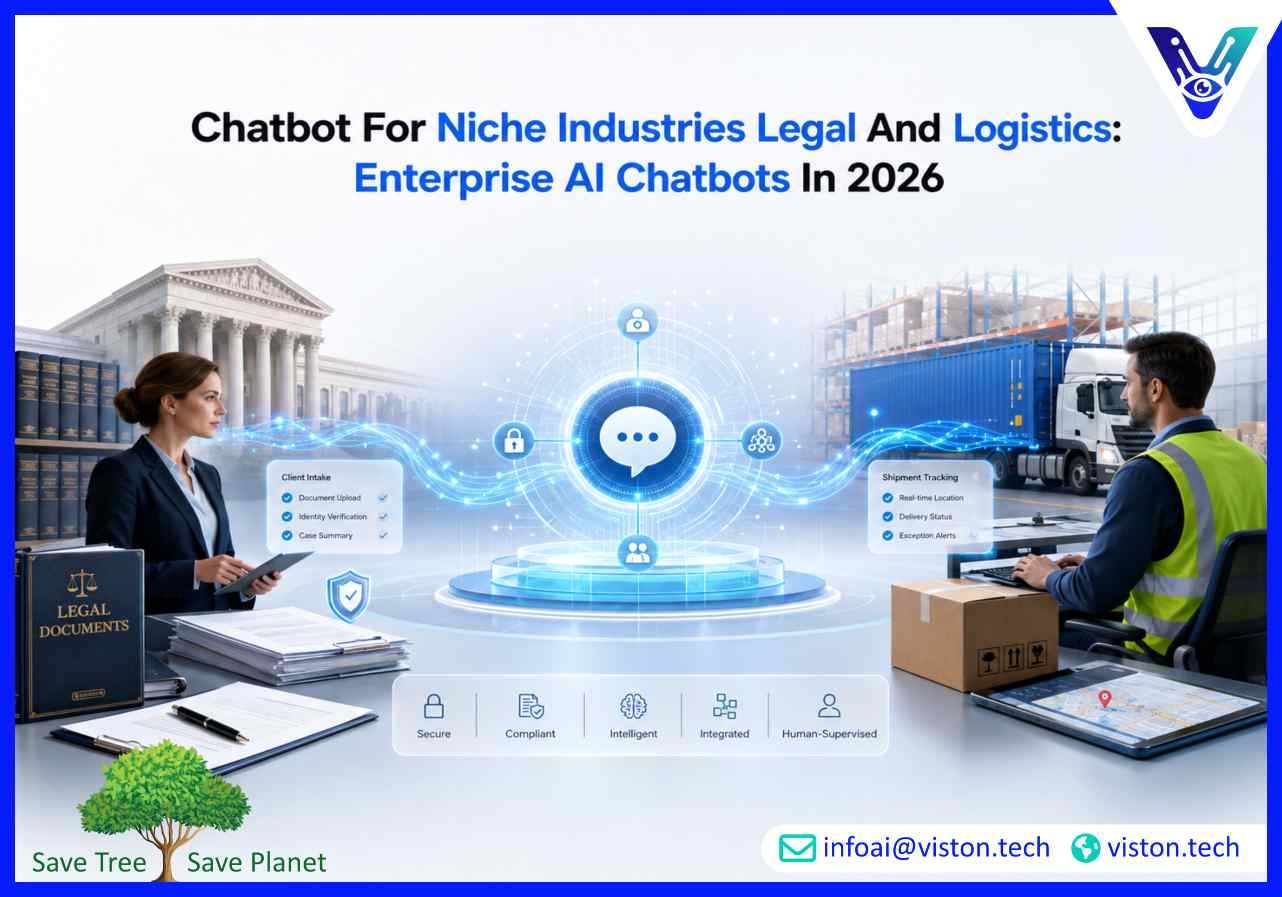
A chatbot for niche industries is no longer a basic support widget. For legal and logistics businesses, it must understand specialist language, sensitive workflows, compliance boundaries, operational urgency, and customer expectations. In 2026, enterprise AI chatbots are becoming practical tools for improving service speed, process accuracy, and scalable communication.
A chatbot for niche industries is a domain-specific conversational AI system built around the real workflows, terminology, data sources, risks, and service expectations of a specialized business sector. Unlike generic chatbots, niche-focused enterprise AI chatbots are designed to interpret context, retrieve accurate information, trigger business processes, and escalate sensitive cases when automation is not appropriate.
For legal and logistics companies, this distinction matters. A legal chatbot may need to help users navigate matter intake, document status, appointment scheduling, policy questions, client onboarding, contract review workflows, or internal knowledge search. A logistics chatbot may need to respond to shipment status requests, customs documentation questions, carrier updates, warehouse queries, exception alerts, delivery rescheduling, and route-related service issues.
Enterprise chatbots are commonly understood as AI-powered conversational systems that support customers and employees by connecting with enterprise data, applications, and workflows. That makes integration, security, governance, and workflow design central to the value of any niche chatbot project, not optional extras.
The strongest niche chatbot systems are built with a clear operating model. They should know what they can answer, where the answer comes from, when to ask for clarification, when to hand off to a human, and how to keep a reliable audit trail. In specialist industries, success is not measured only by conversation volume. It is measured by accuracy, reduced manual effort, lower response delays, better client experience, and fewer operational gaps.
Legal and logistics teams face very different business pressures, but both operate in environments where speed, accuracy, documentation, and trust are critical. Generic automation often fails because it does not understand the consequences of a wrong answer, an incomplete instruction, or a delayed escalation.
In the legal sector, buyers and clients expect fast communication but also careful handling of confidential information. A chatbot cannot behave like an unfiltered general AI assistant. It must respect scope, avoid giving unauthorized legal advice, support intake without overstepping professional boundaries, and route complex issues to qualified legal staff. It should help the firm respond faster without weakening professional judgment.
In logistics, the problem is operational complexity. Customers, vendors, carriers, warehouse teams, customs brokers, and internal coordinators may all need timely answers from different systems. A shipment update may depend on transport management software, warehouse systems, GPS data, customs status, ERP records, and customer service notes. A logistics chatbot must work across these systems to provide current, useful, and reliable responses.
In 2026, businesses also need stronger AI governance. Organizations using generative AI are expected to consider trustworthiness, risk management, privacy, information security, human oversight, and evaluation throughout the AI lifecycle. NIST’s Generative AI Profile is designed to help organizations incorporate trustworthiness considerations into the design, development, use, and evaluation of AI systems.
For businesses in niche industries, this means the chatbot must be planned as an enterprise capability rather than a quick plugin. The project should include:
For legal and logistics companies, the business case is not simply “answer more questions faster.” The deeper value is creating a controlled conversational layer that makes specialist services easier to access, easier to manage, and easier to scale.
A legal chatbot for niche industry use must be designed with caution, precision, and clear boundaries. Legal services involve confidentiality, professional responsibility, jurisdictional differences, and sensitive client matters. A well-designed enterprise AI chatbot does not replace lawyers or legal professionals. It supports the business by handling structured, repeatable, information-led tasks while escalating legal judgment to qualified people.
Client intake is one of the strongest use cases for legal chatbots. The chatbot can collect basic information, identify the type of legal matter, ask structured follow-up questions, capture urgency, check service availability, and route the request to the right department. This reduces back-and-forth emails and helps the firm respond more consistently.
For example, a law firm may use a chatbot to distinguish between employment, commercial contract, property, immigration, or dispute-related enquiries. The chatbot can collect the facts needed for administrative triage without giving legal advice. It can then create a CRM record, notify the intake team, and schedule a consultation.
Many legal teams spend significant time answering status questions. Clients may ask whether a document has been received, whether a contract is under review, whether a filing deadline is confirmed, or whether a next step has been scheduled. A chatbot connected to approved matter management data can provide controlled updates without exposing sensitive internal notes.
This is particularly useful for firms handling high-volume legal work, corporate legal departments, legal process outsourcing teams, and compliance operations. The chatbot can reduce repetitive administrative communication while keeping clients informed.
Legal professionals also need fast access to precedents, policies, clause libraries, playbooks, regulatory guidance, and internal procedures. A secure internal chatbot can help teams search approved knowledge bases and summarize relevant internal materials. The key is that outputs should be grounded in verified sources and should show when human review is required.
A legal chatbot must avoid unsupported conclusions, unauthorized advice, confidentiality breaches, and misleading certainty. It should include disclaimers where appropriate, but disclaimers alone are not enough. The architecture should include access controls, retrieval from approved documents, conversation logging, audit trails, human escalation, and regular quality review.
Where regulations apply, transparency is also important. The European Commission notes that the EU AI Act introduces disclosure obligations so people are informed when they are interacting with AI systems such as chatbots.
Logistics businesses operate across moving parts: shipments, carriers, warehouses, customs documents, delivery windows, invoices, exceptions, and customer commitments. A chatbot for logistics must connect communication with operations. If it cannot access trusted data, it becomes another channel for vague answers. If it is integrated properly, it can become a practical service automation layer.
The most common logistics chatbot use case is shipment tracking. Customers want to know where goods are, when they will arrive, whether a delay has occurred, and what action is required. A chatbot integrated with transport management systems, warehouse management systems, carrier APIs, and order platforms can provide near real-time answers without forcing users to call support teams.
The chatbot should not simply repeat tracking numbers. It should explain status in business-friendly language, identify exceptions, suggest next steps, and escalate when a delivery risk affects service commitments.
Logistics operations depend on fast exception handling. Missed pickups, customs holds, damaged goods, address mismatches, temperature alerts, failed delivery attempts, and stock shortages all require timely action. A logistics chatbot can collect incident details, trigger workflows, notify the correct team, and provide updates to customers or internal users.
This is where enterprise AI chatbots become more valuable than static FAQ bots. They can classify the issue, determine urgency, check relevant systems, and guide the user through the next best action.
International logistics involves paperwork, trade terms, invoice details, packing lists, customs references, and compliance documentation. A chatbot can help users locate the correct document, explain required fields, request missing information, and route complex compliance questions to specialists. It can also support vendors and carriers by answering standard onboarding, portal, billing, and process questions.
Internal logistics teams often lose time switching between systems. A chatbot can act as a conversational interface for approved operational data, allowing staff to ask questions such as which shipments are delayed, which orders require documentation, which warehouse has pending dispatches, or which customers need proactive updates.
For logistics, the real value is not only customer service automation. It is better visibility, faster coordination, fewer manual status checks, and improved response consistency across the supply chain.
Viston AI is relevant to this topic because its service offering directly includes Enterprise AI Chatbots, AI Chatbot Development, AI Chatbot Integration, NLP and text analysis, multilingual chatbot support, AI automation, and custom AI solution development. Its Enterprise AI Chatbots service is positioned around end-to-end conversational AI for customer interactions across channels, languages, and business units, with integration into CRM systems, knowledge bases, and transactional systems.
For legal and logistics businesses, this matters because niche chatbot success depends on more than a conversational interface. It requires secure data access, natural language understanding, workflow automation, escalation logic, and business-system integration. Viston AI’s Enterprise AI Chatbots page describes capabilities such as contextual memory, multi-turn dialogue management, enterprise security, omnichannel intelligence, adaptive learning, integration with CRM, ERP, inventory databases, and legacy infrastructure, as well as audit trails and configurable escalation protocols.
These capabilities align with the needs of legal intake, matter status communication, internal legal knowledge search, logistics shipment tracking, exception management, and operational support. For organizations evaluating enterprise AI chatbots in niche industries, Viston AI’s relevance is strongest where the requirement involves custom workflows, secure integrations, reliable knowledge grounding, multilingual or omnichannel communication, and scalable automation rather than a simple FAQ chatbot.
A chatbot for niche industries is a domain-specific AI chatbot designed for specialized sectors such as legal, logistics, healthcare, finance, manufacturing, or supply chain operations. It uses industry terminology, approved data sources, workflow rules, and escalation processes to support real business tasks.
A normal chatbot may answer basic FAQs. An enterprise AI chatbot connects with business systems, manages multi-step workflows, supports role-based access, handles complex user intents, logs interactions, and follows governance rules. This makes it more suitable for legal and logistics environments.
A legal chatbot should generally avoid giving legal advice unless it is specifically designed, approved, and governed for that purpose within the applicable legal and professional framework. Most legal chatbots are better used for intake, scheduling, document status updates, knowledge search, and administrative support.
A logistics chatbot may need integration with transport management systems, warehouse management systems, ERP platforms, carrier APIs, CRM systems, order management tools, customs documentation systems, and customer communication channels.
Reliability depends on approved knowledge sources, secure integrations, clear escalation paths, role-based access, audit logs, testing against real scenarios, human oversight, and ongoing performance monitoring. In niche industries, reliability is more important than simply generating fluent responses.
Viston AI offers Enterprise AI Chatbots, AI Chatbot Development, AI Chatbot Integration, NLP, workflow automation, and custom AI solution development. These services are relevant to niche chatbot projects that require business-specific workflows, secure system integration, and scalable conversational automation.
A chatbot for niche industries can create significant value for legal and logistics businesses when it is designed around real workflows, trusted data, compliance boundaries, and measurable operational outcomes. In 2026, enterprise AI chatbots should be treated as secure business systems, not simple website add-ons. Legal teams need careful intake, confidentiality, and escalation. Logistics teams need live visibility, exception handling, and system integration. Viston AI is a relevant Enterprise AI Chatbots specialist for organizations that need custom, secure, and scalable chatbot solutions aligned with practical business requirements.
