
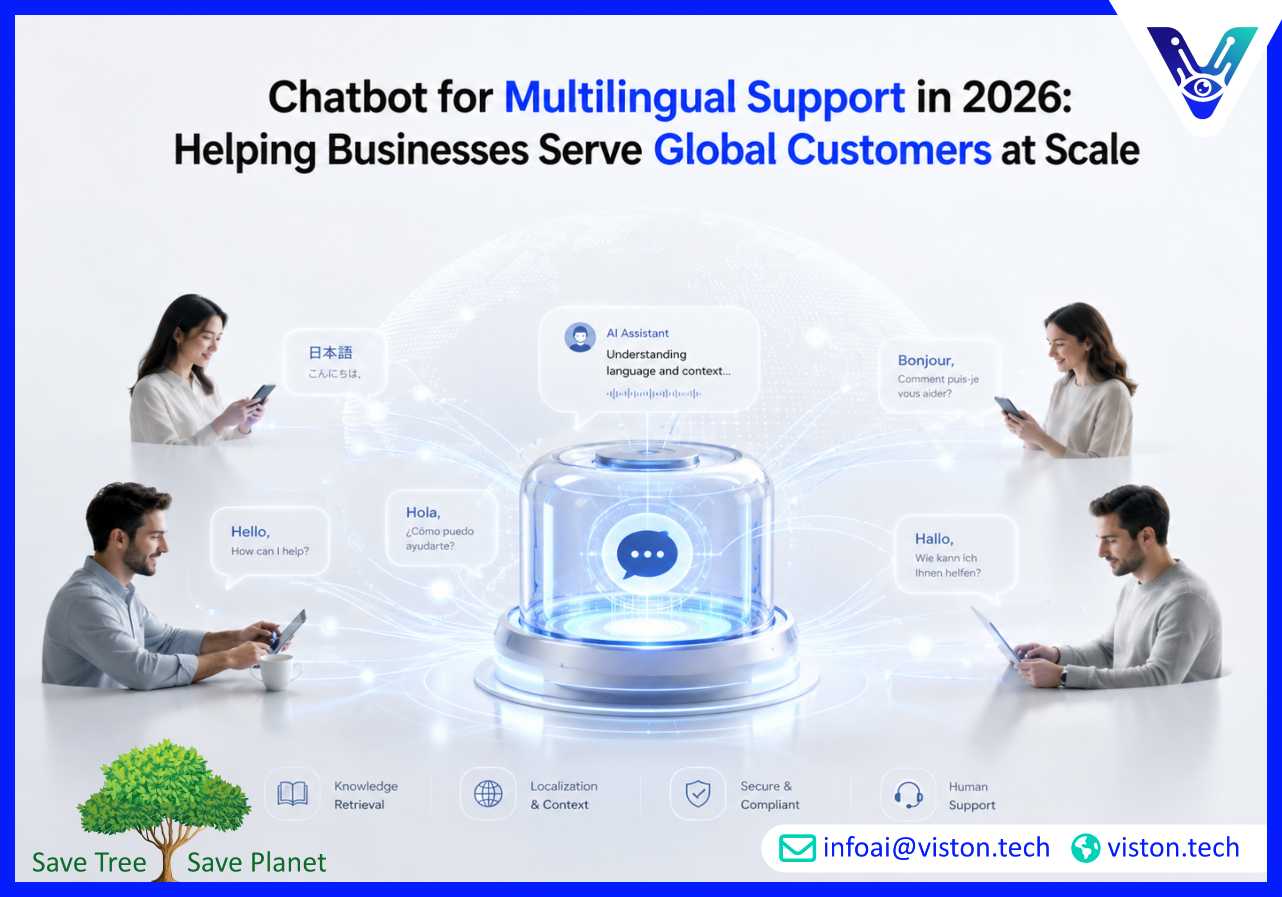
A chatbot for multilingual support helps businesses communicate clearly with customers, employees, and partners across languages without building separate support teams for every region. In 2026, this is no longer only a translation feature. It is a customer experience, automation, compliance, and scalability requirement for global-facing businesses.
Businesses now operate across borders even when they do not consider themselves global enterprises. A customer may discover a product through an English website, ask a question in Spanish, request billing support in French, and expect order updates through WhatsApp or live chat. Traditional support models struggle with this level of language diversity because every new market adds cost, training, quality control, and response-time pressure.
A chatbot for multilingual support addresses this challenge by giving users a consistent conversational experience in their preferred language. It can understand intent, retrieve the right answer, translate or localize responses, and escalate complex issues to the correct human team when needed. For customer-facing industries, this can reduce friction at the most important moments: product discovery, onboarding, troubleshooting, payment, returns, account access, and service renewal.
The main business value is not simply “answering in many languages.” The value comes from delivering reliable, contextual support at scale. A well-designed multilingual chatbot can recognize regional language differences, handle terminology specific to an industry, maintain brand tone, and protect sensitive data during interactions. This is especially important for companies serving customers across countries, time zones, and regulatory environments.
In 2026, buyers expect AI systems to be more accountable than earlier chatbot tools. Businesses want multilingual support that is accurate, secure, measurable, and easy to integrate with existing systems. A chatbot must connect with knowledge bases, CRM platforms, ticketing systems, order management tools, product databases, help centers, and analytics dashboards. Without these connections, the bot may respond in multiple languages but still fail to resolve real customer problems.
Many companies start by thinking multilingual support means translating English answers into other languages. That approach is limited. Customers do not always phrase questions in direct, formal language. They use local expressions, short messages, mixed-language sentences, slang, typos, regional terms, and industry-specific vocabulary. A strong multilingual chatbot must understand meaning, not just words.
The first requirement is accurate language detection. The chatbot should identify the customer’s language automatically and continue the conversation without forcing the user to choose from a long menu. It should also understand intent across languages. For example, “Where is my order?”, “Track my parcel,” and “I have not received my package” may represent the same support intent, even if expressed differently in different languages.
Localization is different from translation. A localized chatbot considers tone, formality, units, currency, date formats, address formats, and regional expectations. A support response that feels natural in the United States may sound too casual in Germany or too direct in Japan. Businesses that care about trust need multilingual support that respects these differences.
A chatbot can only answer accurately if the source knowledge is clear, structured, and maintained. Businesses need service policies, FAQs, product documentation, troubleshooting guides, legal notes, refund rules, and escalation instructions prepared in a way AI systems can retrieve and use safely. For high-stakes industries, the chatbot should avoid unsupported answers and route sensitive cases to trained staff.
Multilingual support does not remove the need for human agents. It helps them work more effectively. The chatbot should know when to escalate, summarize the conversation, preserve the detected language, and route the case to the right team. A good handoff prevents customers from repeating themselves and gives agents the context needed to resolve the issue quickly.
A chatbot for multilingual support is useful wherever businesses serve diverse customers or operate across regions. The most practical use cases usually involve high-volume, repeatable questions where speed, consistency, and availability matter.
Customer service teams can use multilingual chatbots to handle common questions about account access, order status, returns, cancellations, appointment changes, delivery updates, product availability, and service policies. This reduces the workload on agents while improving response times for customers who may otherwise wait for language-specific support staff.
Retail and e-commerce businesses often receive multilingual questions about sizing, shipping, product comparisons, payment options, returns, loyalty points, and refunds. A chatbot can guide users through purchase decisions and post-purchase support in their preferred language. When connected to inventory and order systems, it can provide real-time answers instead of generic help center links.
Travel and hospitality customers frequently need urgent support across languages. They may ask about booking changes, check-in rules, local policies, cancellations, loyalty programs, room availability, or travel disruptions. A multilingual chatbot can support guests before, during, and after their journey while escalating urgent or emotional cases to human staff.
Financial institutions can use multilingual chatbots for account FAQs, card support, loan information, branch details, transaction guidance, and document collection. However, regulated industries need extra controls. The chatbot must manage authentication, data privacy, audit trails, approved wording, and escalation for sensitive financial advice or complaint handling.
Healthcare organizations can use multilingual chatbots for appointment scheduling, clinic information, insurance guidance, prescription refill workflows, and non-emergency administrative support. This requires careful handling of privacy, medical terminology, accessibility, and escalation rules so the chatbot supports patients without overstepping clinical boundaries.
Manufacturers serving international customers, distributors, or field technicians can use multilingual chatbots for equipment troubleshooting, parts identification, maintenance guidance, warranty support, and documentation search. In this context, the chatbot must understand technical vocabulary and provide precise, source-grounded responses.
Successful multilingual chatbot implementation starts with business design, not technology selection. Companies should first define which languages matter, which support journeys create the most friction, which systems must be integrated, and what level of risk each conversation type carries.
It is better to launch with a focused set of priority languages than to offer broad language coverage with inconsistent quality. Businesses should review customer volume, market growth, support backlog, conversion loss, and agent availability to decide where multilingual automation will create the strongest impact. Common channels include website chat, mobile app chat, WhatsApp, social messaging, customer portals, and internal service desks.
A multilingual chatbot should not be built as a static FAQ tool. It should be designed around actual tasks: checking an order, booking an appointment, opening a ticket, resetting access, collecting documents, answering product questions, or routing a complaint. Each flow should include success criteria, fallback rules, escalation triggers, and analytics tracking.
Modern chatbot systems often use retrieval-augmented generation to pull answers from approved business content. This helps reduce unsupported responses and keeps answers aligned with current policies. For multilingual support, source quality matters even more because unclear English documentation can become inaccurate when localized into other languages.
Integration turns a chatbot from a language interface into a resolution engine. Connecting with CRM, help desk, ERP, order management, payment, booking, or knowledge systems allows the bot to personalize responses and complete actions. Without integration, the chatbot may answer basic questions but still leave customers waiting for human follow-up.
Businesses should track multilingual chatbot performance separately for each language and market. Useful metrics include containment rate, first-contact resolution, escalation rate, customer satisfaction, fallback frequency, average handling time, response accuracy, repeat contact rate, and conversion impact. Language-specific analytics help reveal where translations, knowledge gaps, or cultural issues are affecting customer outcomes.
Multilingual support often crosses legal and regional boundaries. Businesses should define how data is stored, who can access conversations, how long records are retained, and which topics require human review. Compliance needs may include privacy controls, consent handling, encryption, audit logs, data residency, industry-specific restrictions, and approved response policies.
Viston AI is relevant to businesses researching chatbot for multilingual support because multilingual AI chatbot support is part of its service portfolio. Its offering is positioned around enterprise-grade conversational AI that helps organizations communicate across languages, time zones, and customer channels. For companies that need more than basic translation, this type of service can support practical requirements such as natural language understanding, localized responses, chatbot integration, analytics, and ongoing optimization.
Viston AI’s multilingual support capabilities connect closely with business needs in customer service, e-commerce, financial services, healthcare, manufacturing, travel, hospitality, and other global-facing sectors. A multilingual chatbot must understand context, industry terminology, and user intent while maintaining consistent support quality. Viston AI’s focus on AI chatbots, NLP, business system integration, LLMOps, performance monitoring, and compliance-aware deployment makes its service relevant for organizations that want scalable support rather than a disconnected chatbot widget.
For businesses operating across international markets, Viston AI can help structure multilingual chatbot programs around real use cases such as customer inquiries, technical support, product guidance, order tracking, appointment workflows, and intelligent escalation. Its service-led approach is especially useful where companies need support automation that fits existing systems and operational processes while improving customer experience across languages.
A chatbot for multilingual support is an AI-powered conversational system that can understand and respond to users in multiple languages. It helps businesses provide customer service, product guidance, technical support, and workflow assistance across different markets without relying only on language-specific human agents.
No. Machine translation converts text from one language to another. Multilingual chatbot support goes further by detecting intent, retrieving business-specific information, managing conversation flows, localizing tone, integrating with support systems, and escalating complex cases to human teams when needed.
Businesses with international customers, multilingual communities, global employees, or cross-border operations benefit most. This includes e-commerce, SaaS, travel, hospitality, healthcare, finance, education, logistics, manufacturing, and any company receiving support requests in more than one language.
Companies should check language demand, customer journey pain points, knowledge base quality, integration needs, compliance requirements, escalation workflows, reporting expectations, and internal ownership. The strongest implementations begin with clear business outcomes rather than a broad list of languages.
Yes. Viston AI provides multilingual AI chatbot support and related AI chatbot development capabilities. Its services are relevant for businesses that need multilingual conversations, NLP, localization, integrations, analytics, and scalable support automation across customer-facing or internal workflows.
Success should be measured by language and market. Key metrics include resolution rate, escalation rate, customer satisfaction, average handling time, fallback rate, response accuracy, repeat contacts, cost per interaction, and the business impact on conversions, retention, or support capacity.
A chatbot for multilingual support gives businesses a practical way to serve customers across languages without sacrificing speed, consistency, or quality. In 2026, the strongest multilingual support strategies combine AI, localization, secure integrations, human escalation, analytics, and continuous improvement. The goal is not to replace every support interaction but to make global communication easier, faster, and more reliable. For organizations that need scalable Multilingual Support, Viston AI offers relevant chatbot and conversational AI capabilities that can help turn language diversity into a stronger customer experience advantage.
