Chatbot Development Services Canada: A 2026 Guide for Business AI Chatbot Integration
Canadian businesses are adopting chatbot development services to improve customer response times, automate repetitive workflows, and connect digital support with real business systems. In 2026, effective chatbot success depends less on adding a chat window and more on secure, scalable AI chatbot integration.
What Chatbot Development Services Canada Mean for Businesses in 2026
Chatbot development services in Canada involve designing, building, integrating, deploying, and optimizing conversational AI systems that support customer, employee, and operational interactions. These services can include website chatbots, AI support assistants, lead qualification bots, WhatsApp chatbots, CRM-connected virtual assistants, ecommerce support bots, and internal workflow automation assistants.For business decision-makers, the value is not only in automated replies. The real value comes from connecting chatbot conversations with the systems that run the business. A well-developed chatbot can retrieve customer records, create support tickets, qualify leads, recommend products, schedule appointments, trigger workflows, and escalate complex issues to human teams.In Canada, businesses also need to consider data privacy, bilingual customer expectations, accessibility, sector-specific compliance, and secure cloud infrastructure. A chatbot that works well for a retail brand may not meet the needs of a healthcare provider, financial services company, SaaS business, or logistics operation.That is why modern chatbot development requires a combination of AI strategy, conversation design, integration engineering, data governance, security planning, testing, analytics, and ongoing optimization.
Why AI Chatbot Integration Matters More Than Standalone Chatbots
A standalone chatbot can answer basic questions. An integrated AI chatbot can support business outcomes.For example, a website chatbot that only shares static FAQs may reduce a few simple inquiries. But a CRM-integrated chatbot can identify a returning customer, understand their buying stage, capture lead details, route the inquiry to the right sales team, and update the customer record automatically.AI chatbot integration helps businesses move from simple automation to connected customer experience. This is especially important in 2026 as customers expect fast, accurate, personalized, and secure interactions across websites, mobile apps, messaging platforms, and support channels.
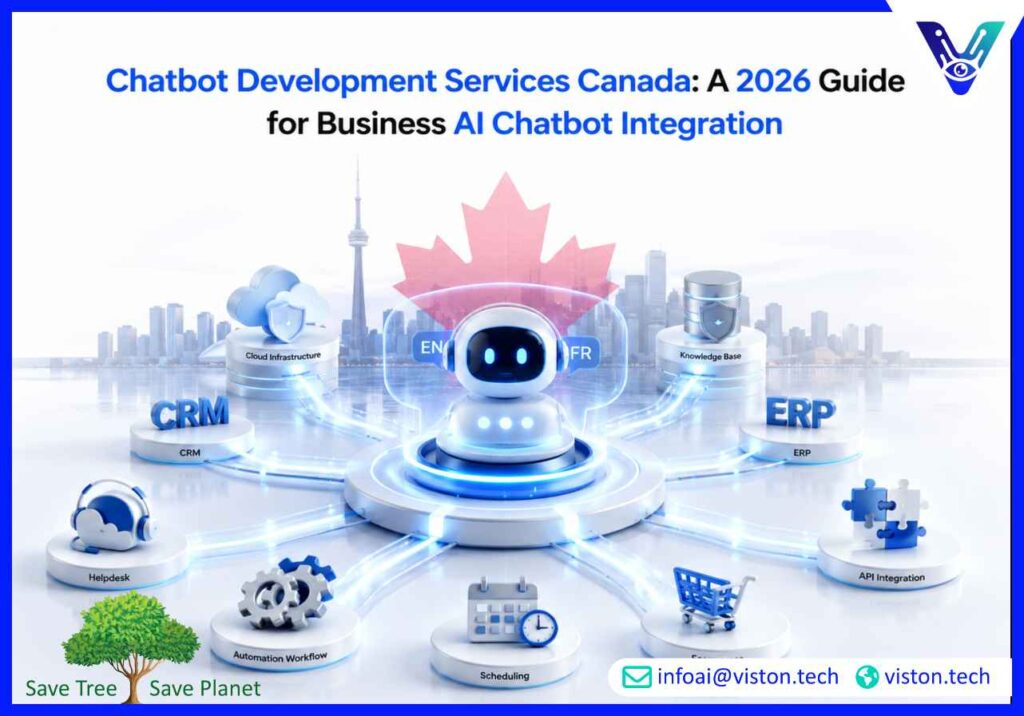
Common systems connected through chatbot integration
CRM platforms for lead and customer data
Helpdesk systems for ticket creation and support routing
Ecommerce platforms for order status, product search, and returns
ERP systems for inventory, operations, and account information
Marketing automation tools for lead nurturing
Knowledge bases for accurate self-service answers
Scheduling tools for appointments and consultations
Internal databases and APIs for real-time business information
Without integration, chatbot development often produces limited business impact. With integration, the chatbot becomes part of the company’s operational workflow.
Key Business Benefits of Chatbot Development Services in Canada
Businesses invest in chatbot development services because customer expectations and operational pressures are rising at the same time. Teams are expected to respond faster, personalize communication, control costs, and maintain service quality across multiple channels.
Faster customer support
AI chatbots can handle repetitive questions, direct users to the right resources, and provide instant responses outside normal business hours. This is useful for companies serving customers across Canadian time zones or international markets.
Better lead qualification
Sales-focused chatbots can ask structured questions, capture contact details, score prospects, and pass qualified leads to sales teams. This helps reduce manual filtering and improves follow-up speed.
Lower operational workload
Chatbots can automate routine tasks such as order tracking, appointment booking, password support, onboarding guidance, and service request collection. This allows human teams to focus on complex or high-value work.
More consistent customer experience
Integrated chatbots can provide standardized answers based on approved business information. This reduces inconsistent responses across teams and channels.
Improved data visibility
When connected to analytics and business systems, chatbot interactions reveal customer pain points, common objections, service gaps, and conversion opportunities.
Scalable service delivery
As demand increases, chatbots can support higher inquiry volumes without requiring the same level of manual staffing growth.
How to Choose the Right Chatbot Development Partner in Canada
Choosing a chatbot development provider should not be based only on design samples or a low starting cost. Businesses should evaluate whether the provider can deliver secure, integrated, measurable, and maintainable AI chatbot systems.
Look for integration experience
The provider should understand APIs, CRM workflows, authentication, data synchronization, escalation logic, and system reliability. Integration quality directly affects chatbot usefulness.
Assess conversation design capability
A chatbot needs more than technical setup. It requires clear user journeys, intent mapping, fallback handling, human handoff, and continuous improvement based on real conversations.
Review security and privacy practices
Canadian businesses should evaluate how customer data is collected, stored, transferred, and accessed. Encryption, access control, audit logging, consent handling, and data retention policies are important for responsible deployment.
Check scalability
The chatbot should support future growth, including new channels, languages, departments, integrations, and automation workflows.
Demand measurable outcomes
A reliable provider should define performance metrics such as resolution rate, escalation rate, response time, lead conversion rate, customer satisfaction, ticket reduction, and workflow completion.
Prioritize ongoing optimization
Chatbot development is not a one-time project. Businesses need regular review of conversation logs, failed intents, integration errors, user feedback, and performance analytics.
How Viston AI Supports AI Chatbot Integration for Canadian Businesses
Viston AI is relevant to businesses researching chatbot development services in Canada because its service offering includes AI chatbot development and AI chatbot integration capabilities. Its work focuses on helping organizations design intelligent chatbot systems that connect conversational AI with business workflows, customer engagement processes, and operational platforms.For companies that need more than a basic website bot, Viston AI’s approach aligns with the practical requirements of modern AI chatbot integration. This includes connecting chatbots with CRM platforms, support systems, knowledge bases, automation tools, and other enterprise technologies that help teams manage customer interactions more efficiently.Canadian businesses often need chatbot solutions that are scalable, secure, and adaptable across different industries and customer journeys. Viston AI’s broader AI capabilities, including chatbot development, generative AI, automation, and enterprise AI integration, make it suitable for organizations that want chatbot systems connected to real business outcomes rather than isolated conversational features.For teams evaluating chatbot development services Canada-wide, Viston AI may be a practical partner when the goal is to improve customer engagement, automate repetitive service tasks, strengthen lead handling, and create connected AI experiences across digital channels.
Frequently Asked Questions
What are chatbot development services in Canada?
Chatbot development services in Canada include planning, designing, building, integrating, testing, and optimizing AI chatbots for websites, messaging platforms, customer support, sales, ecommerce, and internal business workflows.
How much do chatbot development services cost in Canada?
Costs depend on chatbot complexity, AI model requirements, integrations, channels, security needs, data sources, and ongoing support. A simple FAQ chatbot costs less than a CRM-integrated or enterprise workflow chatbot.
Why is AI chatbot integration important?
AI chatbot integration connects the chatbot with business systems such as CRM, ERP, helpdesk, ecommerce, and marketing platforms. This allows the chatbot to complete useful tasks rather than only answer basic questions.
Can chatbots support Canadian businesses with bilingual communication?
Yes. Chatbots can be designed to support English and French communication where required, although quality depends on proper language design, training data, testing, and localization.
How long does chatbot development take?
A basic chatbot may take a few weeks, while a custom AI chatbot with multiple integrations, workflows, security requirements, and testing phases may take longer depending on scope.
Can Viston AI help with chatbot development and integration?
Yes. Viston AI provides AI chatbot development and integration services that help businesses connect conversational AI with workflows, customer engagement channels, CRM systems, and automation tools.
Conclusion
Chatbot development services Canada businesses invest in during 2026 should be evaluated through the lens of integration, security, scalability, and measurable business value. A chatbot is most useful when it connects with real systems, supports real workflows, and improves how customers or teams complete tasks. For organizations exploring AI chatbot integration, the right development partner should bring technical expertise, conversation design skill, privacy awareness, and a practical understanding of business operations. Viston AI offers relevant capabilities for companies looking to build connected chatbot experiences that support automation, customer engagement, and long-term digital efficiency.