
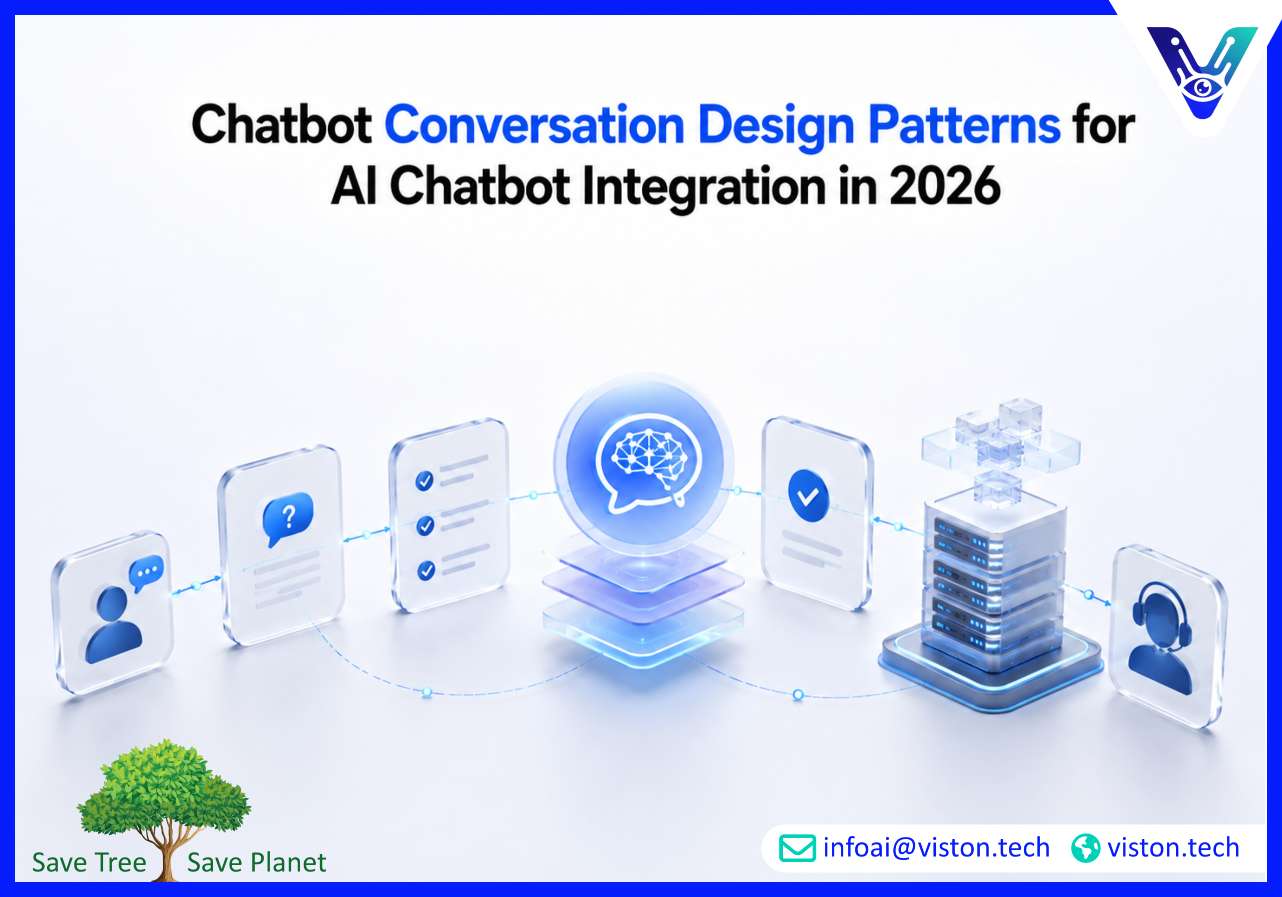
Chatbot conversation design patterns shape how users ask questions, complete tasks, recover from confusion, and move between automation and human support. In 2026, businesses integrating AI chatbots need more than smart language models; they need structured, reliable conversation experiences that connect clearly with business systems, customer journeys, and measurable service outcomes.
Chatbot conversation design patterns are reusable structures that guide how a chatbot understands intent, responds to users, collects information, confirms decisions, escalates issues, and completes tasks. They help businesses avoid random, inconsistent chatbot behavior and create conversations that feel clear, useful, and aligned with real operational workflows.
For modern AI chatbot integration, these patterns are especially important because the chatbot is no longer just answering basic FAQs. It may be connected to CRM records, order management systems, helpdesk tools, scheduling platforms, knowledge bases, payment workflows, HR systems, or internal databases. Viston AI’s AI chatbot integration service is positioned around connecting conversational systems with CRM, ERP, and core business platforms for real-time data synchronization and workflow automation.
A well-designed chatbot conversation does three things. First, it understands what the user is trying to do. Second, it guides the user through the shortest reliable path to completion. Third, it protects the business from incomplete data, poor escalation, compliance gaps, and weak customer experience.
In 2026, conversation design also needs to account for AI-generated responses, retrieval-based answers, multilingual use cases, omnichannel communication, analytics, privacy, and human handoff. The best chatbot experiences are not created by prompts alone. They are designed through intent mapping, task flow planning, fallback logic, content governance, testing, and continuous optimization.
AI chatbot integration gives a chatbot access to business systems. Conversation design determines whether that access creates a useful experience or a confusing one. A chatbot connected to a CRM can still fail if it asks the wrong questions, misunderstands customer context, skips confirmation, or creates duplicate records. A support bot connected to a ticketing platform can still frustrate users if it escalates too late or collects irrelevant information.
This is why conversation patterns must be planned before and during integration. They translate business processes into natural user interactions. For example, a lead qualification bot must know when to ask about budget, timeline, service need, company size, and contact details. A retail support bot must know when to retrieve order data, when to confirm identity, when to start a return, and when to transfer the case to a human agent.
Integrated chatbots also create operational dependencies. If the chatbot updates a CRM, books a meeting, triggers an invoice workflow, or creates a helpdesk ticket, the conversation must be accurate enough to protect downstream systems. Poor conversation design can lead to bad data, incomplete tickets, incorrect routing, unnecessary escalations, and missed revenue opportunities.
Strong design patterns improve chatbot reliability by making user journeys predictable. They help teams define what the chatbot should do, what it should not do, when it should ask for clarification, and how it should recover when confidence is low. This is critical for customer support, sales enablement, HR service delivery, IT support, finance operations, healthcare intake, education services, logistics, and other business workflows where accuracy and trust matter.
The intent confirmation pattern helps the chatbot verify what the user wants before taking action. This is useful when a user’s request could have multiple meanings. For example, “I want to change my order” could mean changing the delivery address, product quantity, payment method, or cancellation request.
A good chatbot should confirm intent naturally: “Do you want to update the delivery address, change items in the order, or cancel the order?” This reduces errors and gives the user control. In integrated systems, this pattern is essential because the chatbot may trigger real actions in CRM, ERP, helpdesk, or order management tools.
Many chatbot failures happen because the bot asks too many questions at once. Progressive information collection solves this by gathering details step by step. Instead of presenting a long form, the chatbot asks for the minimum required information in a logical order.
This pattern works well for appointment booking, quote requests, lead qualification, onboarding, support tickets, insurance claims, product recommendations, and employee service requests. It keeps users engaged while ensuring the business receives structured data that can be passed into connected systems.
Context carryover allows the chatbot to remember relevant information within a conversation and use it later. If a customer has already provided an order number, the chatbot should not ask for it again. If an employee has already selected “payroll issue,” the chatbot should continue the journey from that context.
For AI chatbot integration, context carryover becomes more powerful when it connects to customer profiles, account records, transaction history, previous tickets, or user permissions. Viston AI describes AI chatbot integration as enabling real-time data retrieval, system updates, and bidirectional synchronization across business platforms.
The guided choice pattern gives users clear options instead of leaving every response open-ended. This does not mean making the chatbot rigid. It means helping users move forward faster when the task is known.
For example, a chatbot may ask: “What would you like help with today?” followed by options such as “Track an order,” “Start a return,” “Speak to support,” or “Update account details.” This pattern improves completion rates because users do not need to guess what the chatbot can do.
No chatbot understands every message perfectly. The fallback and recovery pattern defines what happens when confidence is low, when the user asks an unsupported question, or when system data is unavailable.
A weak fallback says, “Sorry, I did not understand.” A strong fallback offers recovery: “I may not have understood that. Are you asking about billing, delivery, account access, or technical support?” For business-critical use cases, fallback logic should include escalation options, search suggestions, knowledge base retrieval, or human handoff.
The human handoff pattern defines when and how the chatbot transfers a conversation to a person. This is essential for complex, emotional, regulated, high-value, or unresolved issues.
A good handoff includes context. The human agent should see the conversation summary, user details, intent, collected information, previous actions, and system status. Without this, users must repeat themselves, and the chatbot feels like a barrier instead of a support layer.
When a chatbot performs an action, it should confirm what will happen before final submission. This is especially important for booking appointments, changing orders, updating records, submitting claims, processing payments, or creating service tickets.
The pattern may include a summary such as: “Please confirm: you want to change delivery to Friday, update the address to your office, and receive confirmation by email.” This reduces risk and improves user confidence.
Conversation design should not be treated as a writing task alone. It is a service design, data, integration, and business process discipline. Before building flows, teams need to map the user journey, define supported intents, identify required data, document system dependencies, and decide what success looks like.
Businesses should begin with high-value use cases. These may include customer support triage, lead qualification, order tracking, appointment scheduling, onboarding, IT helpdesk support, knowledge base search, claims intake, HR policy support, or internal workflow automation. Each use case should be assessed for complexity, integration requirements, risk level, and expected business impact.
Security and privacy must also be designed into the conversation. If a chatbot handles personal data, financial information, health details, internal employee records, or customer account data, it needs role-based access, authentication, audit trails, secure data transfer, and clear data handling rules. Viston AI’s integration content references authentication, API gateway protection, encrypted data transmission, role-based access controls, and audit logging for enterprise chatbot integrations.
Another important consideration is channel behavior. A chatbot on a website may support longer answers and visual buttons. A chatbot on WhatsApp or SMS may need shorter prompts. A chatbot in Slack or Microsoft Teams may serve employees who expect fast task execution. Viston AI references multi-channel orchestration across web, mobile, WhatsApp, Teams, Slack, and SMS for integrated chatbot experiences.
Analytics should be planned from the beginning. Businesses should track containment rate, escalation rate, task completion, abandonment points, misunderstood intents, fallback frequency, average resolution time, user satisfaction, conversion rate, and workflow success. These insights help teams improve conversation patterns over time instead of treating chatbot launch as the finish line.
Many chatbot projects underperform because the bot is technically capable but conversationally unclear. Users do not know what to ask. The bot asks irrelevant questions. Responses sound polished but do not move the task forward. Integrated systems return data, but the chatbot fails to explain it in a useful way.
Conversation design patterns solve these issues by creating structure. They reduce ambiguity, improve user confidence, and make automation easier to manage. A business can standardize how the chatbot handles identification, qualification, routing, error recovery, escalation, and confirmation.
For sales teams, this can mean better lead capture and cleaner CRM data. For support teams, it can mean faster triage and fewer repeated questions. For operations teams, it can mean more consistent workflow execution. For product teams, it can mean better onboarding and lower friction. For leadership, it can mean clearer reporting on chatbot performance and customer needs.
In 2026, businesses also need to consider AI trust. Users are more familiar with AI, but they are also more aware of incorrect answers, hallucinations, privacy risks, and poor automation experiences. Conversation design patterns help create boundaries. They tell the chatbot when to answer, when to retrieve information, when to ask for more detail, when to refuse unsupported actions, and when to escalate.
Viston AI is relevant to chatbot conversation design patterns because conversation quality depends heavily on how well the chatbot is integrated with business systems. Its AI Chatbot Integration service focuses on connecting conversational interfaces with CRM, ERP, and core enterprise platforms so chatbots can retrieve real-time data, synchronize records, trigger workflows, and support unified customer experiences.
For businesses planning chatbot conversation flows, this matters because design decisions must reflect what the chatbot can safely and reliably do. A lead qualification flow may need CRM creation and routing. A support flow may need ticket creation in ServiceNow or Jira. A retail flow may need order, inventory, and return management integration. Viston AI’s service page references integrations with Salesforce, HubSpot, Microsoft Dynamics, SAP, Oracle, NetSuite, ServiceNow, Jira Service Management, web, mobile, WhatsApp, Teams, Slack, and SMS use cases.
This makes Viston AI suitable for organizations that need chatbot experiences connected to practical business outcomes rather than isolated FAQ automation. Its integration approach supports conversation design patterns such as context carryover, workflow orchestration, secure handoff, transaction confirmation, and analytics-driven optimization. For B2B teams, the value is not simply deploying a chatbot; it is designing conversations that can interact with real systems, support real users, and improve operational efficiency.
Chatbot conversation design patterns are reusable structures for managing user intent, questions, responses, data collection, clarification, escalation, and task completion. They help businesses create chatbot experiences that are consistent, reliable, and easier to optimize.
They are important because integrated chatbots can perform real business actions, such as updating CRM records, creating tickets, checking orders, or triggering workflows. Clear design patterns reduce errors, improve user experience, and protect connected systems from poor data.
The most important pattern depends on the use case, but fallback recovery, intent confirmation, context carryover, and human handoff are critical for most business chatbots. These patterns help the chatbot manage uncertainty and guide users toward successful outcomes.
Yes. Better conversation design can improve task completion, reduce unnecessary escalations, increase lead capture quality, shorten support interactions, and improve customer satisfaction. It also makes chatbot analytics more useful because teams can identify where users struggle.
Viston AI supports chatbot conversation design through AI chatbot integration that connects conversational interfaces with business systems such as CRM, ERP, helpdesk, and workflow platforms. This allows chatbot patterns to support real-time data access, automation, and structured business processes.
Yes. Conversation design should be continuously improved using analytics, user feedback, fallback reports, escalation data, and business outcome metrics. A chatbot that performs well at launch still needs optimization as customer needs, systems, and processes change.
Chatbot conversation design patterns are essential for businesses that want AI chatbot integration to deliver reliable, useful, and measurable outcomes. They turn automation into structured user journeys that support clear intent handling, better data collection, safer workflows, stronger escalation, and improved customer experience. In 2026, the strongest chatbot projects will combine AI capability with practical conversation design and secure system integration. For organizations seeking connected chatbot experiences across CRM, ERP, support, and operational workflows, Viston AI offers relevant AI Chatbot Integration expertise that aligns conversation quality with real business execution.
