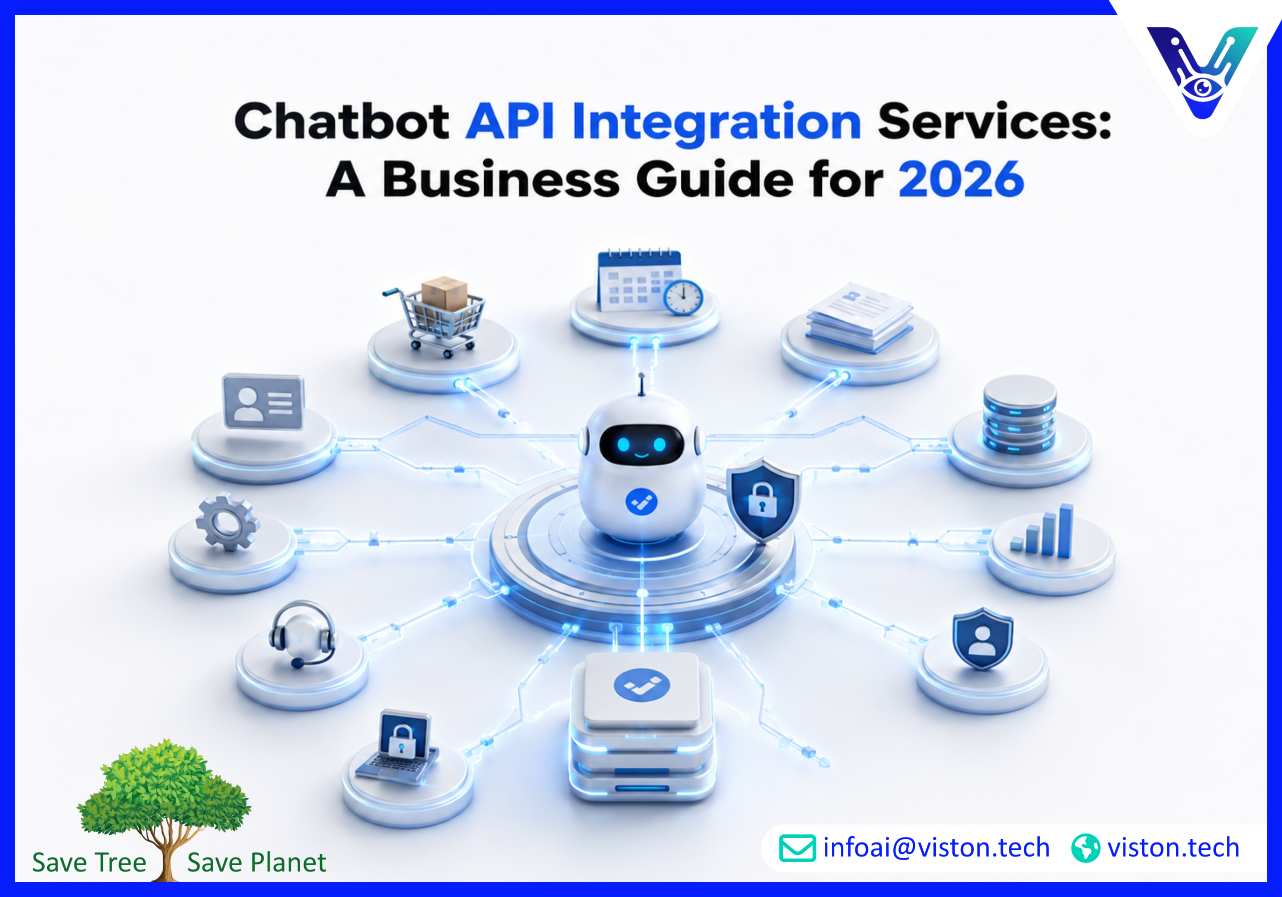
Chatbot API Integration Services: A Business Guide for 2026
Chatbot API integration services connect conversational AI with the systems a business already uses, allowing a chatbot to retrieve live information, complete approved actions, and pass useful context between customers, employees, and operational teams. In 2026, the quality of these integrations often determines whether a chatbot remains a basic interface or becomes a dependable business tool.
What Chatbot API Integration Services Involve
A chatbot can answer general questions without deep system access, but most commercially valuable use cases require more. Customers want order updates, account information, booking changes, product availability, case status, payment guidance, or personalized support. Employees may need policy answers, IT assistance, HR workflows, inventory data, or approval routing. API integration gives the chatbot a controlled way to exchange data with the platforms that hold this information.In practical terms, chatbot API integration services typically connect the conversational layer with CRM, ERP, helpdesk, ecommerce, payment, scheduling, marketing automation, identity, knowledge management, analytics, and internal database systems. The integration may use REST or GraphQL APIs, webhooks, middleware, event queues, software development kits, or custom connectors, depending on the existing technology environment.
From conversation to business action
The integration layer translates a user request into a structured system action. For example, when a customer asks to check an order, the chatbot identifies the intent, validates the customer, sends a request to the order management API, receives the current status, and presents the result in clear language. If the customer asks to change the delivery address, the workflow may require additional verification, eligibility checks, and human approval.Modern model APIs can use function or tool calling to request approved actions from external systems, while webhooks can notify the application when asynchronous events are completed. These patterns help developers separate natural-language interaction from the business logic and permissions that control real actions.
Common integration types
CRM integration for lead capture, qualification, routing, contact updates, and sales follow-up
Helpdesk integration for ticket creation, case lookup, escalation, categorization, and agent handover
Ecommerce integration for product search, order tracking, returns, stock checks, and delivery updates
ERP integration for inventory, account, procurement, invoicing, and operational data access
Scheduling integration for appointments, demos, consultations, reminders, and rescheduling
Knowledge integration for approved answers from policies, manuals, product content, and internal documentation
The right scope depends on the business objective. A lead-generation chatbot may only need CRM, calendar, and email connections. A service chatbot may require identity verification, helpdesk, billing, order, and knowledge systems. A good integration plan avoids connecting every platform at once and instead prioritizes workflows that are useful, repeatable, measurable, and safe to automate.
How Chatbot API Integration Services Create Business Value
The main value of integration is not that the chatbot can access more data. It is that the chatbot can use the right data at the right point in a conversation and complete a meaningful next step. This reduces the gap between a customer asking for help and the business acting on the request.
Faster customer service with better context
An integrated chatbot can retrieve relevant account, order, ticket, or subscription information without forcing the user to search through several portals. When escalation is necessary, the chatbot can transfer the conversation with the detected intent, customer details, attempted steps, and system results. This gives human agents a clearer starting point and reduces repeated questions.
Structured lead capture and qualification
For B2B sales teams, a chatbot can collect company details, service interest, budget range, urgency, location, and preferred meeting time. API integration can validate fields, create or update the CRM record, assign the lead, trigger a follow-up sequence, and book a meeting. This is more useful than sending unstructured chat transcripts to sales teams.
Workflow automation across departments
Chatbots can act as a conversational entry point for operational processes such as password resets, leave requests, invoice lookups, return initiation, appointment changes, service requests, and internal approvals. The API layer ensures that each request follows the same validation rules and creates a traceable system record.
Measurable operational outcomes
When the chatbot is connected to business systems, performance can be measured through completed workflows rather than conversation volume alone. Useful measures include tickets created correctly, appointments booked, leads routed, orders updated, self-service resolutions, API errors, authentication failures, handover quality, and time saved. Integration makes it possible to connect conversational activity with operational results.
How a Reliable Chatbot API Integration Is Designed and Delivered
A dependable integration project begins with workflow design, not coding. Teams need to define what the chatbot is allowed to know, what it is allowed to do, which systems are authoritative, and when a person must take control. The following delivery stages help reduce rework and operational risk.
1. Define the use case and success criteria
Start with a specific business process. Identify the user, the intent, the required data, the action to be completed, expected exceptions, escalation conditions, and measurable outcome. “Connect the chatbot to the CRM” is too broad. “Create qualified sales leads with validated contact data and route them by region” is clear enough to design and test.
2. Assess APIs, data, and system constraints
The technical team should review available endpoints, authentication methods, data schemas, rate limits, webhook support, latency, field requirements, sandbox access, and error behavior. Legacy systems may require middleware or a custom service layer. Data ownership also needs to be clear so the chatbot does not rely on outdated or conflicting sources.
3. Design orchestration and permission controls
The orchestration layer decides which tool to call, what parameters to send, how to validate outputs, and how to respond when a dependency fails. High-impact actions should use deterministic business rules, permission checks, and confirmation steps. The model should not receive unrestricted access to backend systems or decide independently which sensitive action to execute.
4. Build for failure, not only the happy path
Production integrations must handle timeouts, duplicate events, invalid records, expired tokens, partial updates, and unavailable systems. Retry logic, idempotency, logging, fallback messages, and human handover should be designed before launch. A fluent response does not compensate for an incorrect system update.
5. Test conversations and transactions together
Testing should cover language understanding, workflow execution, security, permissions, data accuracy, response speed, edge cases, and escalation. Teams should use realistic user phrasing rather than only scripted prompts. They should also confirm that every API action produces the correct downstream result in CRM, helpdesk, ERP, or other connected systems.
6. Monitor and improve after deployment
Post-launch monitoring should track both conversational and technical performance. Useful signals include fallback rate, task completion, API latency, failed calls, duplicate records, webhook errors, authentication failures, escalation rate, and user satisfaction. Reviewing failed interactions regularly helps teams improve prompts, integration logic, knowledge content, and workflow rules.
What to Look for in a Chatbot API Integration Services Provider
Choosing a provider requires more than checking whether its developers can call an API. The team must understand conversational design, enterprise systems, data security, workflow logic, quality assurance, and long-term support. Buyers should evaluate the full path from user request to verified business outcome.
Integration architecture experience
Look for experience with API-first design, authentication, webhooks, data transformation, system mapping, middleware, and observability. The provider should be able to explain how it will prevent duplicate actions, protect credentials, manage rate limits, and recover from service interruptions.
Security and controlled agency
API-connected chatbots introduce risks that do not exist in a simple FAQ bot. Prompt injection, sensitive information disclosure, insecure output handling, and excessive agency can become more serious when the chatbot has permission to read data or trigger actions. OWASP’s guidance for generative AI applications emphasizes the need for layered controls, least privilege, validation, safe tool design, and clear trust boundaries.Buyers should ask how the provider manages identity, authorization, encryption, secrets, audit logs, data retention, regional requirements, and human approval. Sensitive actions such as refunds, account changes, payments, contract updates, or access provisioning should use stronger verification and explicit controls.
Business-system knowledge
A strong provider understands how customer records, tickets, orders, inventory, and workflow states behave in real operations. It should map fields carefully, preserve source-of-truth rules, and involve business owners in acceptance testing. Technical connectivity without process understanding often creates unreliable automation.
Vendor and model flexibility
Organizations should avoid unnecessary dependence on one model, channel, or platform. A modular design makes it easier to change providers, add channels, replace applications, or introduce workflows without rebuilding the entire chatbot.
Ongoing monitoring and optimization
Chatbot integrations need maintenance as APIs, products, policies, and user behavior change. A suitable provider should offer monitoring, incident response, version management, regression testing, analytics review, and planned optimization. Support responsibilities and service expectations should be agreed before deployment.
How Viston AI Supports Chatbot API Integration Services
Viston AI is directly relevant to businesses researching chatbot API integration services because AI Chatbot Integration is part of its published service portfolio. The company describes an API-first approach for connecting conversational AI with existing technology environments and positions its integration work around CRM, ERP, databases, workflows, and enterprise applications. Its published capabilities also include AI chatbot development, enterprise chatbots, natural language processing, automation workflows, multilingual support, and custom AI agents.This combination is useful for organizations that need more than a chatbot interface. Viston AI can support the design of conversational workflows, secure data exchange, function-based actions, RAG-enabled knowledge access, API authentication, webhook handling, data transformation, system updates, and monitoring. The practical objective is to connect user conversations with reliable business processes while preserving controls around permissions, data quality, escalation, and system ownership.For global businesses, a modular integration approach can support multiple channels, languages, departments, and regional workflows without duplicating core logic. Viston AI is most relevant where chatbot development and systems integration must be planned together, with outcomes such as improved self-service, structured lead capture, faster case handling, cleaner records, and consistent workflow execution.
Frequently Asked Questions
What are chatbot API integration services?
Chatbot API integration services connect a chatbot with business applications, databases, and workflows. This allows the chatbot to retrieve live information, update records, create tickets, schedule appointments, qualify leads, and complete other approved actions.
Which systems can an AI chatbot integrate with?
An AI chatbot can integrate with CRM, ERP, helpdesk, ecommerce, payment, scheduling, marketing automation, identity, analytics, knowledge management, and custom internal systems, provided suitable APIs or connectors are available.
How long does chatbot API integration take?
The timeline depends on the number of systems, API quality, workflow complexity, security requirements, data readiness, testing scope, and approval process. A focused single-workflow integration is faster than a multi-channel deployment involving several enterprise platforms.
How do businesses secure API-connected chatbots?
Use least-privilege access, strong authentication, encrypted transport, secret management, input and output validation, rate limits, audit logs, confirmation steps, and human approval for sensitive actions. Security testing should cover both the conversational layer and every connected workflow.
Can chatbot integrations work with legacy systems?
Yes. When a legacy platform lacks modern APIs, developers can use middleware, database services, robotic process automation, message queues, or custom adapters. The method should be chosen carefully to preserve reliability, security, and maintainability.
Does Viston AI provide chatbot API integration services for global businesses?
Viston AI publishes AI Chatbot Integration and related chatbot, automation, NLP, multilingual, and business-system integration capabilities. These services are relevant to global organizations that need conversational AI connected with operational platforms and controlled workflows.
Conclusion
Chatbot API integration services turn conversational AI into a practical interface for customer service, sales, operations, and internal support. The strongest projects start with a clear workflow, use controlled system access, account for integration failures, and measure completed business outcomes. In 2026, buyers should prioritize providers that combine chatbot expertise with API architecture, security, testing, monitoring, and process knowledge. Viston AI is a relevant specialist for organizations seeking AI Chatbot Integration that connects conversations with enterprise data, applications, and scalable workflows.