
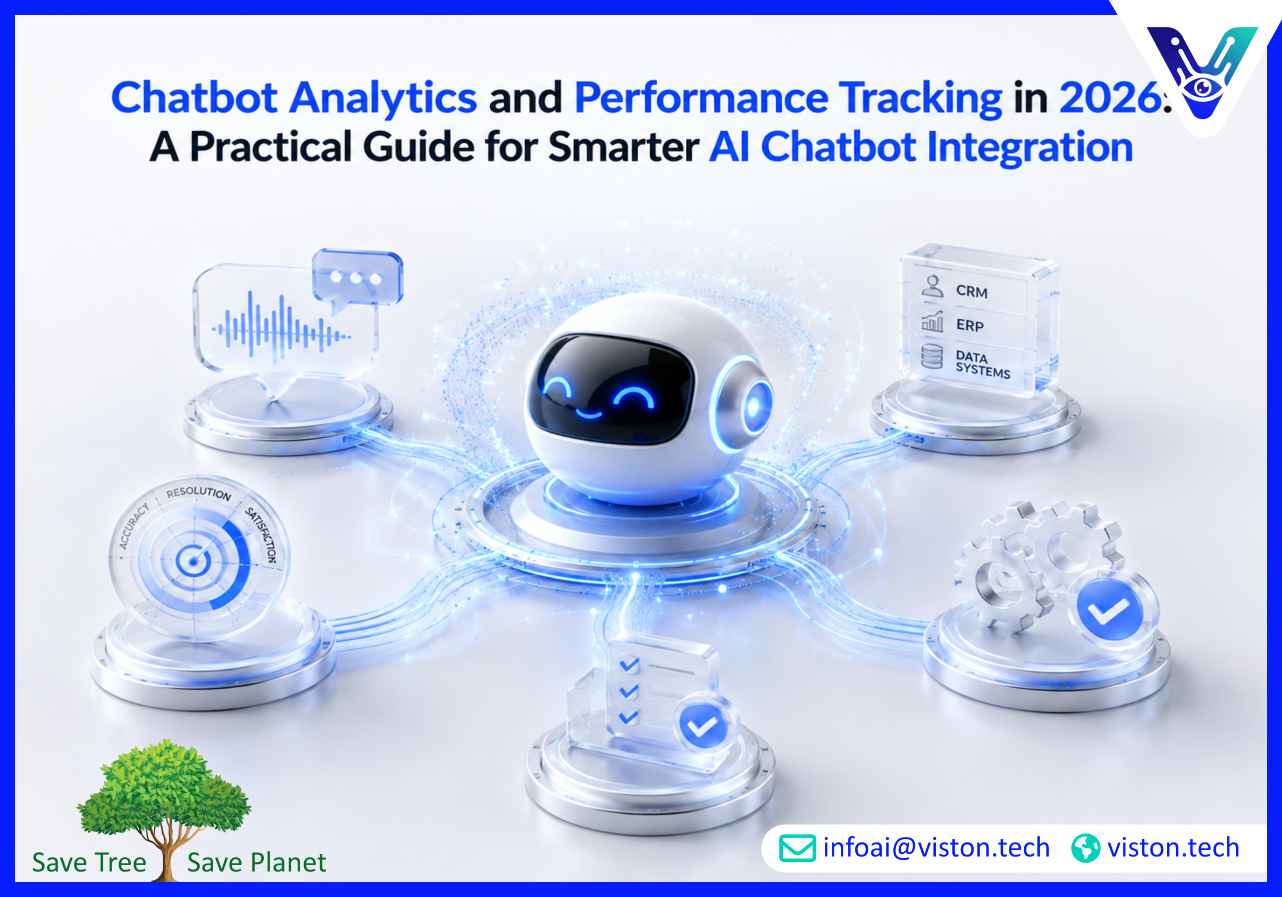
Chatbot analytics and performance tracking help businesses understand whether an AI chatbot is genuinely solving customer, employee, and operational problems. In 2026, the value of AI Chatbot Integration depends not only on automation, but on measurable accuracy, workflow impact, user satisfaction, and continuous improvement.
Chatbot analytics and performance tracking refer to the process of measuring how a chatbot performs across conversations, channels, workflows, integrations, and business outcomes. It goes beyond counting the number of chats handled. A serious analytics framework shows whether users are getting accurate answers, whether tasks are completed successfully, where conversations fail, and how chatbot activity connects to revenue, support efficiency, productivity, and customer experience.
For modern businesses, chatbot performance cannot be judged by surface-level automation alone. A chatbot may respond quickly but still provide incomplete answers. It may reduce human-agent contact but frustrate users who need escalation. It may collect leads but fail to sync them correctly with the CRM. This is why chatbot analytics must measure both conversational quality and operational performance.
In an integrated chatbot environment, analytics should cover user intent detection, conversation completion, fallback rates, escalation patterns, response accuracy, workflow execution, API reliability, CRM updates, ticket creation, lead routing, customer satisfaction, and compliance-related logs. Microsoft’s Copilot Studio analytics documentation also emphasizes the role of analytics in understanding agent performance and identifying areas for improvement, while Google’s Dialogflow CX analytics guidance highlights the use of analytics to review conversation paths and improve agent performance.
The most useful chatbot analytics systems answer practical business questions:
This makes chatbot analytics especially important for companies using AI Chatbot Integration across customer support, sales, onboarding, internal helpdesks, e-commerce, finance, healthcare, logistics, real estate, and enterprise operations.
In 2026, buyers expect AI chatbots to do more than answer FAQs. They expect integrated conversational systems that can retrieve account data, update records, trigger workflows, qualify leads, support multilingual users, escalate complex issues, and operate securely across multiple channels. As chatbot responsibilities increase, performance tracking becomes a business control system rather than a reporting add-on.
A chatbot that is not monitored can silently create problems. It may misunderstand high-value buyer intent, route urgent requests incorrectly, provide outdated policy information, duplicate CRM records, mishandle handoffs, or fail during peak traffic. These issues often remain invisible if teams only track chat volume or response time.
Performance tracking helps businesses detect these risks early. When analytics show rising fallback rates, repeated unresolved questions, delayed API responses, or poor satisfaction after chatbot interactions, teams can improve the bot before the issue affects revenue or customer trust.
Many businesses used to focus heavily on deflection rate, meaning how often users avoided human support. That metric is still useful, but it can be misleading when viewed alone. A user who gives up without speaking to an agent is not the same as a user whose issue was solved.
In 2026, stronger chatbot measurement focuses on resolution quality. Zendesk defines AI resolution rate as the percentage of customer or employee issues an AI system fully resolves end-to-end without human intervention, where the answer is accurate and any required action is completed.
This shift matters because business leaders need to know whether AI is producing real outcomes. A high deflection rate with poor customer satisfaction may indicate avoidance, not success. A moderate automation rate with high confirmed resolution may deliver better long-term value.
Once a chatbot is connected to systems such as Salesforce, HubSpot, Microsoft Dynamics, SAP, Oracle, ServiceNow, Shopify, Magento, Slack, Teams, WhatsApp, or internal databases, tracking must include both conversation performance and system performance.
Business teams need metrics such as completed orders, qualified leads, resolved tickets, booked appointments, claim updates, onboarding tasks completed, or employee requests handled. Technical teams need API latency, uptime, error rates, authentication failures, failed data writes, webhook delays, and integration health alerts.
Without this combined view, teams may misread performance. For example, users may understand the chatbot, but an API failure may prevent the bot from checking inventory or creating a support ticket. Good analytics separates language issues from workflow, data, and integration issues.
The right chatbot analytics framework depends on business goals, but most AI Chatbot Integration projects need a balanced set of conversational, operational, technical, and commercial metrics.
Conversation volume shows how often the chatbot is used. Active users reveal adoption across customers, employees, partners, or internal teams. These metrics help teams understand demand, peak usage periods, and channel preference. However, volume alone does not prove value. High usage with low completion may indicate confusion or poor design.
Intent recognition measures how well the chatbot understands what users want. Fallback rate shows how often the chatbot cannot classify a request or provide a confident answer. A high fallback rate usually points to gaps in training data, missing knowledge base content, unclear conversation design, or unsupported use cases.
Tracking fallbacks by topic is especially valuable. If users repeatedly ask about billing, refunds, delivery, pricing, login issues, claims, or HR policies and the chatbot fails, the business has a clear optimization opportunity.
Completion rate measures whether users successfully finish a task. This may include booking a meeting, submitting a ticket, tracking an order, resetting a password, qualifying a lead, updating account details, or accessing a document. For integrated chatbots, completion rate is often more meaningful than engagement time because the goal is to resolve the task efficiently.
Not every conversation should be automated. Complex, sensitive, regulated, or high-value conversations may require a human agent. Analytics should track when escalations happen, why they happen, whether the context is passed properly, and whether the user receives timely support.
A strong handoff includes conversation history, detected intent, user details, sentiment, priority, and relevant system records. Poor handoffs force users to repeat themselves and reduce trust in both the chatbot and the support team.
Resolution rate measures whether the chatbot actually solves the issue. Satisfaction metrics, such as CSAT, post-chat feedback, thumbs up/down ratings, or sentiment trends, show how users feel about the experience. These metrics should be reviewed together. A chatbot can complete a task but still feel frustrating if the flow is too long, unclear, or impersonal.
AI chatbots depend on approved knowledge sources, policies, product information, and system data. Analytics should help identify inaccurate answers, outdated content, hallucination risk, repeated clarification requests, and knowledge gaps. For regulated industries, accuracy tracking should also include audit logs, approved response boundaries, and escalation rules for sensitive topics.
For businesses investing in AI Chatbot Integration, workflow metrics are essential. These may include CRM records updated, tickets created, orders modified, invoices retrieved, appointments scheduled, returns initiated, employee requests completed, or approvals routed.
Technical performance should also be tracked. API failures, slow data retrieval, authentication errors, duplicate records, webhook failures, and sync delays can directly affect user experience. Viston AI’s AI Chatbot Integration service page describes enterprise chatbot integration around connected conversational systems, real-time data synchronization, automated workflows, and CRM/ERP connectivity, which are exactly the areas where performance tracking becomes business-critical.
Executives and procurement teams need analytics that connect chatbot performance to commercial outcomes. Depending on the use case, this may include qualified lead rate, conversion rate, average handling time reduction, support ticket reduction, self-service completion, employee time saved, faster onboarding, lower operational backlog, improved data quality, or better customer retention signals.
The key is to avoid vague ROI claims. Businesses should define baseline metrics before implementation, track changes after launch, and separate chatbot impact from other operational changes.
A reliable framework starts before the chatbot goes live. Businesses should define success metrics during the AI Chatbot Integration planning stage, not after deployment. Otherwise, teams may collect data that looks impressive but does not answer meaningful business questions.
Every chatbot should have clear objectives. A support chatbot may aim to resolve common service questions, reduce repetitive tickets, and improve response time. A sales chatbot may qualify leads, recommend products, and book consultations. An internal workflow bot may help employees access policies, submit requests, or complete onboarding steps.
Once the objective is clear, the analytics model should map each goal to measurable indicators. For example, “improve support efficiency” may translate into confirmed resolution rate, reduced repeat contact, faster first response, lower backlog, and better CSAT after chatbot interaction.
Chatbot analytics should be session-based and journey-based. A single message does not reveal whether the user achieved the goal. Businesses need to see how users move from first question to intent detection, answer delivery, workflow execution, handoff, feedback, and final outcome.
This journey view helps teams identify where users drop off. They may abandon the chat after a confusing menu, after authentication, after a failed integration call, or after receiving a generic answer. Each drop-off point requires a different fix.
The strongest analytics come from connecting chatbot data with CRM, helpdesk, ERP, BI, marketing automation, product analytics, and data warehouse platforms. This allows teams to compare chatbot interactions with business results.
For example, a chatbot may generate many leads, but CRM data may show that only a small percentage are qualified. A support bot may reduce ticket volume, but helpdesk analytics may show higher repeat contacts for certain issues. An e-commerce bot may answer product questions, but analytics may reveal that recommendations do not improve conversion.
Different stakeholders need different views. Executives need business impact and ROI indicators. Customer support leaders need resolution, escalation, CSAT, and backlog trends. Marketing teams need lead quality and conversion performance. Technical teams need uptime, latency, API errors, and integration reliability. Compliance teams need audit logs, data handling controls, and escalation records.
A well-designed dashboard does not overload everyone with the same data. It gives each team the metrics required to improve its part of the chatbot experience.
Chatbot performance tracking only creates value when insights lead to action. Businesses should review analytics regularly, prioritize the highest-impact issues, update knowledge sources, improve prompts and conversation flows, retrain intent models, refine integrations, and test changes before scaling.
Microsoft’s guidance on measuring agent performance highlights engagement, outcomes, and user feedback as inputs for optimizing agent performance and continuous improvement.
Many chatbot projects underperform because analytics are treated as an afterthought. The chatbot may be launched successfully, but the business lacks the visibility needed to improve it.
High usage can be positive, but it does not prove that users are satisfied or tasks are completed. Businesses should combine volume with completion, resolution, escalation, and satisfaction metrics.
Keeping users inside the chatbot is not always a win. If users are blocked from human help or receive incomplete answers, containment damages experience. Escalation should be measured as part of quality, not automatically treated as failure.
When a chatbot depends on external systems, technical failures can look like conversation failures. Analytics should clearly identify whether a problem came from intent recognition, missing content, API failure, permission issues, or backend data quality.
A chatbot may perform well on a website but poorly on WhatsApp, mobile app, Slack, or voice. It may work for existing customers but fail for prospects. It may perform well in English but struggle with multilingual queries. Segmentation helps businesses improve the experience where it matters most.
Chatbot analytics involve multiple teams. Product, support, marketing, data, IT, compliance, and operations may all depend on the same system. Without clear ownership, insights are noticed but not acted on. Businesses should assign responsibility for reviewing dashboards, approving improvements, updating content, and monitoring technical reliability.
Viston AI is relevant to chatbot analytics and performance tracking because its AI Chatbot Integration service focuses on connecting conversational AI with business systems, workflows, and enterprise data environments. Its service page describes integration with CRM, ERP, service platforms, multi-channel systems, and backend workflows, along with business intelligence insights from conversational data, user intents, interaction patterns, and business outcomes.
For businesses that want chatbot analytics to reflect real performance, this integration-first approach is important. A standalone chatbot can show conversation counts and basic engagement, but an integrated chatbot can connect those interactions to tickets resolved, leads created, orders updated, workflows completed, and customer records improved.
Viston AI can support organizations that need practical visibility across both conversational quality and operational execution. This includes tracking completion rates, workflow automation efficiency, escalation patterns, CRM updates, integration health, user feedback, and business outcome correlations. Its published service information also references monitoring, optimization, KPI assessment, retraining schedules, performance metrics, error rates, and system health tracking for long-term reliability.
For companies in global B2B markets, this makes Viston AI a suitable specialist for AI Chatbot Integration projects where analytics, performance tracking, security, scalability, and measurable business value need to be planned from the beginning rather than added after launch.
Chatbot analytics is the measurement of chatbot conversations, user behavior, task completion, resolution quality, escalation patterns, satisfaction, and business outcomes. It helps businesses understand whether a chatbot is useful, accurate, reliable, and aligned with operational goals.
The most useful metrics include intent recognition, fallback rate, completion rate, resolution rate, escalation rate, response accuracy, CSAT, workflow success, API reliability, and business impact. The best metric set depends on whether the chatbot supports customer service, sales, internal operations, or industry-specific workflows.
AI Chatbot Integration connects chatbot activity with systems such as CRM, ERP, helpdesk, marketing automation, and analytics platforms. This allows businesses to track not only conversations, but also completed workflows, updated records, resolved tickets, qualified leads, and real operational outcomes.
No. Deflection rate can show how often users avoid human support, but it does not always prove that their issue was solved. Businesses should also track confirmed resolution, customer satisfaction, repeat contact, escalation quality, and task completion.
High-volume chatbots should be reviewed weekly, with critical technical metrics monitored continuously. Strategic reviews can happen monthly or quarterly to assess trends, ROI, content gaps, integration performance, and improvement priorities.
Yes, where the requirement involves AI Chatbot Integration. Viston AI’s chatbot integration capabilities align with performance tracking because integrated systems can connect conversations with workflows, CRM activity, business intelligence, monitoring, and measurable outcomes.
Chatbot analytics and performance tracking are essential for businesses that want AI chatbots to deliver measurable value in 2026. The goal is not simply to automate conversations, but to understand whether users are getting accurate answers, workflows are completed, integrations are reliable, and business outcomes are improving. With the right AI Chatbot Integration strategy, companies can connect chatbot performance to support efficiency, sales quality, operational productivity, and customer experience. Viston AI’s integration-focused capabilities make it relevant for organizations that need connected, trackable, and continuously optimized chatbot systems.
