
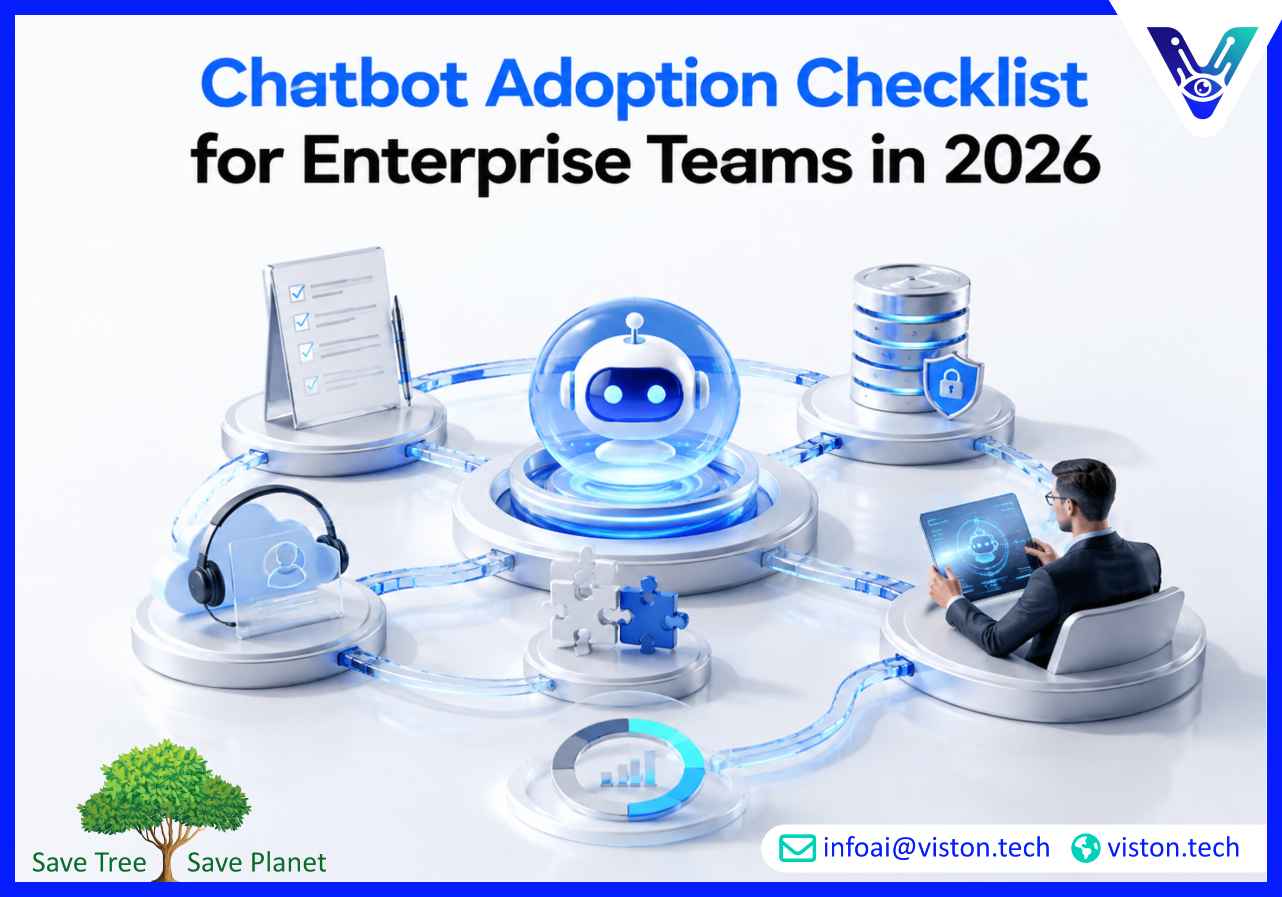
A chatbot adoption checklist helps enterprise teams move from AI interest to practical deployment without creating security gaps, workflow confusion, or poor user adoption. In 2026, successful Enterprise AI Chatbots need clear business ownership, reliable data access, strong governance, integration planning, and measurable outcomes from the start.
Enterprise chatbot adoption is not just the act of launching a conversational interface on a website, employee portal, CRM, or support channel. It is the process of preparing people, systems, data, workflows, governance, and measurement so the chatbot becomes a useful part of business operations.
For enterprise teams, the checklist matters because chatbot projects often fail when they begin with technology before business readiness. A chatbot may have advanced natural language capabilities, but it will not deliver value if it answers from outdated documents, cannot connect to core systems, lacks escalation rules, or is introduced to users without clear expectations.
A strong adoption checklist gives business leaders, IT teams, security teams, operations managers, support leaders, and procurement stakeholders a shared framework. It helps them decide whether the organization is ready to deploy an AI chatbot, which use cases should come first, what risks must be controlled, and how success will be measured after launch.
Enterprise AI Chatbots have moved beyond simple FAQ automation. Modern teams expect chatbots to retrieve internal knowledge, automate support workflows, qualify leads, guide employees, assist customers, update records, trigger tickets, summarize interactions, and work across channels such as websites, mobile apps, WhatsApp, Slack, Microsoft Teams, helpdesk platforms, and CRM portals.
This higher capability creates higher responsibility. Chatbots now interact with customer data, internal policies, pricing information, product documentation, HR content, financial workflows, and regulated business processes. Enterprise adoption therefore requires more than a pilot. It needs controlled access, validated knowledge sources, human oversight, auditability, change management, and continuous optimization.
Before selecting or deploying a chatbot, enterprise teams should confirm whether the business problem is clear enough for automation. A chatbot should not be adopted because competitors are using AI or because a department wants a quick innovation project. It should support a defined operational need.
The first checklist item is use case clarity. Teams should identify the exact problem the chatbot will solve, the user group it will serve, and the outcome it must support. Common enterprise use cases include customer support automation, internal knowledge search, lead qualification, employee helpdesk support, onboarding assistance, order status updates, claims handling, appointment scheduling, policy guidance, and product recommendation support.
Each use case should have a business owner. Without ownership, chatbot decisions become fragmented across IT, marketing, support, and operations. A clear owner helps define priorities, approve workflows, review performance, and ensure the chatbot stays aligned with business goals.
Enterprise teams should confirm whether there is enough recurring demand to justify chatbot adoption. High-volume repetitive questions are usually strong candidates. Complex, sensitive, or judgment-heavy requests may still need human support, even if a chatbot can assist with intake, triage, or knowledge retrieval.
Useful readiness signals include repeated support tickets, long response times, overloaded service teams, frequent internal policy questions, poor knowledge base usage, high lead response delays, or inconsistent customer answers across channels.
A chatbot is only as reliable as the content and systems it can access. Before adoption, teams should review whether their knowledge base, product documentation, service policies, FAQs, process guides, and internal documents are accurate, current, structured, and approved.
If documents are outdated or inconsistent, the chatbot may produce confusing answers. Enterprises should assign content owners, remove duplicate guidance, define approved sources, and create a review cycle before connecting the chatbot to business knowledge.
Many enterprise chatbot projects depend on integrations. A support chatbot may need access to a ticketing platform. A sales chatbot may need CRM integration. An ecommerce chatbot may need inventory, order, and payment status data. An employee assistant may need HRIS, ITSM, or document management access.
The checklist should define which systems the chatbot needs, what data it can read or write, which APIs are available, what authentication is required, and where human approval is needed before an action is completed.
Once readiness is confirmed, the next step is implementation planning. This is where the chatbot moves from concept to controlled deployment. Enterprise teams should treat implementation as a cross-functional project involving business users, IT, data, security, compliance, customer experience, and operations.
Before development, teams should map the user journey. This includes entry points, welcome prompts, common intents, required information, system lookups, fallback paths, escalation points, and completion messages. The goal is to design conversations that feel useful, not forced.
Enterprise users often need direct answers and clear next steps. A chatbot should not ask unnecessary questions, hide support options, or trap users in loops. If the chatbot cannot resolve a request confidently, it should hand over to a human with full context.
Enterprise AI Chatbots should follow role-based access principles. Not every user should see the same information or trigger the same actions. A customer may be allowed to check order status, while an employee may access internal policy content, and a manager may access workflow approvals.
Access control should include user authentication, permission boundaries, secure session handling, data masking, audit logs, and limits on what the chatbot can disclose or update. These controls are especially important when the chatbot handles personal data, financial data, health information, contracts, confidential business records, or regulated workflows.
Traditional application security is still necessary, but AI chatbots introduce additional risks. Enterprise teams should evaluate prompt injection, sensitive information disclosure, unsafe tool use, insecure plugin or API behavior, overreliance on generated answers, and inaccurate responses presented with confidence.
Practical controls include retrieval restrictions, approved knowledge sources, output validation, human review for high-risk actions, clear confidence thresholds, content filtering, logging, abuse detection, red-team testing, and regular security reviews. The chatbot should be designed to assist users without exposing confidential data or acting beyond its authorized scope.
A pilot helps teams validate adoption before enterprise-wide rollout. The first version should focus on a narrow, high-value use case rather than trying to automate every department at once. A good pilot includes real users, controlled data access, defined success metrics, support team feedback, and clear improvement cycles.
During the pilot, teams should review failed conversations, fallback queries, user satisfaction, unresolved requests, escalation quality, and integration errors. These findings help improve the chatbot before broader deployment.
After deployment, chatbot adoption depends on governance and continuous improvement. Enterprise teams should not treat launch day as the end of the project. Chatbots need monitoring, training, testing, content updates, and performance review as business needs change.
Every enterprise chatbot should have clear accountability. Governance roles may include a business owner, technical owner, content owner, security reviewer, compliance stakeholder, analytics lead, and support escalation manager. These roles help prevent unclear decision-making when the chatbot needs updates, access changes, risk review, or workflow expansion.
Governance should also define what the chatbot is allowed to do. Some chatbots may only answer questions. Others may create tickets, update CRM records, book appointments, process requests, or trigger automated workflows. The more action the chatbot can take, the stronger the oversight should be.
Enterprise teams should track chatbot performance through outcomes, not just conversation volume. Useful KPIs include user adoption rate, conversation completion rate, self-service resolution rate, fallback rate, escalation rate, customer satisfaction, average response time, ticket deflection, lead qualification rate, workflow success rate, and cost per resolved interaction.
For internal chatbots, teams may also track employee usage, time saved, knowledge search success, repeated query reduction, and helpdesk workload reduction. For customer-facing chatbots, resolution quality, handover experience, conversion influence, and satisfaction matter more than raw usage alone.
Adoption improves when users understand what the chatbot can and cannot do. Enterprise teams should introduce the chatbot with clear messaging, examples of supported tasks, escalation options, and guidance for effective use. Internal teams should know how to review bot performance, report issues, and suggest new intents.
Change management is especially important when the chatbot affects service teams. Human agents should not see the chatbot only as a replacement tool. It should reduce repetitive work, improve handover context, and allow employees to focus on more complex requests.
Chatbot adoption should include ongoing optimization. Teams should regularly review analytics, failed intents, user feedback, support transcripts, new business policies, product updates, seasonal demand, and integration performance. This helps the chatbot stay useful as the enterprise changes.
A mature improvement cycle includes monthly performance reviews, quarterly governance checks, retraining plans, content audits, security testing, and roadmap updates for new use cases. This keeps the chatbot from becoming outdated after launch.
Viston AI is relevant to a chatbot adoption checklist because its Enterprise AI Chatbots service focuses on building conversational AI for enterprise complexity, not only basic FAQ automation. Its service offering includes enterprise chatbot development, natural language understanding, multilingual support, voice-enabled assistants, integration with business systems, workflow automation, and AI strategy capabilities.
For enterprise teams, this matters because adoption requires more than a chatbot interface. Businesses need help identifying practical use cases, connecting the chatbot to CRM, knowledge bases, transactional systems, and internal workflows, while maintaining contextual accuracy, security, escalation logic, and measurable performance. Viston AI’s positioning around enterprise-grade conversational AI aligns with adoption needs such as omnichannel deployment, real-time knowledge access, workflow automation, business system integration, and governance-focused delivery.
Organizations across industries can use this type of support when they want chatbot adoption to improve service delivery, customer experience, employee productivity, lead handling, and operational efficiency. Instead of launching a disconnected tool, enterprise teams can work toward a chatbot that fits their systems, data environment, compliance expectations, user journeys, and long-term automation roadmap.
An enterprise chatbot adoption checklist should include use case definition, business ownership, knowledge readiness, integration planning, security controls, user journey mapping, pilot testing, escalation rules, governance roles, performance KPIs, and continuous improvement processes.
Teams are usually ready when they have repeated support or operational questions, approved knowledge sources, clear business outcomes, available system integrations, defined data access rules, and internal owners who can manage adoption after launch.
Common reasons include unclear use cases, poor knowledge quality, weak integration planning, limited security review, no human escalation path, lack of user training, unrealistic expectations, and failure to measure performance after deployment.
Most enterprise teams should start with one focused use case that has clear value and manageable risk. After the chatbot proves useful, the organization can expand into additional departments, channels, languages, or workflow automations.
Important KPIs include adoption rate, completion rate, resolution rate, fallback rate, escalation rate, customer satisfaction, workflow success rate, ticket deflection, lead qualification rate, and integration accuracy.
Viston AI’s Enterprise AI Chatbots service is aligned with adoption planning because it supports chatbot development, business system integration, multilingual conversational experiences, workflow automation, and enterprise-focused AI implementation.
A chatbot adoption checklist for enterprise teams helps businesses deploy Enterprise AI Chatbots with greater clarity, control, and long-term value. In 2026, adoption success depends on practical use cases, trusted data, secure integrations, clear ownership, user readiness, governance, and measurable outcomes. Enterprises should avoid treating chatbots as isolated tools and instead plan them as part of customer experience, employee productivity, and operational automation. With the right checklist and specialist support from providers such as Viston AI, businesses can turn chatbot adoption into a scalable and reliable enterprise capability.
