
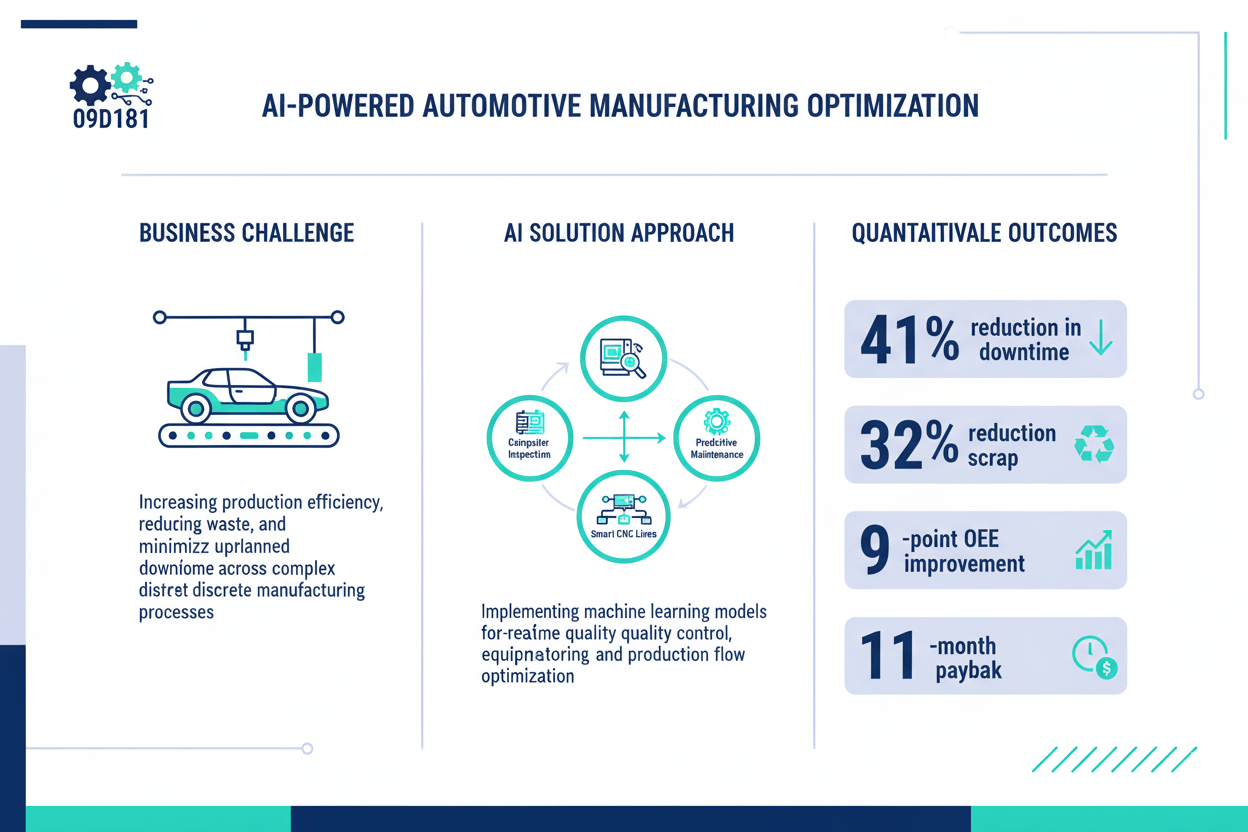
We partnered with Viston to deploy predictive maintenance and vision-based quality inspection to reduce unplanned downtime and minimize scrap across two automotive component manufacturing plants.
Business Challenge
Unplanned downtime on CNC production lines and inconsistent defect rates during final assembly inspection.
Siloed Operational Technology (OT) and Information Technology (IT) data, combined with strict works council requirements and GDPR compliance constraints.
Our Approach and Solution
Connected PLC/SCADA data and camera feeds to build AI-powered failure prediction models and deploy an edge-based computer vision system for automated defect detection.
Implemented unified monitoring, model governance, and change control processes with human acceptance gates before production deployment.
AI Applications and Benefits Delivered
Predictive Maintenance
Remaining Useful Life (RUL) prediction for CNC spindles and bearings to reduce unexpected equipment failures.
AI-Powered Quality Inspection
Computer vision using YOLOv8 to detect surface defects, missing fasteners, and component misalignment during final assembly.
Prescriptive Maintenance Scheduling
AI-driven maintenance recommendations integrated with SAP Plant Maintenance (SAP PM) for optimized service scheduling.
Cost of Implementation
EUR 670,000 for the complete end-to-end implementation, including edge hardware deployment and MLOps infrastructure.
Time to Implement
6 months to achieve steady-state production across two manufacturing plants.
Tools and Technologies Used
- AWS IoT Greengrass
- Apache Kafka
- Databricks
- Delta Lake
- XGBoost
- CatBoost
- YOLOv8
- OpenCV
- NVIDIA Jetson (Edge Devices)
- Prometheus
- Grafana
- Apache Airflow
- MLflow
- Great Expectations
- SAP PM Connector
Quantitative Outcomes
- 41% reduction in unplanned downtime on targeted assets.
- 32% reduction in scrap across inspected SKUs.
- 9 percentage point improvement in Overall Equipment Effectiveness (OEE).
- Full project payback achieved within 11 months.
Key Performance Indicators (KPIs) Tracked
- Mean Time Between Failures (MTBF)
- Mean Time to Repair (MTTR)
- Defect Rate (PPM)
- Overall Equipment Effectiveness (OEE)
- Model Precision and Recall
- False Reject Rate
- Maintenance Labor Hours
Pre- and Post-Implementation Metrics
- Downtime (Targeted Lines): 62 hrs/month → 36 hrs/month
- Scrap Rate (Target SKUs): 2,900 PPM → 1,970 PPM
- Inspection Throughput: 420 units/hour → 560 units/hour
Stakeholder Quotes
Plant Manager
“We finally predict failures before weekend shifts. The maintenance plan is proactive, not reactive.”
Head of Quality
“Vision AI caught defects our manual spot-checks missed.”
Regulatory and Compliance Considerations
- GDPR compliance
- Data minimization practices
- On-premises edge inference
- No biometric data processing
- Works council approvals
- TISAX-aligned security controls
- EU data residency compliance
Lessons Learned and Next Steps
Lessons Learned
An edge-first deployment strategy successfully addressed network limitations, reduced latency, and met data sovereignty requirements.
Next Steps
Expand the computer vision system to include torque verification and implement anomaly detection for assembly torque trace analysis.
Attribution
Name and Designation: Confidential, Plant Manager
Company: Confidential Tier-1 Automotive Supplier, Germany
