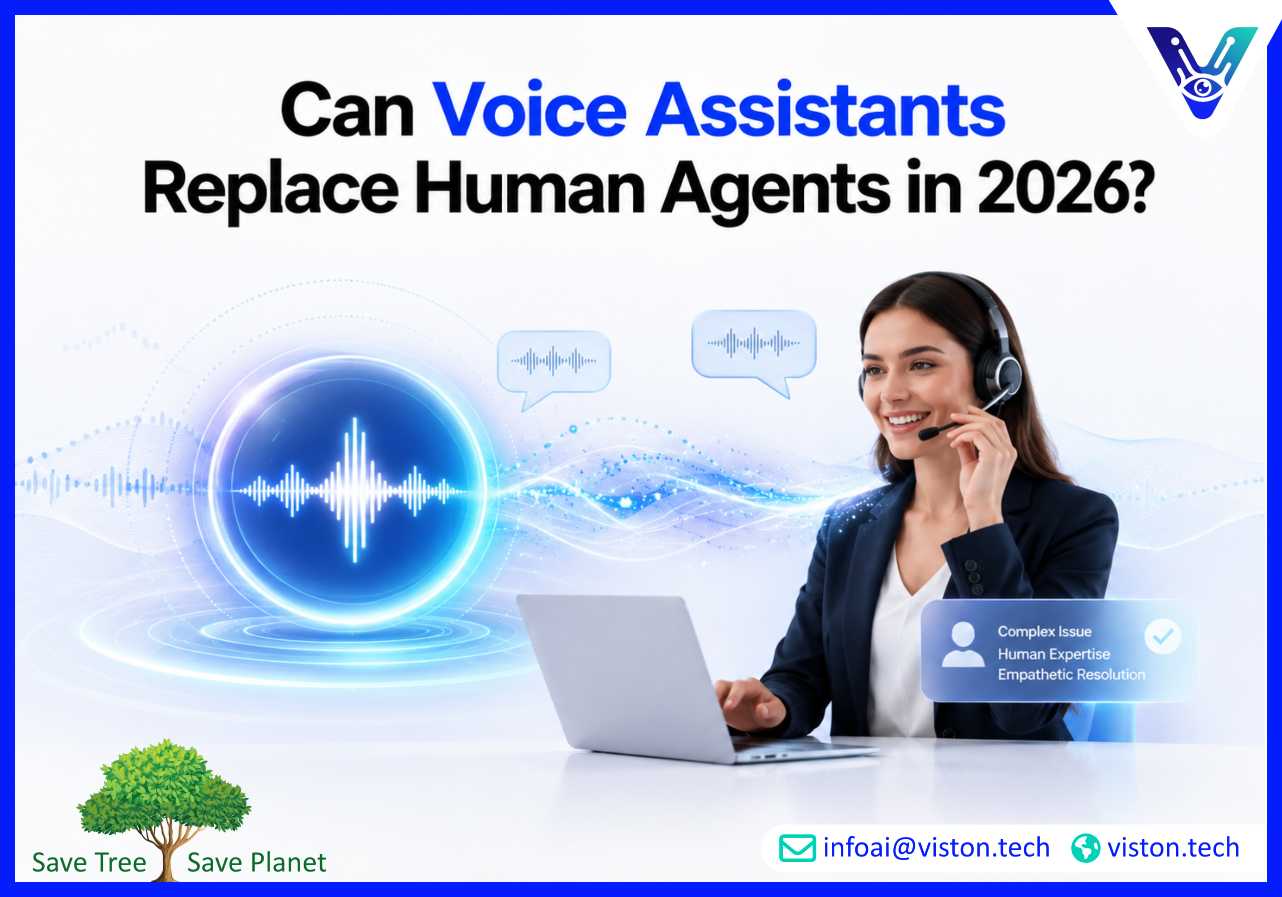
Can Voice Assistants Replace Human Agents in 2026?
Can voice assistants replace human agents? For many routine interactions, they already can. However, complete replacement is rarely the right business objective. The strongest service models use voice-enabled assistants for speed, scale, and consistency while preserving human expertise for complex, sensitive, or high-value conversations.
What Replacing Human Agents Actually Means
Replacing a human agent does not necessarily mean removing people from customer service, sales, or internal support. In practical business terms, it means allowing a voice assistant to complete specific tasks that previously required an employee.A modern voice-enabled assistant can listen to spoken requests, identify intent, retrieve information, ask follow-up questions, perform approved actions, and respond through natural-sounding speech. When connected to business systems, it can also update customer records, create tickets, schedule appointments, check order status, qualify inquiries, or route calls.This is significantly more capable than a traditional interactive voice response system. Conventional IVR usually requires callers to navigate fixed menus. A conversational voice assistant allows users to explain what they need in their own words and can guide them through a multi-step interaction.In 2026, contact centres are increasingly using AI agents to handle high-volume requests while human agents concentrate on interactions requiring judgment, empathy, negotiation, or specialist knowledge.
Automation should be measured by outcomes
A voice assistant should not be considered successful simply because it answers calls. It must complete useful work accurately and safely.Relevant performance indicators include:
First-contact resolution rate
Task completion rate
Call containment and appropriate escalation rates
Average response and handling time
Customer satisfaction
Intent recognition accuracy
Workflow and system-update success
Repeat-contact rate
A high automation rate can be misleading if customers receive incomplete answers or struggle to reach a person. The goal should be effective resolution rather than maximum containment.
Which Human-Agent Tasks Can Voice Assistants Replace?
Voice assistants are most effective when interactions are frequent, structured, predictable, and supported by reliable data. These tasks often consume substantial employee time without requiring deep judgment.
Answering routine questions
A voice assistant can answer common questions about opening hours, account processes, product availability, delivery times, service coverage, policies, and appointment requirements. Using an approved knowledge base helps keep responses consistent across calls.This is valuable for organisations receiving the same questions repeatedly. Customers receive immediate answers, while employees spend less time repeating basic information.
Handling simple transactions
Voice-enabled assistants can complete structured transactions when they are connected securely to the required systems. Common examples include:
Booking, changing, or cancelling appointments
Checking order or delivery status
Creating support tickets
Updating basic contact details
Confirming reservations
Sending payment or document links
Resetting passwords through approved verification steps
These processes work well when the rules are clear and exceptions are limited. The assistant should confirm important information before completing an action and provide a clear summary afterward.
Qualifying and routing calls
Voice AI can ask preliminary questions, collect structured details, identify the purpose of a call, and route the customer to the appropriate team. A sales assistant might capture company size, requirements, timeframe, and contact information before scheduling a consultation.A support assistant can identify the product involved, collect an account number, classify the issue, and pass the conversation to a specialist. This reduces repetitive discovery work and gives the human agent useful context before the handover.
Providing after-hours and overflow coverage
Voice assistants can answer calls outside normal working hours and support organisations during seasonal peaks, campaigns, service incidents, or unexpected demand. Unlike human staffing, automated capacity can often be expanded without recruiting and training a temporary team.This does not mean every after-hours issue should be resolved automatically. The assistant should recognise emergencies, high-risk situations, and requests that require an authorised person.
Supporting employees internally
Voice-enabled assistants are also useful for internal service desks. Employees can ask about policies, submit IT requests, retrieve operational instructions, or initiate approved workflows without opening a portal or waiting for an internal support representative.In warehouses, healthcare settings, manufacturing environments, and field operations, hands-free access can be particularly useful when employees cannot easily use a keyboard or screen.
Where Human Agents Remain Essential
Voice assistants can replace tasks more reliably than they can replace complete roles. Human agents remain important when conversations involve emotional intelligence, uncertainty, accountability, or unusual circumstances.
Complex or ambiguous problems
Customers do not always describe issues clearly. They may provide incomplete information, combine several problems, change their objective during the conversation, or use terminology the system does not recognise.A well-designed voice assistant can ask clarifying questions, but it should not continue indefinitely when confidence is low. Human agents are better placed to investigate unclear situations, connect information from multiple sources, and adapt their approach dynamically.
Complaints and emotionally sensitive conversations
Customers dealing with financial loss, service failure, bereavement, medical concerns, urgent disruption, or repeated frustration often need more than a correct scripted response. They may need reassurance, discretion, negotiation, and evidence that someone understands the impact of the problem.Synthetic speech may sound natural, but natural delivery is not the same as genuine human judgment. Businesses should define escalation triggers for negative sentiment, repeated objections, vulnerable customers, formal complaints, and cancellation risk.
High-risk and regulated decisions
Voice assistants should not independently make decisions that require professional accountability, legal interpretation, clinical judgment, financial suitability assessment, or approval outside established authority limits.They can gather information, explain approved processes, verify documents, and help users prepare for the next step. Final decisions should remain with qualified employees when regulations, contracts, safety, or significant financial consequences are involved.
Negotiation and relationship management
Complex B2B sales, account retention, supplier discussions, service recovery, and contract negotiations depend heavily on context. Human representatives can interpret hesitation, explore competing priorities, adjust commercial proposals, and build long-term trust.A voice assistant can support these conversations by qualifying opportunities, preparing account information, scheduling meetings, and summarising earlier interactions. It should strengthen the representative’s work rather than attempt to automate the entire relationship.
Unexpected exceptions
Automation performs best inside defined boundaries. Real operations contain exceptions: duplicate records, policy conflicts, unusual requests, system outages, missing data, and customers whose circumstances do not fit the standard process.Human oversight provides a safe path when the normal workflow fails. Without effective escalation, voice automation can trap users in repeated questions and damage trust more quickly than a traditional service delay.
How to Build an Effective Human and Voice AI Service Model
The most practical answer to whether voice assistants can replace human agents is to divide work according to capability and risk. Voice AI should manage suitable interactions, while people retain control of situations requiring expertise or accountability.
Start with narrow, high-volume use cases
Businesses should begin with a defined group of calls rather than trying to automate the entire contact centre. Suitable starting points include appointment booking, order tracking, frequently asked questions, lead capture, ticket creation, and basic account enquiries.Each use case should have clear success criteria, approved information sources, action limits, authentication rules, and escalation conditions.
Design escalation before launch
Human handover should be part of the original conversation design, not added after complaints begin. Customers should be transferred when:
The assistant repeatedly fails to understand the request
The customer asks for a person
Confidence in the answer is below an approved threshold
The issue is sensitive, urgent, or regulated
An integration or workflow fails
The request falls outside the assistant’s authority
The human agent should receive the transcript, detected intent, customer details, verification status, actions already attempted, and relevant records. This prevents the customer from starting again.
Connect the assistant to trusted systems
A disconnected voice bot can provide generic information but cannot resolve many real requests. Effective automation usually requires controlled integration with CRM platforms, helpdesk tools, scheduling systems, order databases, knowledge bases, and workflow applications.Access should follow the principle of least privilege. The assistant should receive only the data and permissions necessary for each task. Sensitive information should be protected through authentication, encryption, retention controls, redaction, logging, and role-based access.
Monitor real conversations continuously
Voice behaviour changes across accents, languages, background noise, devices, and customer groups. Teams should review failed calls, fallback patterns, interruptions, long pauses, incorrect routing, negative feedback, and incomplete workflows.Monitoring should also assess whether the assistant follows policies, uses current knowledge, protects personal information, and escalates at the right moment. A system that worked well at launch can decline as products, policies, and customer expectations change.
Prepare employees for redesigned roles
Voice automation changes the type of work human agents perform. As routine calls decrease, the remaining interactions may be more complex and emotionally demanding. Employees therefore need stronger problem-solving skills, better access to customer context, and clear authority to resolve exceptions.Businesses should involve frontline teams in conversation design and optimisation. Agents understand where customers become confused, which policies create friction, and which interactions should never be fully automated.
How Viston AI Supports Human-Centred Voice Automation
Viston AI provides Voice-Enabled Assistants designed to combine speech recognition, natural language processing, contextual conversation management, speech synthesis, analytics, and enterprise integration. Its service is relevant to businesses that want to automate suitable voice interactions without treating human removal as the sole objective.The company’s published capabilities include multilingual voice experiences, multi-turn conversations, intent classification, sentiment analysis, real-time monitoring, business-system connectivity, and lifecycle management for voice models. These capabilities can support customer service, internal assistance, lead handling, appointment workflows, and other structured voice processes.Viston AI also describes human-in-the-loop intervention points, audit trails, role-based access, compliance guardrails, and performance monitoring within its voice assistant offering. These controls are important when businesses need automation that can recognise its limits and transfer responsibility appropriately.A practical implementation would begin by identifying repeatable call types, mapping the required data and systems, designing safe escalation paths, testing speech performance with real users, and monitoring outcomes after deployment. This approach helps organisations use voice-enabled assistants to improve availability and operational efficiency while retaining human agents where their judgment produces the greatest value.
Frequently Asked Questions
Can voice assistants completely replace call centre agents?
Voice assistants can replace many routine call-handling tasks, but complete replacement is rarely appropriate. Human agents remain necessary for complex problems, sensitive complaints, negotiations, unusual exceptions, and regulated decisions.
Which calls should be automated first?
Businesses should begin with high-volume, low-risk calls that follow clear rules. Examples include appointment scheduling, order tracking, basic FAQs, ticket creation, lead capture, reservation confirmation, and simple account enquiries.
Will customers accept speaking to a voice assistant?
Customers are more likely to accept voice AI when it responds quickly, understands natural speech, completes the requested task, explains what it is doing, and provides easy access to a human. Poorly designed automation creates resistance regardless of how advanced the technology is.
How can a business prevent voice AI from frustrating customers?
Use short prompts, allow natural responses, avoid unnecessary questions, maintain accurate knowledge, confirm important actions, and provide immediate escalation after repeated misunderstanding. Monitoring real conversations is essential for identifying friction.
Are voice assistants suitable for sensitive industries?
They can support sensitive industries when their role is carefully limited and appropriate security, consent, access, audit, and human-review controls are applied. High-impact decisions should remain with authorised professionals.
Can Viston AI build a voice assistant that works with existing systems?
Viston AI positions its Voice-Enabled Assistants around integration with business platforms and custom APIs. The exact architecture should be defined according to the organisation’s systems, workflows, security requirements, languages, and escalation model.
Conclusion
Can voice assistants replace human agents? They can replace a significant share of routine, structured, and repetitive work, but they should not remove human support from situations requiring empathy, judgment, accountability, or flexibility. The strongest 2026 strategy is a hybrid model in which Voice-Enabled Assistants provide immediate service and complete approved workflows while people manage complex and high-value interactions. Viston AI offers relevant voice AI, integration, analytics, multilingual, and governance capabilities for businesses planning this transition. Success depends on automating the right tasks, designing reliable handovers, and measuring genuine resolution rather than automation volume alone.