Can NLP Automate Customer Support? A Business Guide for 2026
Customer expectations continue to rise, while support teams face increasing pressure to handle more inquiries across multiple channels. As a result, many organizations are exploring whether Natural Language Processing (NLP) can automate customer support effectively. In 2026, NLP has become a core technology behind intelligent customer service systems, helping businesses improve response times, reduce operational costs, and deliver more consistent support experiences.
What Is NLP and How Does It Support Customer Service?
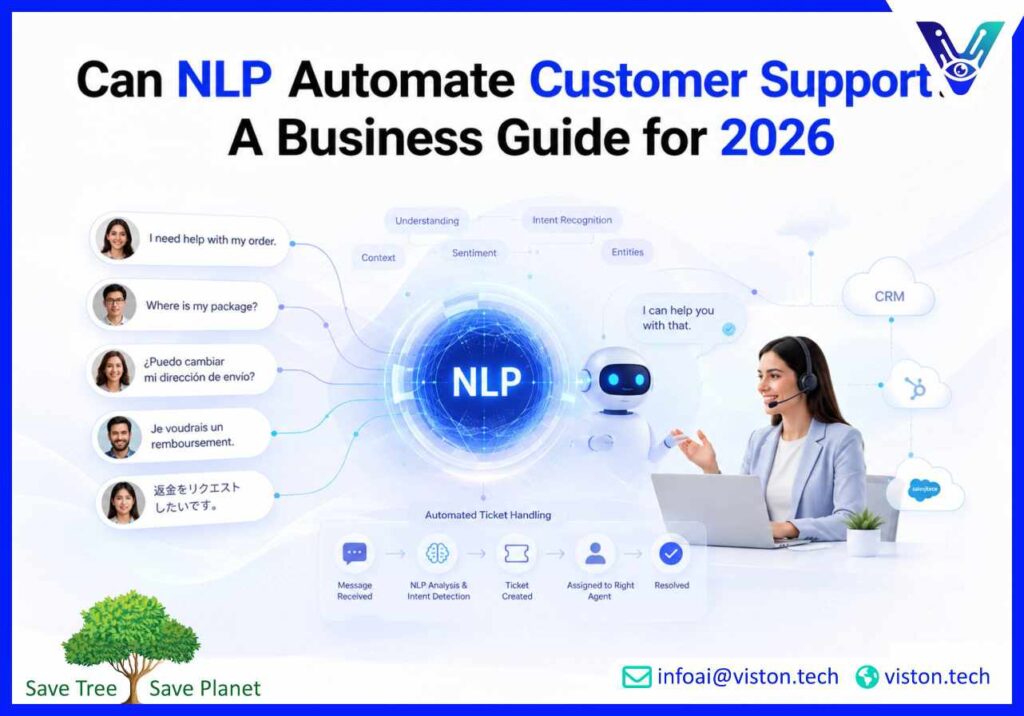
Natural Language Processing (NLP) is a branch of artificial intelligence that enables computers to understand, interpret, process, and generate human language. Unlike traditional rule-based systems, NLP-powered solutions can analyze customer intent, recognize context, identify key information, and provide relevant responses.In customer support environments, NLP allows businesses to automate conversations, classify inquiries, retrieve information, and assist customers without requiring immediate human intervention.Common NLP-powered customer support capabilities include:
AI chatbots and virtual assistants
Automatic ticket classification
Intent detection and routing
Sentiment analysis
Knowledge base search
Email and message categorization
Customer feedback analysis
Multilingual support automation
These capabilities help organizations provide faster and more scalable support while maintaining service quality.
How NLP Automates Customer Support Processes
NLP automation extends far beyond answering basic questions. Modern customer support systems use NLP throughout the customer service workflow.
Automated Customer Conversations
NLP-powered chatbots can understand customer requests and respond in a conversational manner. They can handle common inquiries such as account questions, order tracking, appointment scheduling, password resets, and product information requests.Instead of relying on predefined keywords, modern NLP systems interpret the meaning behind customer messages, allowing for more natural interactions.
Intelligent Ticket Routing
Support teams often receive thousands of inquiries through email, chat, and contact forms. NLP can automatically analyze incoming messages, determine intent, assess urgency, and route tickets to the appropriate department or specialist.This reduces manual triage efforts and improves response efficiency.
Knowledge Base Assistance
NLP enables customers to search knowledge bases using natural language queries rather than exact keywords. This helps users find relevant answers more quickly and reduces dependency on support agents.For example, a customer can ask, “Why can’t I access my account?” rather than searching through multiple support articles manually.
Sentiment Detection
NLP systems can analyze customer language to identify emotions such as frustration, satisfaction, urgency, or dissatisfaction.Support teams can use this information to prioritize critical cases and improve customer experience management.
Benefits of NLP Customer Support Automation in 2026
Organizations implementing NLP-based customer support solutions often achieve measurable operational and customer experience improvements.
Faster Response Times
NLP-powered systems can respond instantly to customer inquiries, eliminating long wait times for routine questions.
Reduced Support Costs
By automating repetitive interactions, businesses can reduce the workload on support teams and allocate resources to more complex customer issues.
24/7 Availability
Unlike human-only support models, NLP-driven systems can provide assistance around the clock, improving service accessibility for customers across different time zones.
Improved Consistency
Automated support systems deliver standardized responses based on approved information, helping maintain service quality and compliance.
Scalability
As customer volumes grow, NLP systems can handle increasing interaction volumes without proportional increases in staffing requirements.
Limitations and Challenges of NLP Customer Support Automation
While NLP can automate many support functions, it is not a complete replacement for human agents.
Complex Customer Issues
Highly technical, sensitive, or emotionally complex cases often require human judgment, empathy, and problem-solving abilities that automation cannot fully replicate.
Contextual Understanding Limitations
Although NLP models have improved significantly, misunderstandings can still occur when conversations involve ambiguity, sarcasm, incomplete information, or highly specialized terminology.
Data Quality Requirements
Successful NLP automation depends on access to accurate business data, well-maintained knowledge bases, and properly structured workflows.
Integration Complexity
Customer support automation often requires integration with CRM systems, helpdesk platforms, customer databases, and communication channels to deliver meaningful results.Without proper integration, chatbot functionality may remain limited.
Best Practices for Successful NLP Customer Support Automation
Businesses that achieve strong results from NLP automation typically follow a structured implementation approach.
Start with High-Volume Use Cases
Identify repetitive customer inquiries that consume significant support resources and automate those processes first.Examples include:
Order status requests
Password recovery
Account information inquiries
Appointment scheduling
Billing questions
Maintain Human Escalation Options
Customers should always have access to human assistance when automated systems cannot resolve an issue effectively.
Continuously Train and Improve Models
NLP systems improve through ongoing analysis of customer interactions, feedback, and performance metrics.
Integrate with Existing Systems
Connecting NLP solutions with CRM, support, and business systems significantly improves accuracy, personalization, and automation effectiveness.
Monitor Key Performance Indicators
Organizations should measure:
First response time
Resolution rates
Customer satisfaction scores
Ticket reduction percentages
Escalation rates
Cost savings
Automation success rates
How Viston AI Helps Businesses Automate Customer Support with NLP
For organizations seeking to improve customer service efficiency, Viston AI provides Natural Language Processing Solutions designed to support intelligent automation, conversational AI, and customer engagement workflows.Effective customer support automation requires more than deploying a chatbot. Successful implementations often involve intent recognition, language understanding, workflow automation, system integrations, knowledge management, analytics, and ongoing optimization. Viston AI focuses on helping businesses connect NLP capabilities with real operational requirements to improve service delivery and customer experiences.Its Natural Language Processing Solutions support organizations looking to automate customer inquiries, streamline support operations, enhance self-service capabilities, and improve responsiveness across digital communication channels. By combining NLP technologies with business-focused implementation strategies, companies can create scalable customer support environments that balance automation with human expertise where needed.
Frequently Asked Questions
Can NLP completely replace customer support agents?
No. NLP can automate many routine interactions, but complex, sensitive, or highly specialized issues still benefit from human expertise and decision-making.
What customer support tasks can NLP automate?
NLP can automate chat conversations, ticket classification, routing, knowledge base searches, customer feedback analysis, sentiment detection, and common service requests.
Is NLP customer support suitable for small businesses?
Yes. Many small and medium-sized businesses use NLP-powered chatbots and automation tools to improve support efficiency without significantly increasing staffing costs.
How accurate are modern NLP customer support systems?
Accuracy depends on training data quality, implementation design, integrations, and continuous optimization. Modern NLP systems can achieve high performance for well-defined support workflows.
Can Viston AI help businesses automate customer support using NLP?
Yes. Viston AI provides Natural Language Processing Solutions that support customer service automation, conversational AI implementation, workflow integration, and support process optimization.
Conclusion
So, can NLP automate customer support? The answer is yes—particularly for repetitive, high-volume, and structured customer interactions. In 2026, NLP has become a powerful technology for improving support efficiency, reducing operational costs, enhancing self-service experiences, and providing scalable customer assistance. However, the most successful customer support strategies combine automation with human expertise to ensure complex issues receive appropriate attention. Businesses investing in Natural Language Processing Solutions can create more responsive and efficient support environments while maintaining high customer satisfaction. For organizations looking to implement practical NLP-driven automation, Viston AI offers specialized expertise in developing business-focused customer support solutions.