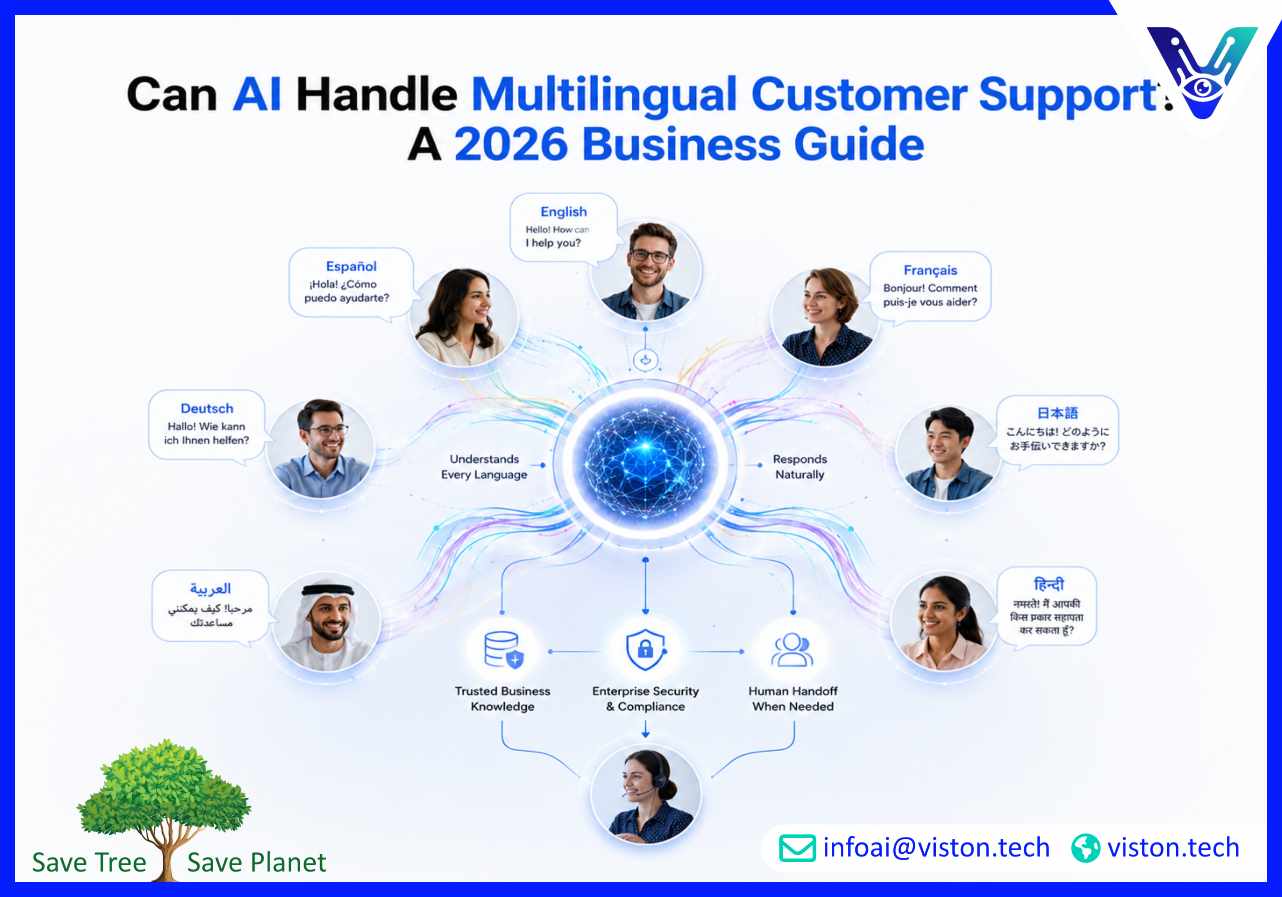
Can AI Handle Multilingual Customer Support? A 2026 Business Guide
Can AI handle multilingual customer support reliably? Yes—when it is connected to trusted business knowledge, tested in each supported language, and backed by clear human escalation. In 2026, AI can manage a substantial share of global customer conversations, but successful deployment requires more than adding automatic translation to a chatbot.
Can AI Handle Multilingual Customer Support Reliably?
AI can handle multilingual customer support across chat, email, messaging applications, websites, mobile apps, voice channels, and self-service portals. It can identify the customer’s language, understand the likely intent, retrieve relevant information, generate or translate a response, complete approved tasks, and route the conversation when human help is needed.Natural language processing enables computer systems to understand, interpret, and generate human language, forming the foundation of modern translation services, virtual assistants, and chatbots. Multilingual customer support combines this language capability with business knowledge, workflow automation, integrations, and operational controls.The important qualification is that AI does not perform equally well in every language, situation, or industry. Quality depends on the underlying model, training data, available knowledge, local terminology, conversation design, system integrations, and testing process.
What multilingual AI can do well
A properly designed system can support several customer service activities:
Detect the language used in an incoming message
Understand common customer intents across varied phrasing
Answer frequently asked questions from approved content
Translate conversations between customers and agents
Guide users through troubleshooting or onboarding steps
Retrieve order, booking, subscription, or account information
Create tickets and update customer records
Summarize conversations for human agents
Route customers according to language, issue, urgency, or location
Operate outside normal business hours
These capabilities make AI particularly useful for businesses that receive repetitive enquiries from several markets but cannot maintain a fully staffed support team for every language and time zone.
What AI cannot guarantee by itself
AI cannot automatically guarantee accurate, culturally appropriate service in every language. Regional expressions, dialects, mixed-language messages, spelling variations, technical terminology, humour, sarcasm, and culturally sensitive wording can all affect interpretation.The risk is higher when the answer involves contractual obligations, healthcare information, financial decisions, legal rights, safety instructions, refunds, complaints, fraud, or unusual account circumstances. In these situations, fluent language is not enough. The response must also be factually correct, policy-compliant, appropriately authorized, and sensitive to the customer’s circumstances.Businesses should therefore treat multilingual AI as a controlled service capability rather than an unrestricted replacement for people.
How AI Multilingual Customer Support Works in 2026
Effective AI multilingual customer support is not one piece of software. It is a coordinated system that combines language detection, natural language understanding, knowledge retrieval, response generation, business rules, integrations, analytics, and human handover.
Language detection and intent recognition
The first step is identifying the language and determining what the customer wants. A user may write, “Where is my parcel?”, “My delivery has not arrived,” or the equivalent in another language. The system must recognize that these messages relate to shipment tracking rather than treating them as unrelated questions.Language detection should also account for code-switching, where a customer moves between languages in the same conversation. This is common when people use English product names, technical terms, or account labels inside messages written mainly in another language.
Trusted knowledge retrieval
Once the intent is understood, the AI needs an approved source for the answer. This may include a knowledge base, product documentation, return policy, pricing catalogue, service guide, internal procedure, or customer-specific record.Strong systems retrieve information from controlled sources instead of improvising unsupported answers. If the relevant information is missing, outdated, contradictory, or restricted, the AI should ask a clarifying question or escalate the case.Businesses also need consistent terminology. A feature name, policy term, subscription level, medical phrase, or technical component should not be translated differently across the website, chatbot, help centre, and agent responses.
Translation and native-language generation
Some systems translate the customer’s message into a central working language, process it, and translate the answer back. Others use multilingual models that can understand and generate responses directly in the customer’s language.Neither approach is automatically superior in every situation. Translation-based workflows may simplify centralized knowledge management, while direct multilingual generation can produce more natural conversations. The right choice depends on the languages, content complexity, accuracy requirements, model quality, and available quality-assurance resources.
Business system integration
A multilingual chatbot becomes more useful when it can access the systems needed to resolve the enquiry. Integrations may connect the AI with CRM software, helpdesk platforms, ecommerce systems, booking tools, ERP platforms, payment services, identity systems, or internal knowledge repositories.Without integration, the AI may explain how order tracking works but remain unable to find the customer’s order. With secure integration, it can verify the user, retrieve current information, provide the answer in the preferred language, and log the interaction for future support.
Omnichannel continuity
Customers may begin on a website, continue through WhatsApp, receive an email, and later speak with an agent. A mature multilingual support model should preserve language preference, identity, conversation history, and case context across channels.This continuity prevents customers from repeating their issue and helps agents understand what the AI has already attempted.
Where AI Performs Well and Where Human Support Is Essential
The best way to use multilingual AI is to match the level of automation to the complexity and risk of the conversation. Businesses should automate predictable tasks while preserving fast access to qualified people for sensitive or exceptional cases.
Suitable multilingual AI use cases
AI is generally well suited to enquiries with clear rules, trusted data, and repeatable outcomes. Examples include:
Order and delivery status
Business hours and location information
Appointment scheduling and confirmation
Password reset guidance
Product specifications and availability
Subscription and billing explanations
Basic troubleshooting
Returns and cancellation procedures
Customer onboarding
Lead capture and qualification
Ticket creation and status updates
These interactions can often be resolved quickly because the required information is structured and the next action is known.
Cases that usually need human judgment
Human support remains important when the issue involves ambiguity, emotion, negotiation, discretion, authorization, or significant consequences. Examples include:
Escalated complaints and service recovery
Unusual refunds, compensation, or contract disputes
Financial hardship or vulnerable customers
Legal, regulatory, medical, or safety-related questions
Fraud, identity concerns, or account security incidents
Complex technical failures
High-value sales or procurement discussions
Conversations where the customer requests a person
The AI should recognize signals such as repeated failure, negative sentiment, urgency, sensitive keywords, low confidence, or explicit escalation requests. The handover should include the original conversation, a translated summary, detected intent, customer details, attempted actions, and relevant records.
The hybrid support model
A hybrid model uses AI to provide immediate multilingual assistance while human specialists handle cases requiring expertise or empathy. The AI can also support agents by translating messages, recommending approved answers, retrieving information, and summarizing long conversations.This approach does not remove people from customer service. It allows them to spend less time translating repetitive questions and more time resolving situations where judgment creates the most value.
How to Implement AI Multilingual Customer Support Successfully
A successful deployment begins with operational planning, not with the number of languages advertised by a technology provider. Businesses should define what they can support accurately, which tasks they want to automate, and how quality will be managed after launch.
1. Prioritize languages using real demand
Review customer locations, website language settings, support tickets, sales enquiries, product usage, abandoned conversations, and expansion plans. Begin with languages that represent meaningful service demand or commercial opportunity.Supporting five languages well is usually more valuable than claiming broad coverage without testing accuracy, content completeness, and escalation capacity.
2. Prepare approved source content
Audit FAQs, help articles, policies, technical documentation, scripts, and workflow instructions before connecting them to AI. Remove outdated or conflicting information and assign owners responsible for future updates.Create a terminology glossary covering product names, industry language, abbreviations, restricted phrases, and preferred translations. Localize meaning and tone rather than translating individual sentences without context.
3. Define automation boundaries
Specify what the AI may answer, which actions it may complete, what information it may access, and when it must escalate. Sensitive workflows may require identity checks, approval steps, or restricted access based on the user’s role and location.
4. Test each language independently
Testing only the English version and assuming equivalent performance elsewhere is a major implementation mistake. Test realistic native-language queries, informal wording, spelling mistakes, regional terminology, code-switching, ambiguous requests, and adversarial inputs.Native or fluent reviewers should assess factual accuracy, naturalness, tone, cultural suitability, policy alignment, and workflow completion. Testing should continue after launch because customer language and business information change over time.
5. Build transparent and compliant interactions
Customers should understand when they are communicating with an AI system and how to reach a person. Businesses serving European users should also monitor the EU AI Act, which establishes a risk-based legal framework and includes transparency requirements for relevant AI interactions. Most provisions of the regulation apply from 2 August 2026, subject to its phased implementation.Privacy, consent, retention, access control, encryption, audit logging, and vendor governance should be addressed according to the business, location, industry, and type of customer data involved.
6. Measure quality by language
Do not rely on one global chatbot score. Track performance separately for every supported language and channel. Useful measures include:
Resolution and task-completion rate
Fallback and misunderstanding rate
Human escalation rate
Customer satisfaction
Repeat-contact rate
Response accuracy
Translation or localization corrections
Workflow and integration success
Average response and resolution time
Agent acceptance of AI-generated suggestions
Teams should review failed conversations regularly and use them to improve knowledge coverage, terminology, prompts, routing rules, and escalation logic.
How Viston AI Supports Multilingual Customer Service Automation
Viston AI provides multilingual AI chatbot support alongside enterprise chatbot development, natural language processing, business system integration, workflow automation, and model monitoring. These capabilities are directly relevant to organizations that want multilingual customer service to operate as part of a wider support process rather than as a standalone translation tool.Its service approach can support language-aware conversations, business-specific intent recognition, approved knowledge access, automation workflows, and connections with CRM, helpdesk, ERP, or other operational platforms. Viston AI also positions its NLP solutions for multilingual deployment across European, Asian, and American markets.For businesses evaluating whether AI can handle multilingual customer support, this combination matters because language fluency alone does not resolve customer issues. The system must understand the request, access the correct information, perform permitted actions, transfer complex cases, and provide measurable reporting.A practical Viston AI engagement may include use-case discovery, language prioritization, knowledge preparation, chatbot development, model and workflow integration, testing, deployment, and ongoing optimization. This makes the offering relevant to companies seeking scalable multilingual support while maintaining control over service quality, security, operational context, and human escalation.
Frequently Asked Questions
Can AI fully replace multilingual customer support agents?
No. AI can automate many repetitive and structured enquiries, translate conversations, retrieve information, and assist agents. Human specialists remain important for sensitive complaints, complex decisions, negotiations, unusual cases, and conversations requiring empathy or authority.
How many languages can an AI customer support system handle?
The number depends on the model and platform, but advertised language coverage should not be treated as proof of equal quality. Businesses should validate accuracy, terminology, knowledge coverage, workflow reliability, and escalation performance separately for every priority language.
Is multilingual AI support the same as automatic translation?
No. Translation converts content between languages. Multilingual support also includes intent recognition, localized knowledge, customer context, business rules, system integrations, human routing, quality monitoring, and consistent service delivery.
What customer support tasks should be automated first?
Begin with high-volume, low-risk enquiries supported by clear information and repeatable workflows. Common starting points include order tracking, appointment confirmation, account guidance, product information, subscription questions, basic troubleshooting, and ticket creation.
How can businesses check multilingual AI accuracy?
Use native-language test cases, review real conversations, compare answers with approved sources, test regional phrasing, and monitor fallbacks, corrections, escalations, repeat contacts, and customer satisfaction for each language.
Can Viston AI integrate multilingual support with existing systems?
Viston AI’s published capabilities include enterprise chatbot development, multilingual support, NLP, workflow automation, and integration with business systems. This can help connect customer conversations with the knowledge, records, and operational tools needed to resolve enquiries.
Conclusion
Can AI handle multilingual customer support? It can manage a significant share of routine conversations when supported by trusted knowledge, reliable integrations, language-specific testing, and clear human oversight. The strongest model is not unrestricted automation, but a controlled hybrid service that uses AI for speed and scale while directing complex cases to qualified people. Businesses considering Multilingual Support should prioritize accuracy, localization, security, transparency, workflow completion, and measurable performance. Viston AI offers relevant chatbot, NLP, integration, automation, and monitoring capabilities for organizations building practical multilingual customer service operations.