
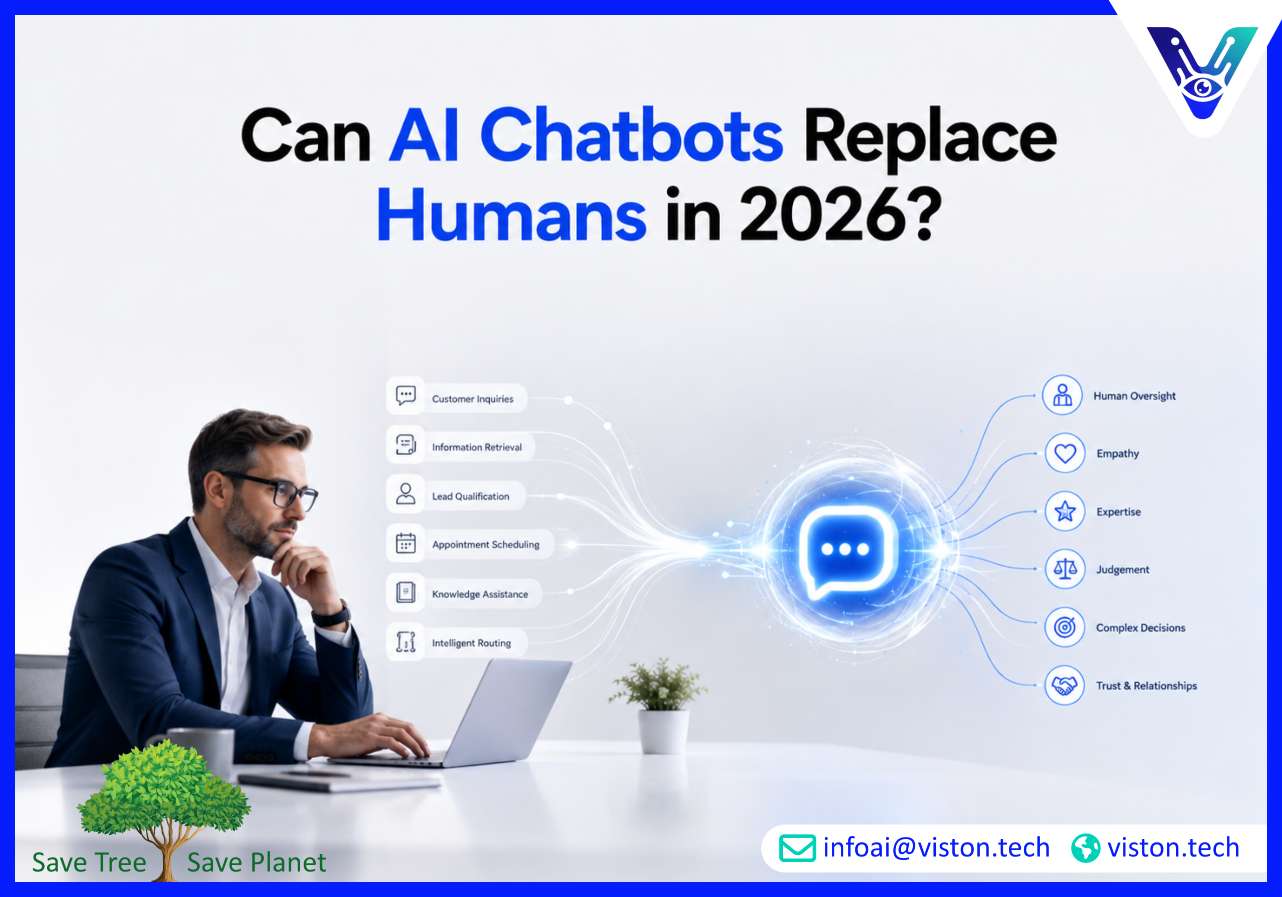
Can AI chatbots replace humans? For business leaders in 2026, the real answer is not simply yes or no. AI chatbots can replace some repetitive tasks, but the strongest results usually come from combining automation with human judgement, empathy, accountability, and specialist expertise.
When businesses ask whether AI chatbots can replace humans, they are usually asking a more practical question: which conversations, workflows, and customer interactions can be automated without damaging service quality? That distinction matters. Replacing a task is very different from replacing a person.
AI chatbot development has moved far beyond scripted FAQ bots. Modern AI chatbots can understand natural language, detect intent, retrieve information from business knowledge bases, summarize conversations, qualify leads, book appointments, create support tickets, route users to departments, and connect with CRM, helpdesk, ecommerce, HR, and internal workflow systems.
This means AI chatbots can take over many structured interactions that previously required human time. A chatbot can answer opening-hour questions, collect customer details, explain basic service options, check order status, guide users through forms, or ask qualification questions before a sales call. These are valuable uses because they reduce delays and allow employees to focus on higher-value work.
However, replacing human involvement completely is much harder. Human employees do more than respond to questions. They interpret emotion, handle ambiguity, build trust, negotiate, make judgement calls, understand business context, manage exceptions, and take responsibility for outcomes. These qualities are especially important when a customer is frustrated, a deal is complex, a compliance issue exists, or a decision involves risk.
In 2026, the most effective AI chatbot strategy is usually selective automation. Businesses should identify where chatbots can provide faster, more consistent support and where human expertise must remain central. Good AI chatbot development does not remove people from the business. It redesigns how people and intelligent systems work together.
AI chatbots are strongest when the work is repetitive, high-volume, process-driven, and supported by clear data. In these situations, automation can improve speed, consistency, and availability without reducing the quality of the customer or employee experience.
Many support requests follow predictable patterns. Customers ask about pricing, delivery, refunds, account access, product features, service availability, onboarding steps, or troubleshooting basics. A well-built AI chatbot can handle these conversations instantly and consistently, especially when it is connected to an accurate knowledge base.
This does not mean every support agent becomes unnecessary. Instead, agents spend less time answering the same simple questions and more time solving complex cases. The chatbot becomes the first layer of support, while humans remain responsible for escalations, sensitive issues, and exceptions.
AI chatbots can replace the manual work of asking initial qualification questions. They can identify the visitor’s company size, budget range, urgency, use case, preferred service, and decision timeline. They can then route the lead to the right sales representative or schedule a meeting automatically.
For B2B companies, this can improve response speed and reduce missed opportunities. Human sales teams still matter for relationship building, consultation, negotiation, proposal development, and closing complex deals. The chatbot supports the sales process rather than replacing the strategic role of the salesperson.
AI chatbots can manage appointment requests, confirm availability, collect required information, send reminders, update calendars, and trigger follow-up workflows. This is especially useful for service businesses, healthcare administration, consulting firms, professional services, training providers, and internal operations teams.
When the workflow is clearly defined, the chatbot can reduce administrative workload significantly. Human staff can then focus on cases that need judgement, prioritization, or personal attention.
Businesses are also using AI chatbots internally. Employees can ask questions about HR policies, IT troubleshooting, onboarding steps, company documents, expense rules, training materials, or internal processes. Instead of waiting for a department response, they get guided answers from a controlled knowledge base.
This type of AI chatbot does not replace HR, IT, or operations teams completely. It reduces repetitive requests and gives specialists more time to handle complex employee needs, policy decisions, system improvements, and strategic work.
AI chatbots are powerful, but they are not suitable for every conversation. Businesses that try to automate too much often create frustration, trust issues, and operational risk. Responsible AI chatbot development requires clear boundaries around what the chatbot should and should not do.
When users are angry, anxious, disappointed, confused, or dealing with a serious personal issue, human support is often essential. AI can detect sentiment and adjust tone, but it does not genuinely understand human emotion in the way a trained employee can.
In sensitive situations, the chatbot should recognize escalation signals and transfer the conversation to a human quickly. A poor handoff can make customers feel ignored. A smooth handoff can preserve trust and improve the overall experience.
AI chatbots can support decision-making by gathering facts, summarizing options, and explaining standard processes. But they should not independently make high-impact decisions without proper oversight. This is especially important in areas involving finance, healthcare, legal processes, employment, compliance, procurement, or enterprise risk.
Human teams remain necessary when decisions require accountability, ethical judgement, negotiation, or interpretation of incomplete information. The chatbot can assist, but the final judgement should belong to qualified people.
AI performs best when it has good data and clear instructions. When a problem is unusual, poorly described, or outside the chatbot’s knowledge base, the risk of inaccurate answers increases. A chatbot that confidently gives the wrong response can create more damage than no chatbot at all.
This is why fallback design, knowledge boundaries, escalation rules, and response validation are important parts of AI chatbot development. A reliable chatbot should know when not to answer and when to involve a human.
In many industries, trust is built through human relationships. Enterprise sales, strategic consulting, account management, partnerships, customer success, and high-value service delivery all depend on personal understanding. AI chatbots can support these interactions by preparing information, summarizing conversations, and automating routine follow-ups, but they should not replace the relationship itself.
Businesses should avoid viewing chatbots as a substitute for human trust. The better approach is to use AI to make human teams more responsive, informed, and efficient.
The strongest business model in 2026 is not chatbot versus human. It is chatbot plus human. This hybrid model uses AI to handle speed, scale, and consistency while humans provide judgement, empathy, creativity, and accountability.
A well-designed hybrid AI chatbot system usually includes clear role separation. The chatbot handles simple questions, data collection, initial triage, routine workflows, and self-service support. Human teams handle complex issues, escalations, complaints, strategic advice, and relationship-led conversations.
The handoff between chatbot and human is critical. A customer should not have to repeat everything after escalation. The chatbot should summarize the conversation, capture user intent, provide relevant details, and transfer the case to the right person or team. This makes human support faster and more informed.
Hybrid systems also need monitoring. Businesses should review unanswered questions, failed conversations, escalation patterns, user satisfaction, lead quality, conversion rates, and resolution outcomes. These insights help improve chatbot performance and reveal where human teams need better tools, content, or processes.
In AI chatbot development, this means success depends on more than selecting a model. It requires conversation design, data preparation, integration planning, security controls, testing, analytics, and ongoing optimization. The chatbot must be designed around real business workflows rather than treated as a simple website widget.
Businesses should also be transparent. Users should understand when they are interacting with AI and when they are speaking to a person. Transparency supports trust and reduces frustration, especially when the chatbot is used in customer service, employee support, or sales conversations.
The right hybrid approach can improve response times, reduce repetitive workload, extend service availability, and help teams focus on work that genuinely needs human expertise. It does not remove the need for people. It changes where people create the most value.
Viston AI is relevant to the question “Can AI chatbots replace humans?” because its AI Chatbot Development services focus on building intelligent conversational systems for customer engagement, lead generation, business process automation, and contextual support. These capabilities align with the practical needs of businesses that want automation without losing service quality.
Viston AI’s chatbot development capabilities include solutions powered by technologies such as ChatGPT, Gemini, and custom models, along with broader strengths in natural language processing, AI chatbot integration, workflow automation, custom AI solution development, and model monitoring. This matters because a chatbot that replaces repetitive human tasks must still understand intent, access reliable information, connect with business systems, and escalate appropriately when human help is needed.
For businesses across global markets, Viston AI can support the design of chatbot systems that balance automation with human oversight. This includes mapping common user journeys, identifying automation opportunities, connecting chatbots with operational tools, improving response consistency, and supporting scalable conversational experiences.
The most useful AI chatbot projects are not built around the idea of removing humans entirely. They are built around better allocation of work. Viston AI’s service offering is suited to organizations that want AI chatbots to handle routine interactions while allowing human teams to focus on complex decisions, relationship building, and high-value service delivery.
AI chatbots can replace many routine customer service tasks, but they should not completely replace agents in most businesses. Human agents are still needed for complex complaints, emotional conversations, sensitive issues, unusual cases, and decisions that require accountability.
AI chatbots mostly affect roles that involve repetitive question answering, basic support, appointment scheduling, lead capture, internal helpdesk responses, and administrative communication. However, they often change these roles rather than remove them by shifting employees toward higher-value work.
AI chatbots are better than humans at speed, availability, consistency, and handling repetitive high-volume questions. Humans are better at empathy, judgement, relationship building, negotiation, creativity, and managing exceptions. The best result usually comes from combining both.
Businesses should review conversation volume, repetition, risk level, required judgement, data availability, and user expectations. Low-risk, repetitive, well-documented tasks are strong candidates for chatbot automation. High-risk or emotionally sensitive interactions should include human review or escalation.
Yes. Viston AI’s AI Chatbot Development and integration capabilities can support chatbot systems that automate routine conversations, connect with business workflows, and escalate complex cases to human teams when needed.
AI chatbots can reduce costs by lowering repetitive support workload, improving response speed, and automating administrative tasks. The actual value depends on chatbot quality, integration depth, user adoption, monitoring, and whether the system is designed around measurable business outcomes.
Can AI chatbots replace humans? In 2026, they can replace many repetitive tasks, but they should not replace human expertise completely. The best AI Chatbot Development strategy is to use chatbots for speed, scale, qualification, self-service, and workflow automation while keeping people involved where empathy, judgement, trust, and accountability matter. Businesses that take this balanced approach can improve efficiency without weakening customer relationships. Viston AI is well positioned to support organizations that want human-centered chatbot solutions designed around practical automation, reliable integrations, and long-term business value.
