
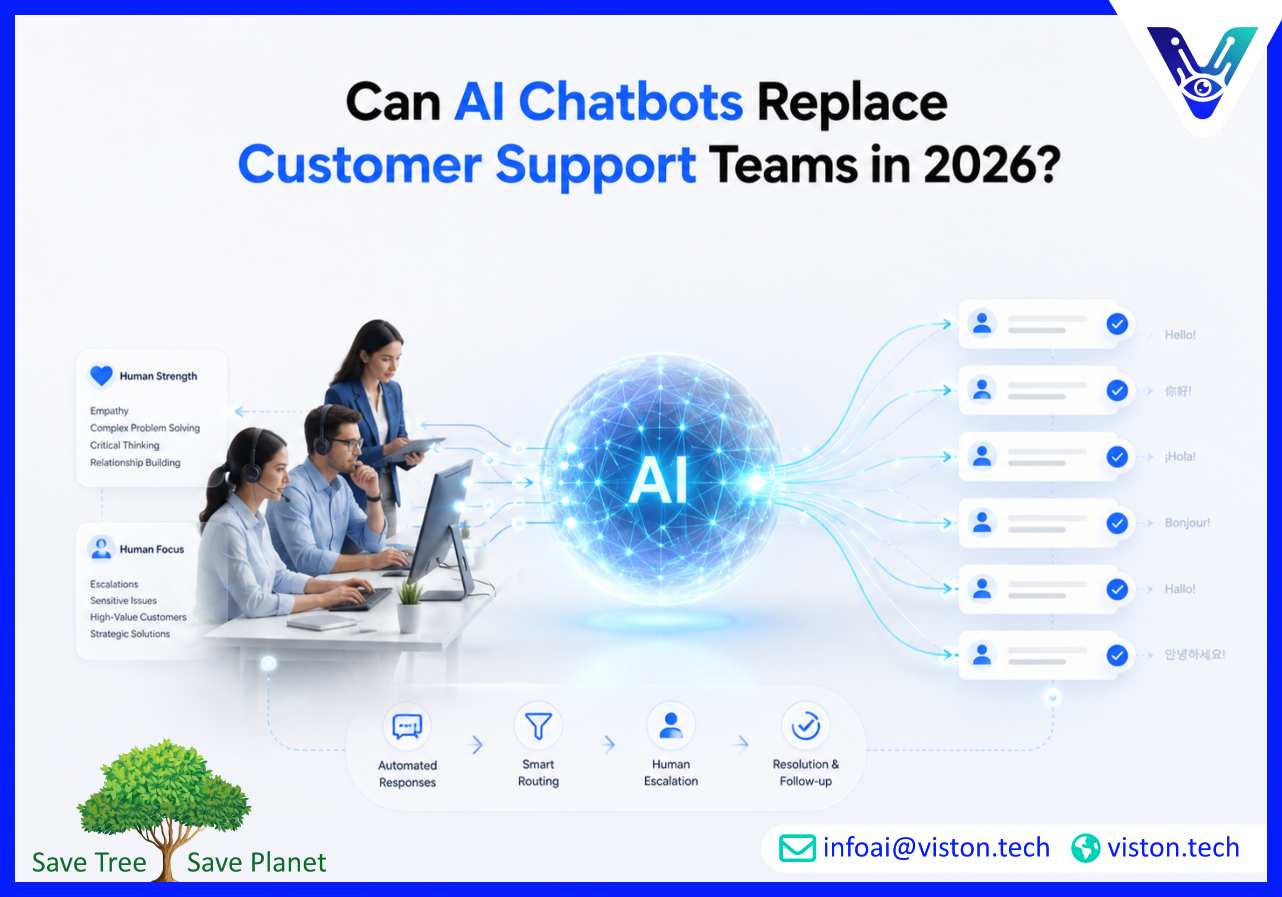
Can AI chatbots replace customer support teams? For most businesses, the realistic answer is not full replacement, but intelligent support transformation. Enterprise AI Chatbots can automate repetitive conversations, improve response speed, and support agents, while human teams remain essential for empathy, judgment, exceptions, and complex customer relationships.
The question is often framed too simply. Replacing a customer support team does not only mean answering questions. A support team handles context, emotion, policy exceptions, complaints, renewals, refunds, technical troubleshooting, escalation, account risk, and customer trust. Enterprise AI Chatbots can perform many support tasks, but they do not automatically replace the full responsibility of a trained service operation.
In 2026, AI chatbots are much more capable than older scripted bots. They can understand natural language, retrieve knowledge base content, summarize conversations, detect intent, route tickets, update CRM records, support multiple languages, and guide users through workflows. This makes them highly valuable for high-volume support environments.
However, customer support is not only a volume problem. It is also a quality, trust, and relationship problem. Customers often contact support when something has already gone wrong. They may be frustrated, confused, under pressure, or dealing with a business-critical issue. In these moments, automation must be used carefully.
AI chatbots can often manage predictable, low-risk, and repeatable requests without human involvement. These include order status checks, password resets, appointment scheduling, return policy questions, account information retrieval, subscription changes, lead qualification, basic troubleshooting, and internal knowledge search.
When these use cases are clearly defined, chatbots can reduce response delays and free support teams from repetitive work. The business benefit is not simply fewer agents. It is better use of human capacity. Agents can focus on complex cases instead of spending most of their time answering the same basic questions.
Human agents remain important when a conversation requires negotiation, emotional intelligence, ethical judgment, regulatory awareness, exception handling, or complex problem-solving. A chatbot may explain a refund policy, but a human may need to decide whether an exception is appropriate for a long-term customer. A chatbot may gather technical details, but a specialist may need to diagnose a complicated integration failure.
For this reason, the strongest support models use AI chatbots as the first layer of service, not the only layer of service. The goal is to create a faster, more scalable, and more consistent support system while preserving human judgment where it matters most.
Customer expectations have changed. Buyers expect quick answers, 24/7 availability, personalized service, and consistent communication across websites, mobile apps, messaging platforms, customer portals, and email. At the same time, support teams are under pressure to reduce costs, improve service levels, manage higher ticket volumes, and maintain quality.
Enterprise AI Chatbots help address these pressures by creating an always-available support layer that can respond instantly and handle many conversations at the same time. This is especially useful for businesses with seasonal peaks, global customers, multilingual support needs, or high volumes of repetitive inquiries.
One of the clearest advantages of AI chatbots is instant response. Customers no longer need to wait in a queue for simple answers. A well-designed chatbot can provide immediate help at any time of day, including weekends, holidays, and outside office hours.
This does not mean every answer should be automated. It means the first response should be useful. Even when the chatbot cannot resolve the full issue, it can collect relevant details, identify the customer’s intent, check account information, and route the case to the right person with context.
Human teams may interpret policies differently, especially across locations, departments, or outsourced support partners. Enterprise AI Chatbots can help standardize approved answers, brand tone, troubleshooting steps, and escalation rules. This improves consistency across web chat, mobile apps, WhatsApp, internal portals, and helpdesk systems.
Consistency is especially important for regulated or process-heavy businesses. A chatbot connected to approved knowledge sources can reduce the risk of outdated or inconsistent responses, provided the underlying content is properly maintained.
AI chatbots also create useful operational data. They can identify recurring customer questions, common complaint themes, product confusion, failed journeys, sentiment patterns, and gaps in help center content. This turns support conversations into business intelligence.
For managers, this data can support better staffing decisions, product improvements, knowledge base updates, workflow redesign, and customer experience planning. In this sense, the chatbot is not only a support tool. It becomes a listening layer across the customer journey.
The practical way to evaluate whether AI chatbots can replace customer support teams is to break support work into task categories. Some tasks are highly automatable. Some should be AI-assisted. Others should stay human-led.
Enterprise AI Chatbots can replace manual handling for many routine support interactions when the process is stable and the answer can be verified from trusted systems. These tasks include:
These tasks are ideal because they are repetitive, measurable, and process-driven. Automation improves speed while reducing unnecessary workload for human agents.
Some support work benefits from AI assistance but still needs human oversight. Examples include complex technical diagnostics, high-value account support, cancellation prevention, billing disputes, compliance-sensitive conversations, warranty exceptions, enterprise onboarding, and complaints from frustrated customers.
In these cases, AI can summarize history, suggest responses, retrieve relevant documents, recommend next steps, and prepare the agent before they enter the conversation. This improves agent productivity without removing human accountability.
Human-led support remains necessary when the issue involves empathy, risk, negotiation, discretion, or customer relationship management. Examples include serious complaints, legal threats, vulnerable customer situations, enterprise contract disputes, safety concerns, sensitive healthcare or financial matters, and strategic customer success conversations.
Even the best chatbot should know when not to continue. Strong escalation logic is a sign of a mature enterprise chatbot. It protects the customer experience and prevents automation from creating frustration or risk.
The best support strategy is not “AI versus humans.” It is deciding which work should be automated, which work should be assisted, and which work should remain human-led. This decision should be based on customer needs, business risk, ticket volume, process complexity, and service expectations.
Businesses should begin by mapping the most common support intents. An intent is the customer’s reason for contacting support, such as “track my order,” “reset my password,” “cancel my plan,” “report a billing issue,” or “speak to technical support.”
Each intent should be evaluated by volume, complexity, risk, data requirements, and customer emotion. High-volume and low-risk intents are usually good candidates for chatbot automation. High-risk or emotionally sensitive intents should be routed to humans faster.
A chatbot that only provides static answers has limited value. Enterprise AI Chatbots become much more useful when they connect to CRM systems, helpdesk platforms, knowledge bases, order management tools, product databases, authentication systems, and workflow automation platforms.
Integration allows the chatbot to check customer records, update tickets, trigger workflows, provide account-specific answers, and pass complete context to agents. Without integration, the chatbot may answer basic questions but fail to resolve meaningful support issues.
Escalation should not feel like failure. It should be part of the service design. A chatbot should escalate when confidence is low, the user repeats the same request, sentiment becomes negative, the issue involves a protected category, the customer asks for a human, or business rules require approval.
The handoff should include the conversation summary, detected intent, customer details, attempted resolution, relevant account data, and urgency level. This prevents customers from repeating themselves and helps agents resolve cases faster.
Automation rate alone is not enough. A chatbot that handles many conversations but leaves customers dissatisfied is not successful. Businesses should measure resolution rate, customer satisfaction, escalation quality, fallback rate, first contact resolution, cost per resolved case, average response time, and agent productivity.
The right goal is not maximum replacement. The right goal is reliable service improvement. A mature support operation uses AI to reduce friction, improve access, and strengthen human performance.
Viston AI is relevant to this topic because its Enterprise AI Chatbots service focuses on building conversational AI for complex business environments where automation must work alongside real operational teams. Its capabilities include enterprise chatbot development, natural language understanding, multilingual support, workflow automation, business system integration, voice-enabled assistants, AI chatbot integration, and ongoing optimization.
For businesses asking whether AI chatbots can replace customer support teams, Viston AI’s role is best understood as helping organizations design the right automation model rather than forcing full replacement. A practical chatbot strategy identifies which customer support tasks can be automated, which cases require escalation, and how AI can support agents with better context, faster knowledge retrieval, and cleaner workflow execution.
Viston AI’s enterprise-focused approach is useful for companies that need chatbots connected to CRM systems, knowledge bases, support tools, and transactional platforms. This matters because customer support automation only creates real value when the chatbot can access accurate business information and trigger the right next step. For global or multi-channel businesses, Viston AI can help build chatbot experiences that support consistency, scalability, customer service efficiency, and responsible human handoff.
In most businesses, AI chatbots should not fully replace customer support teams. They can automate repetitive and low-risk tasks, but human agents are still needed for complex issues, emotional conversations, exceptions, complaints, and high-value customer relationships.
Enterprise AI Chatbots are best suited for FAQs, order tracking, ticket creation, appointment scheduling, account lookups, lead qualification, basic troubleshooting, customer onboarding, internal knowledge search, and routine workflow automation.
AI chatbots can reduce the need for agents to handle repetitive requests manually. However, many businesses use automation to reassign agents to more complex, higher-value work rather than remove the human support function entirely.
AI chatbots improve support quality by providing instant responses, consistent answers, 24/7 availability, faster routing, better ticket details, multilingual support, and smoother handoffs when connected to business systems and approved knowledge sources.
The risks include poor customer experience, inaccurate answers, weak escalation, lack of empathy, compliance exposure, unresolved complaints, and damaged trust. These risks increase when chatbots are deployed without governance, testing, integration, and human oversight.
Yes. Viston AI’s Enterprise AI Chatbots service is aligned with hybrid support models where chatbots automate routine conversations, integrate with business systems, and support human agents through contextual handoff, workflow automation, and knowledge access.
Can AI chatbots replace customer support teams? In 2026, the strongest answer is that Enterprise AI Chatbots can replace many repetitive support tasks, but they should not replace the full human support function in most organizations. Customer service still requires empathy, judgment, escalation, and relationship management. The best business outcome comes from combining chatbot automation with skilled human agents, clear governance, reliable integrations, and continuous improvement. Viston AI is positioned to support this balanced approach by helping businesses build enterprise chatbot systems that improve service efficiency while keeping human expertise available where it matters most.
