
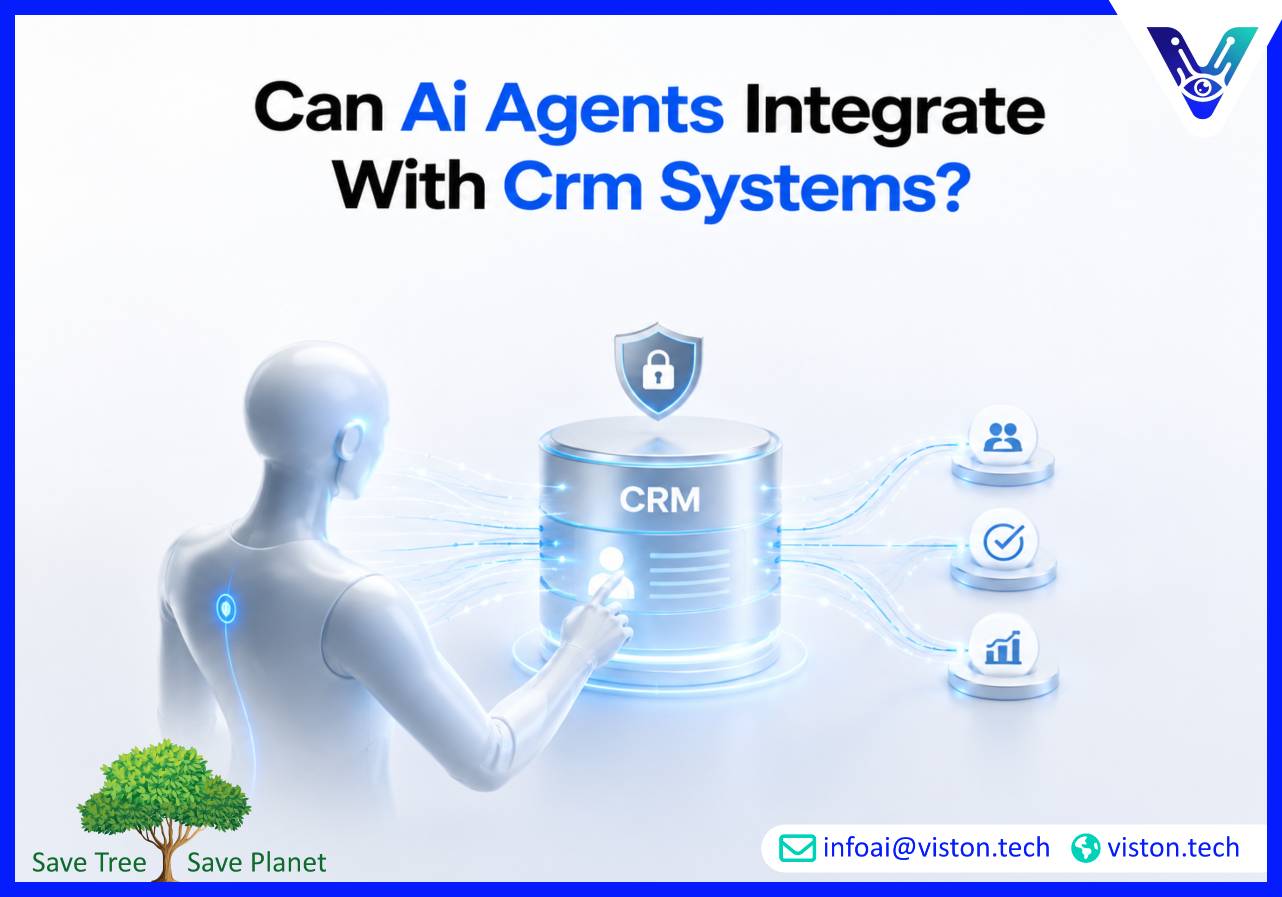
AI agents can integrate with CRM systems when they are connected through secure APIs, workflow automation, data pipelines, and role-based access controls. For businesses in 2026, this matters because CRM platforms are no longer just databases; they are central systems for sales, marketing, support, and customer operations.
When businesses ask, “Can AI agents integrate with CRM systems?”, the answer is yes, but successful integration depends on how the agent is designed, what CRM data it needs, and what actions it is allowed to perform.
An AI agent is not simply a chatbot. A well-designed agent can understand instructions, access approved systems, retrieve customer information, trigger workflows, update records, summarize interactions, and recommend next steps. When connected to a CRM, it can support teams by working directly with leads, contacts, accounts, opportunities, tickets, notes, tasks, and communication history.
CRM integration allows AI agents to move from basic conversation to practical execution. Instead of only answering questions, an integrated agent can help sales teams follow up with prospects, assist support teams with case resolution, enrich customer records, prepare meeting summaries, and automate repetitive CRM tasks.
CRM systems contain some of the most valuable operational data inside a business. Sales conversations, customer preferences, deal stages, support history, buying signals, and account activity all live inside the CRM. Without integration, AI agents have limited context and cannot deliver reliable business value.
In 2026, businesses expect automation to be contextual, secure, and measurable. A disconnected AI tool may provide generic answers, but an integrated AI agent can support real workflows because it understands the customer journey inside the CRM.
For decision-makers, the real value is not just automation. The value comes from helping teams act faster with better context while reducing the operational drag caused by repetitive CRM work.
AI agent integration services usually connect the agent to the CRM through structured technical methods. The right method depends on the CRM platform, security requirements, data structure, workflow complexity, and business use case.
Most modern CRM systems provide APIs that allow approved applications to read, write, update, and retrieve CRM data. AI agents can use these APIs to access customer records, create tasks, update deal stages, log notes, or pull account information.
AI agents can be connected to CRM workflows so that specific actions happen automatically. For example, when a new lead enters the CRM, the agent can analyze the inquiry, classify intent, assign a priority level, and notify the right team member.
Some businesses need AI agents to work across multiple systems, such as CRM, email, helpdesk, ERP, marketing automation, and analytics platforms. In these cases, integration services help synchronize data so the agent can work with consistent information.
CRM integration often requires more than a technical connection. Businesses need custom rules that reflect their sales process, customer lifecycle, approval flows, compliance needs, and internal operating model.
AI agents can support many CRM-related workflows when they are properly integrated, governed, and monitored.
An AI agent can review lead source, message intent, company profile, engagement history, and CRM criteria to help prioritize prospects. It can identify high-intent inquiries and route them to the right sales representative.
Sales teams often lose opportunities because follow-ups are delayed or inconsistent. An AI agent can create reminders, draft follow-up messages, summarize previous conversations, and suggest next actions based on CRM activity.
When integrated with CRM records and support history, an AI agent can help service teams understand customer context quickly. It can summarize past issues, suggest responses, and escalate complex cases when human review is needed.
Incomplete or inconsistent CRM data weakens reporting and decision-making. AI agents can help detect missing fields, duplicate records, outdated notes, and incomplete activity logs.
For account managers, AI agents can surface renewal risks, upsell opportunities, inactive accounts, or unresolved service issues based on CRM patterns and customer activity.
CRM integration should be planned carefully because the agent may interact with sensitive customer and commercial data. A strong implementation requires technical design, security controls, workflow clarity, and ongoing optimization.
Not every AI agent should access every CRM field. Businesses should define what data the agent can read, update, or act on. Role-based permissions reduce risk and protect sensitive information.
Some CRM actions should require human approval, especially when they involve pricing, contract terms, customer complaints, legal matters, or major account changes.
AI agents perform better when CRM data is clean, structured, and reliable. Poor data can lead to weak recommendations, incorrect summaries, or flawed automation.
Businesses should consider encryption, authentication, audit logs, data retention, access controls, and compliance requirements before allowing AI agents to interact with customer records.
The best AI agent integration is built around real business workflows. It should support how sales, marketing, support, and operations teams actually work, rather than forcing teams into a generic automation model.
Viston AI can be positioned as a specialist partner for businesses exploring AI agent integration services, particularly when the goal is to connect AI agents with operational systems such as CRM platforms. CRM integration requires more than deploying an AI assistant; it requires understanding how customer data, workflows, permissions, automation rules, and business outcomes connect.
For companies that want AI agents to support lead handling, customer follow-up, sales operations, support workflows, or CRM data management, Viston AI’s relevance lies in helping design practical integrations that work inside existing business environments. A strong integration approach considers API connectivity, CRM structure, task automation, human approval points, security expectations, and ongoing performance monitoring.
This kind of service is valuable for businesses that want to move beyond isolated AI experiments and create agents that can support measurable operational tasks. By focusing on AI agent integration services, Viston AI can help organizations connect intelligent automation with real CRM workflows in a way that is structured, scalable, and aligned with business needs.
AI agents can integrate with many modern CRM systems if the CRM supports APIs, webhooks, automation tools, or custom connectors. The complexity depends on the CRM platform and business workflow.
An AI agent can qualify leads, update records, create tasks, summarize customer interactions, suggest next steps, support ticket handling, and help maintain CRM data quality.
It can be safe when proper controls are used, including role-based access, authentication, audit logs, data encryption, approval workflows, and limits on what the agent can change.
No. AI agents usually support CRM users by reducing repetitive work, improving speed, and surfacing useful information. Human teams still manage judgment-heavy decisions and customer relationships.
AI agent integration services are useful when businesses need contextual decision-making, custom workflows, multi-system connectivity, CRM-specific logic, and scalable automation beyond simple rule-based tasks.
Viston AI is relevant for businesses looking at AI agent integration services where CRM connectivity, workflow automation, and practical deployment planning are required.
AI agents can integrate with CRM systems, and this integration is becoming increasingly important for businesses that want faster, smarter, and more consistent customer operations. The strongest results come from secure CRM connectivity, clean data, clear workflow design, controlled permissions, and practical automation use cases. For organizations exploring AI agent integration services, the goal should not be automation for its own sake. The goal should be better sales execution, stronger customer support, cleaner CRM processes, and more reliable business outcomes. Viston AI can support this direction by helping businesses connect AI agents with CRM workflows in a structured and business-focused way.
