
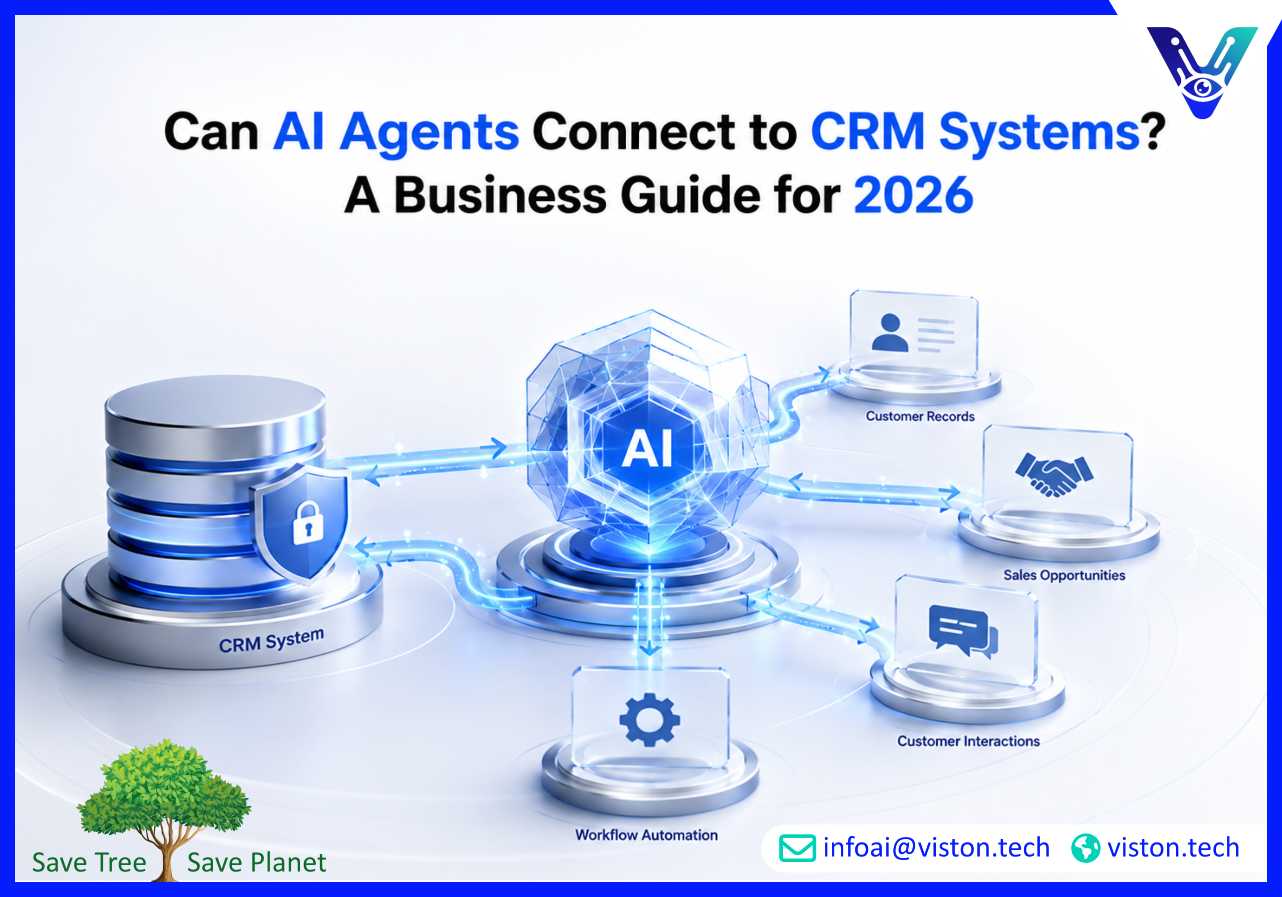
As businesses increasingly adopt AI-driven automation, one of the most common questions is whether AI agents can connect directly to CRM systems. The answer is yes. Modern AI agents can integrate with CRM platforms to automate workflows, improve customer engagement, streamline sales operations, and help teams make faster, data-driven decisions.
Customer Relationship Management (CRM) systems are often the central hub for customer data, sales activities, support interactions, and business relationships. AI agents become significantly more valuable when they can access and interact with this information in real time.
Without CRM integration, AI agents operate with limited context. Once connected, they can understand customer histories, update records, manage tasks, trigger workflows, and support business teams with relevant insights.
In 2026, organizations are increasingly looking beyond standalone AI assistants and toward integrated AI ecosystems where agents actively participate in business operations.
Most modern CRM platforms provide APIs, webhooks, integration frameworks, and automation tools that allow AI agents to communicate securely with business data and workflows.
APIs are the most common method for connecting AI agents to CRM systems. Through APIs, agents can retrieve customer information, create records, update opportunities, manage contacts, and execute workflow actions automatically.
This approach is widely used with platforms such as:
Many businesses use integration tools that allow AI agents to connect with CRM systems without extensive custom development. These platforms can route information between systems and trigger actions based on predefined business rules.
This enables organizations to deploy AI-powered workflows faster while maintaining operational control.
Larger organizations often require custom integrations that connect AI agents with CRM platforms, ERP systems, customer support software, knowledge bases, communication tools, and internal databases simultaneously.
This creates a unified environment where agents can work across multiple systems instead of operating within a single application.
CRM-connected AI agents can support numerous business functions across sales, marketing, customer service, and operations.
AI agents can review incoming leads, analyze available information, score prospects based on predefined criteria, and route opportunities to the appropriate sales representatives.
Manual CRM updates are often time-consuming and inconsistent. AI agents can automatically capture customer interactions, update records, create notes, and maintain data accuracy.
Agents can draft emails, prepare follow-up messages, summarize conversations, and provide contextual recommendations based on CRM history.
AI agents can monitor deal stages, identify stalled opportunities, generate reminders, and suggest next actions to improve pipeline progression.
When integrated with support systems and CRM data, agents can access customer histories, retrieve relevant information, classify tickets, and assist support teams in resolving issues faster.
AI agents can gather CRM data, generate summaries, identify trends, and provide actionable insights that help leadership teams make informed decisions.
Organizations that successfully integrate AI agents with CRM platforms often experience improvements in efficiency, visibility, and customer experience.
The greatest value comes from allowing teams to focus on strategic and relationship-driven activities while AI agents handle repetitive operational tasks.
While AI agent integration offers significant benefits, successful implementation requires careful planning.
CRM systems often contain sensitive customer information. AI agents should operate within clearly defined permission structures and security policies.
Not every agent should have unrestricted access to all CRM data. Role-based permissions help ensure compliance and reduce operational risk.
Businesses should clearly define which actions agents can perform independently and which require human approval.
AI agents depend on accurate information. Poor CRM data quality can reduce effectiveness and create workflow issues.
Organizations should implement logging, performance monitoring, auditing, and quality control processes to ensure reliable operation over time.
For businesses looking to connect AI agents with CRM platforms, Viston AI’s Agent Integration Services help bridge the gap between AI capabilities and real-world business operations. Successful CRM integration requires more than connecting APIs. It involves workflow design, system integration, security planning, automation logic, testing, and ongoing optimization.
Through Agent Integration Services, Viston AI helps organizations identify high-value automation opportunities, connect AI agents with CRM environments, establish governance frameworks, and create workflows that support sales, customer service, operations, and business growth objectives.
Whether businesses are using cloud-based CRM platforms or complex enterprise systems, a structured integration approach helps ensure AI agents operate reliably, securely, and in alignment with business goals.
Yes. With appropriate permissions and integration setup, AI agents can create, update, and manage CRM records automatically.
Most modern CRM systems support integration through APIs, including Salesforce, HubSpot, Microsoft Dynamics 365, Zoho CRM, and many others.
They can be highly secure when implemented with proper authentication, access controls, encryption, monitoring, and governance policies.
Yes. AI agents can assist with lead qualification, follow-up recommendations, opportunity management, CRM updates, reporting, and customer engagement activities.
No. AI agents enhance CRM systems by automating tasks, providing insights, and improving workflow efficiency. The CRM remains the system of record for customer data.
Yes. Viston AI’s Agent Integration Services support businesses seeking to connect AI agents with CRM systems, automate workflows, and improve operational efficiency through structured integration approaches.
AI agents can connect to CRM systems and are becoming an increasingly important part of modern business operations in 2026. By integrating AI agents with CRM platforms, organizations can automate repetitive tasks, improve customer engagement, enhance sales productivity, and gain better visibility into business performance. When implemented strategically through Agent Integration Services, CRM-connected AI agents can transform how businesses manage customer relationships and operational workflows. For organizations exploring this opportunity, Viston AI provides expertise in designing and implementing practical AI agent integrations that align with real business objectives.
