
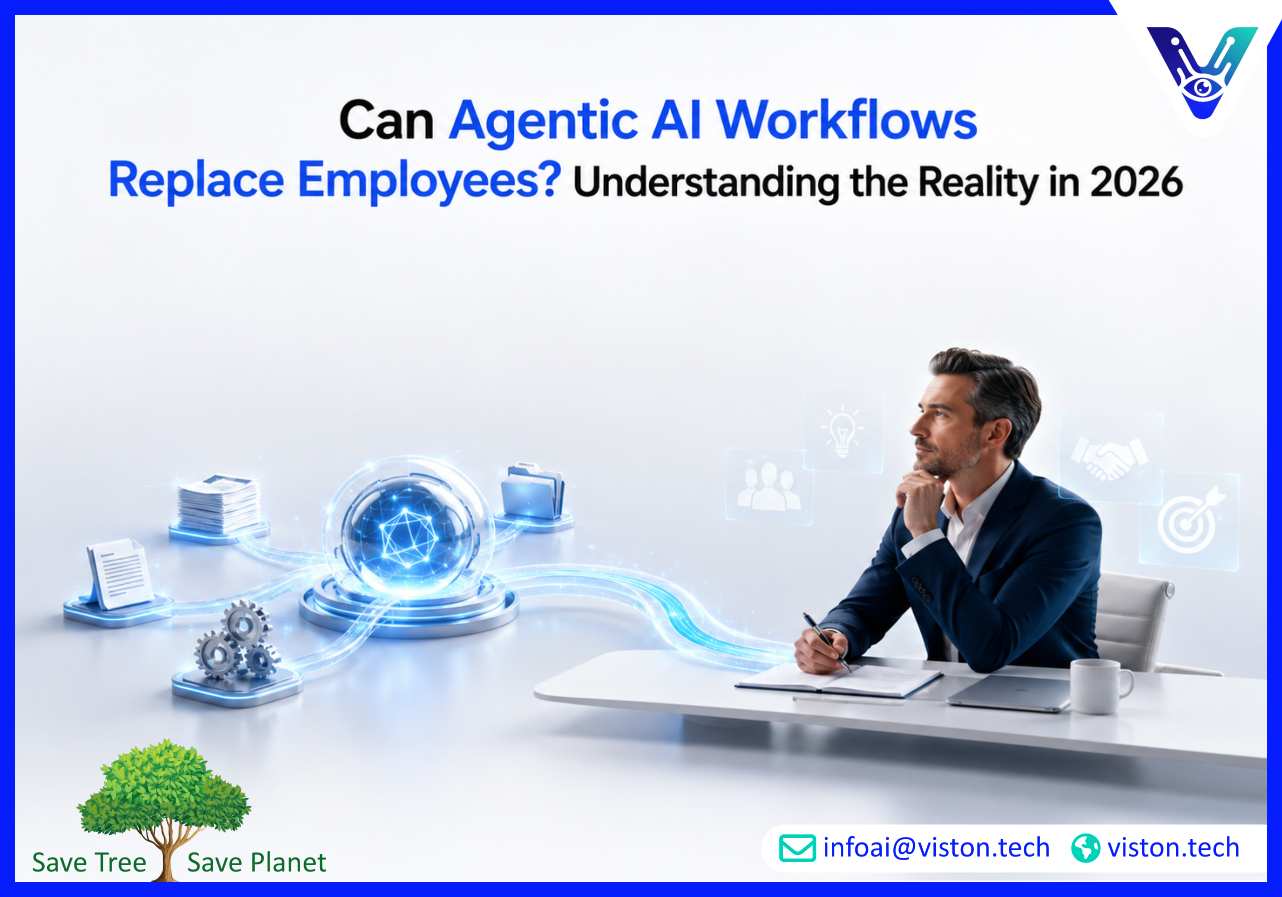
As agentic AI adoption accelerates across industries, many business leaders are asking a critical question: can agentic AI workflows replace employees? While AI agents are becoming increasingly capable of handling complex tasks and coordinating business processes, the reality is more nuanced. In 2026, agentic AI workflows are transforming how work gets done, but they are not simply replacing entire workforces.
Agentic AI workflows are structured systems where AI agents can plan, execute, monitor, and optimize tasks with varying levels of autonomy. Unlike traditional automation, which follows predefined rules, agentic workflows can make contextual decisions, interact with multiple systems, retrieve information, and adapt their actions based on changing conditions.
These workflows often involve multiple specialized AI agents working together to complete business processes such as:
The goal is not simply task automation but intelligent workflow execution across business systems.
Organizations face increasing pressure to improve efficiency, reduce operational costs, and respond faster to customers. Agentic AI workflows offer a way to automate repetitive coordination tasks that often consume significant employee time.
In many organizations, employees spend hours each week moving information between systems, responding to routine requests, gathering data, updating records, generating reports, and coordinating approvals. These activities are often necessary but do not fully utilize human expertise.
Agentic AI workflows can handle many of these operational responsibilities while allowing employees to focus on strategic, creative, and relationship-driven work.
However, these benefits do not automatically translate into employee replacement.
The most accurate way to evaluate agentic AI is to focus on tasks rather than entire job roles. Most positions consist of multiple responsibilities, some of which are highly automatable and others that remain heavily dependent on human judgment.
These activities typically involve predictable patterns, structured information, and repeatable workflows that AI agents can manage effectively.
While AI can assist with these activities, it generally lacks the contextual understanding, accountability, emotional intelligence, and organizational awareness required for complete autonomy.
The evidence emerging across industries suggests that agentic AI workflows are more likely to transform jobs than eliminate them entirely.
Historically, technology adoption has changed the nature of work rather than simply removing workers. Agentic AI follows a similar pattern. Employees increasingly become supervisors, orchestrators, reviewers, analysts, and decision-makers rather than performing every operational task manually.
For example:
The result is often a shift toward higher-value responsibilities rather than complete workforce replacement.
Organizations that view agentic AI purely as a workforce reduction tool often encounter unexpected challenges.
Experienced employees possess contextual knowledge that is rarely documented completely. Removing human expertise too quickly can create operational gaps that AI systems cannot fill.
Business environments change constantly. Human employees remain essential for interpreting new situations, managing uncertainty, and adapting processes that AI systems may not fully understand.
Many industries require human oversight for regulatory, legal, financial, and compliance-related decisions. Agentic workflows often work best when paired with human review mechanisms.
While AI can handle many interactions effectively, certain situations require empathy, trust-building, and nuanced communication that customers expect from human representatives.
Successful organizations typically combine automation with thoughtful workforce planning rather than pursuing full replacement strategies.
For organizations exploring agentic AI workflows, the challenge is not simply deploying AI agents but integrating them into business operations responsibly and effectively.
Viston AI specializes in Agentic AI Workflows that help businesses automate repetitive processes, improve operational efficiency, and create scalable workflow systems without losing critical human oversight. Effective implementation requires workflow analysis, agent design, system integration, governance controls, and performance monitoring.
Rather than focusing solely on workforce reduction, modern agentic workflow strategies prioritize productivity improvement, operational consistency, and better resource allocation. This allows organizations to automate routine work while enabling employees to contribute in areas where human expertise creates the most value.
Businesses adopting agentic AI successfully often view AI agents as digital collaborators that support employees rather than direct replacements. This balanced approach tends to produce stronger long-term outcomes, better adoption rates, and more sustainable operational improvements.
In most cases, no. Agentic AI can automate many tasks but typically cannot replace the full range of human judgment, leadership, creativity, and relationship management required in most roles.
Roles with significant administrative, repetitive, data-processing, or workflow coordination responsibilities are likely to see the greatest transformation through agentic AI adoption.
Yes. Human oversight remains important for governance, compliance, strategic decisions, risk management, and handling exceptional situations that require judgment.
Many organizations are creating new roles focused on AI governance, workflow orchestration, agent management, automation strategy, and AI operations as adoption grows.
Viston AI helps organizations design, integrate, and optimize agentic AI workflows that improve efficiency while maintaining the operational controls and oversight needed for reliable business outcomes.
The question is not whether agentic AI workflows can replace employees, but which tasks they can automate and how businesses can use them effectively. In 2026, the most successful organizations are using agentic AI workflows to eliminate repetitive operational work while empowering employees to focus on higher-value activities. Agentic AI is reshaping how work is performed, but human expertise remains essential for strategy, leadership, creativity, governance, and customer relationships. For businesses exploring Agentic AI Workflows, Viston AI provides the expertise needed to build practical, scalable systems that balance automation with human oversight.
