
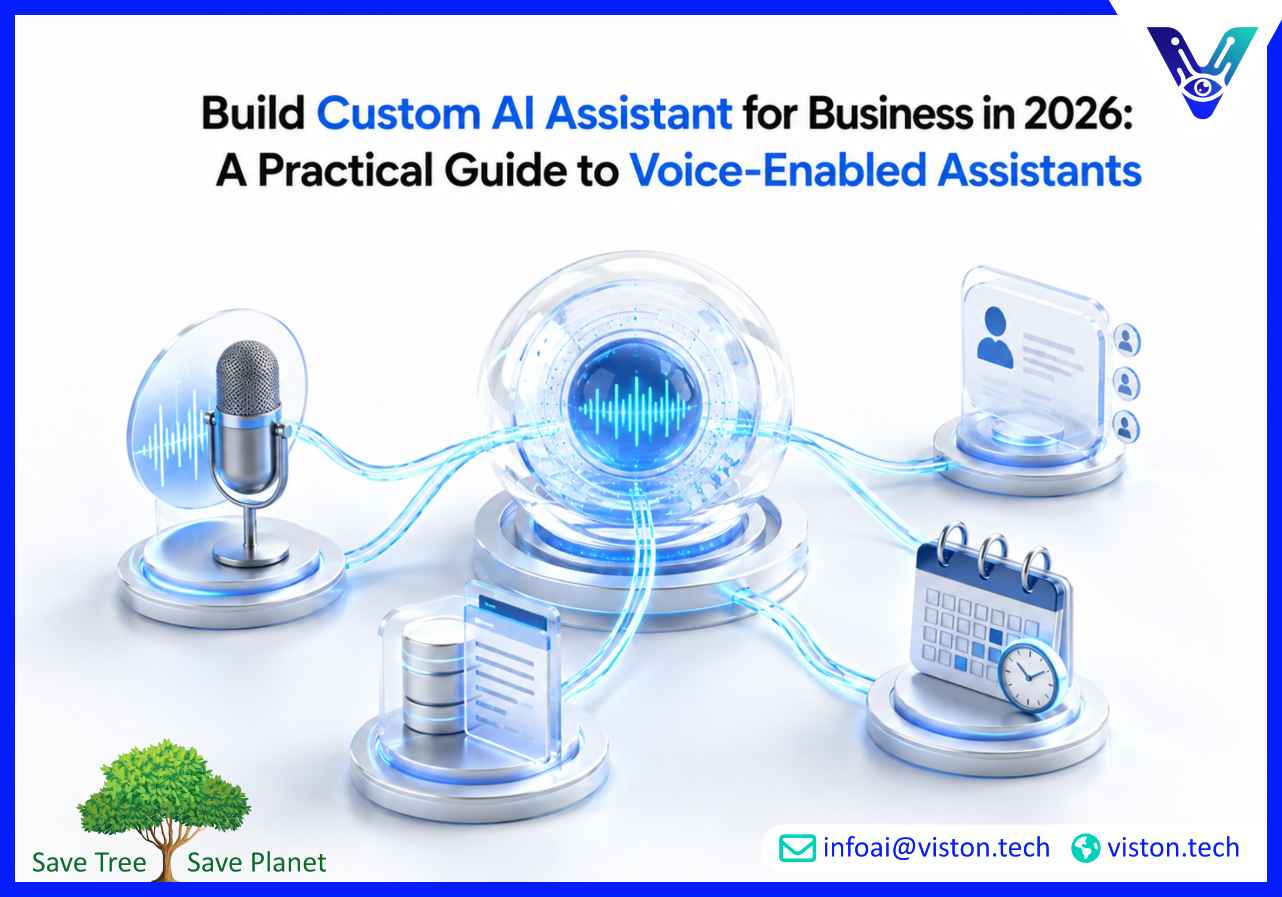
Businesses are moving beyond simple chatbots and scripted phone menus. In 2026, the need to build custom AI assistant for business operations is driven by faster service expectations, leaner teams, multilingual communication, and the demand for more natural customer and employee interactions.
To build custom AI assistant for business use, a company needs more than a generic voice bot or pre-built automation widget. A custom AI assistant is designed around a company’s workflows, customer journeys, internal systems, data sources, compliance needs, tone of communication, and operational goals.
When the main service is voice-enabled assistants, the solution must understand spoken language, identify user intent, manage multi-turn conversations, retrieve accurate information, trigger business actions, and respond in a natural voice. This may include answering customer questions, booking appointments, qualifying leads, collecting information, routing calls, supporting employees, updating CRM records, or escalating complex cases to human teams.
The value of a custom assistant comes from context. A retail business may need a voice assistant that checks order status and handles returns. A healthcare provider may need appointment scheduling, patient intake, and secure routing. A financial services company may need identity-aware conversations, compliance-sensitive responses, and audit-ready logs. A SaaS company may need voice support connected to knowledge bases, ticketing tools, and customer success workflows.
Unlike a basic IVR system, a modern voice-enabled AI assistant can interpret natural speech instead of forcing users through rigid menu options. Instead of asking callers to “press one” or repeat limited commands, it can understand intent, clarify missing details, and guide the conversation toward a useful outcome.
For business leaders, the goal is not to replace every human interaction. The goal is to reduce repetitive work, improve availability, capture better data, and give employees more time for high-value conversations. A well-built custom AI assistant becomes part of the operating model, not just a customer-facing experiment.
In 2026, buyers expect fast, accessible, and consistent communication across channels. Many customers still prefer voice when the issue is urgent, complex, emotional, or easier to explain verbally. At the same time, businesses are under pressure to reduce response delays, manage staffing costs, and maintain service quality outside traditional working hours.
Voice-enabled assistants help address these pressures by creating a conversational layer between users and business systems. They can respond instantly, collect structured information, answer common questions, and hand off complex cases with context already captured.
Customers no longer compare a company only with direct competitors. They compare every interaction with the fastest and most convenient digital experiences they have elsewhere. Long hold times, repeated questions, disconnected systems, and inconsistent answers create friction quickly.
A custom AI assistant can support a smoother experience by recognizing the user’s intent, accessing relevant data, and keeping the conversation focused. This is especially useful for service teams handling high call volumes, sales teams managing inbound inquiries, and operations teams coordinating repetitive internal requests.
Earlier voice bots were often limited to scripts. Modern assistants are increasingly connected to business applications, knowledge bases, CRMs, calendars, help desks, payment systems, logistics platforms, and internal databases. This makes them more useful because they can do more than speak; they can take action.
For example, a voice-enabled assistant can confirm an appointment, update a ticket, create a lead record, summarize a call, trigger a follow-up email, or notify a team member. These actions turn the assistant into a practical workflow tool.
Voice interaction also supports users who may not want to type, cannot easily navigate complex portals, or prefer communication in their spoken language. For global and multi-region businesses, voice-enabled assistants can support multilingual conversations, localized terminology, and more inclusive service delivery when designed properly.
To build custom AI assistant for business success, the solution needs the right technical and operational capabilities. The assistant must be accurate enough to be trusted, flexible enough to handle real conversations, and secure enough to operate inside business environments.
Speech recognition converts spoken words into text, while natural language understanding identifies intent, entities, and context. A business-grade assistant must handle accents, background noise, interruptions, incomplete phrases, and industry-specific language.
This is especially important in customer service, healthcare, logistics, finance, travel, hospitality, education, and field operations, where callers may use varied terminology. A weak assistant may misunderstand key details, while a strong one asks clarifying questions and confirms important information before taking action.
Real conversations rarely follow a perfect script. A customer may start with one question, change direction, ask a follow-up, or provide partial information. Multi-turn dialogue allows the assistant to maintain context across the conversation.
Good conversational design defines how the assistant greets users, confirms intent, handles uncertainty, manages errors, escalates issues, and closes the conversation. It also ensures the assistant speaks in a tone that fits the brand while remaining clear and useful.
A custom voice assistant becomes valuable when it connects to business systems. Common integrations include CRM platforms, help desk tools, booking systems, ERP software, payment gateways, knowledge bases, communication platforms, analytics dashboards, and workflow automation tools.
Without integration, the assistant can only provide general answers. With integration, it can check account status, retrieve order details, schedule meetings, update records, assign tickets, or trigger internal workflows. This connection between conversation and execution is one of the biggest differences between a basic assistant and an enterprise-ready solution.
Voice-enabled assistants may process sensitive customer, employee, or business data. Security and governance must be planned from the beginning. This includes access controls, data retention policies, encryption, authentication, audit logs, human review processes, and role-based permissions.
For regulated industries, the assistant should be designed around compliance expectations, escalation rules, and clear boundaries. It should not guess when accuracy matters. It should know when to transfer the conversation, request verification, or limit the type of information it can provide.
A custom assistant should improve over time. Businesses need reporting on call volumes, resolved intents, failed conversations, escalation rates, response accuracy, customer satisfaction signals, and operational outcomes. These insights help teams refine prompts, update knowledge sources, improve training data, and add new use cases gradually.
The best way to build custom AI assistant for business operations is to start with a focused use case, prove value, and then expand. Trying to automate every conversation at once usually creates complexity, risk, and poor user experience.
Strong early use cases are repetitive, high-volume, clearly defined, and measurable. Examples include appointment booking, lead qualification, order updates, FAQs, ticket intake, internal IT support, HR policy questions, payment reminders, service routing, and call summarization.
A good use case should have a clear business owner, defined success metrics, available knowledge sources, and a practical escalation path. If the process is unclear for humans, it will usually be difficult for an AI assistant to handle reliably.
Before development, teams should map what users ask, what information the assistant needs, where that information lives, what actions it should take, and when it should escalate. This planning reduces confusion during deployment.
For voice-enabled assistants, workflow mapping should also include fallback responses, confirmation points, authentication needs, silence handling, interruption handling, and handoff messages. Small design details can make a major difference in user trust.
A voice assistant is only as useful as the information it can access. Businesses should prepare approved FAQs, product information, service policies, internal procedures, pricing rules, support documentation, and escalation guidelines.
For more advanced assistants, retrieval-augmented generation can help the system answer questions from controlled business knowledge rather than relying only on a general model. This improves accuracy and makes updates easier when policies or services change.
Testing should include realistic calls, different accents, noisy environments, unexpected user behavior, incomplete information, emotional customers, and edge cases. The goal is to identify where the assistant misunderstands intent, responds too broadly, or fails to complete a task.
Human review is important before launch. Teams should check whether responses are accurate, brand-safe, compliant, and useful. After launch, ongoing monitoring helps improve the assistant based on real conversations.
Useful performance metrics may include containment rate, average handling time, first-contact resolution, missed call reduction, lead capture rate, appointment completion, escalation quality, customer satisfaction, employee time saved, and cost per interaction.
The right metrics depend on the business goal. A sales assistant should be measured differently from an internal HR assistant or a customer support voice agent. Clear measurement helps decision-makers decide when to expand the assistant into additional workflows.
Custom voice-enabled assistants can support many industries because the underlying need is consistent: businesses want faster communication, better workflow execution, and more scalable support. The strongest results usually come from matching the assistant to a specific operational pain point.
Voice assistants can answer routine questions, collect issue details, provide status updates, route calls, and summarize conversations for support teams. This reduces repetitive work while improving responsiveness for customers who need quick answers.
For sales teams, a custom assistant can qualify inbound leads, ask discovery questions, capture buyer intent, schedule consultations, and sync information to a CRM. This helps teams respond faster and focus on higher-intent opportunities.
Healthcare clinics, wellness providers, and appointment-led businesses can use voice assistants for scheduling, reminders, intake questions, and service routing. In sensitive environments, careful governance and escalation design are essential.
Retail and logistics businesses can use voice AI for order tracking, return requests, delivery updates, store information, product availability, and customer notifications. When connected to operational systems, the assistant can reduce support volume and improve customer visibility.
Custom AI assistants are not only for customers. They can also support employees by answering policy questions, creating tickets, retrieving documents, logging tasks, summarizing meetings, and helping teams navigate internal systems through voice commands.
Viston AI is relevant to businesses that want to build custom AI assistant for business communication, workflow automation, and customer engagement because its service portfolio includes Voice-Enabled AI Assistants, AI chatbot and virtual assistant development, NLP solutions, AI automation, system integration, and custom AI solution development.
For voice-enabled assistant projects, Viston AI’s capabilities align with the practical requirements businesses need in 2026: natural language processing, speech recognition, multi-turn dialogue design, LLMOps infrastructure, integration with business systems, and scalable deployment support. This matters because a voice assistant must do more than respond verbally; it must understand context, connect with operational data, and help complete real business tasks.
Viston AI can support use cases across customer support, lead qualification, appointment scheduling, internal workflow assistance, multilingual communication, and enterprise automation. Its broader AI service background also makes it relevant for organizations that need a voice assistant connected to CRM systems, help desks, analytics tools, knowledge bases, and automation platforms.
For companies across industries and global markets, the main advantage of working with a specialist is structured delivery. Discovery, proof of concept, development, integration, monitoring, and optimization all need to be handled carefully. Viston AI’s positioning around enterprise-grade AI solutions, conversational AI, automation, model monitoring, and business-focused implementation makes it a credible option for companies planning practical voice-enabled assistant adoption.
The best approach is to begin with one clear business use case, such as customer support, lead qualification, appointment booking, or internal help desk assistance. Then define the conversation flow, connect reliable data sources, integrate business systems, test real scenarios, and monitor performance after launch.
A chatbot usually communicates through text, while a voice-enabled AI assistant communicates through spoken language. Voice assistants require speech recognition, voice response generation, conversational timing, interruption handling, and stronger audio experience design. Many businesses use both voice and text channels together.
Yes. A properly built assistant can integrate with CRMs, help desks, calendars, ERP systems, knowledge bases, payment tools, communication platforms, and workflow automation systems. These integrations allow the assistant to retrieve information, update records, trigger actions, and support real business processes.
They can automate common tasks such as answering FAQs, booking meetings, qualifying leads, checking order status, creating support tickets, routing calls, sending reminders, collecting intake information, summarizing calls, and helping employees access internal knowledge.
Yes, if the use case is practical and measurable. Small and mid-sized businesses often benefit from assistants that reduce missed calls, improve response times, capture leads after hours, and handle repetitive questions without requiring large support teams.
Viston AI provides Voice-Enabled AI Assistants and related AI chatbot, NLP, automation, and integration services. This makes it relevant for businesses that need a custom assistant designed around real workflows, customer conversations, and business system connectivity.
To build custom AI assistant for business success in 2026, companies need a practical strategy, not just a voice interface. The assistant must understand real conversations, connect with trusted business systems, protect sensitive data, and support measurable outcomes. Voice-Enabled Assistants can improve customer service, sales response, appointment handling, internal productivity, and operational consistency when implemented with clear use cases and strong governance. For businesses looking for specialist support, Viston AI offers relevant capabilities in voice-enabled assistants, conversational AI, NLP, automation, and custom AI development.
