
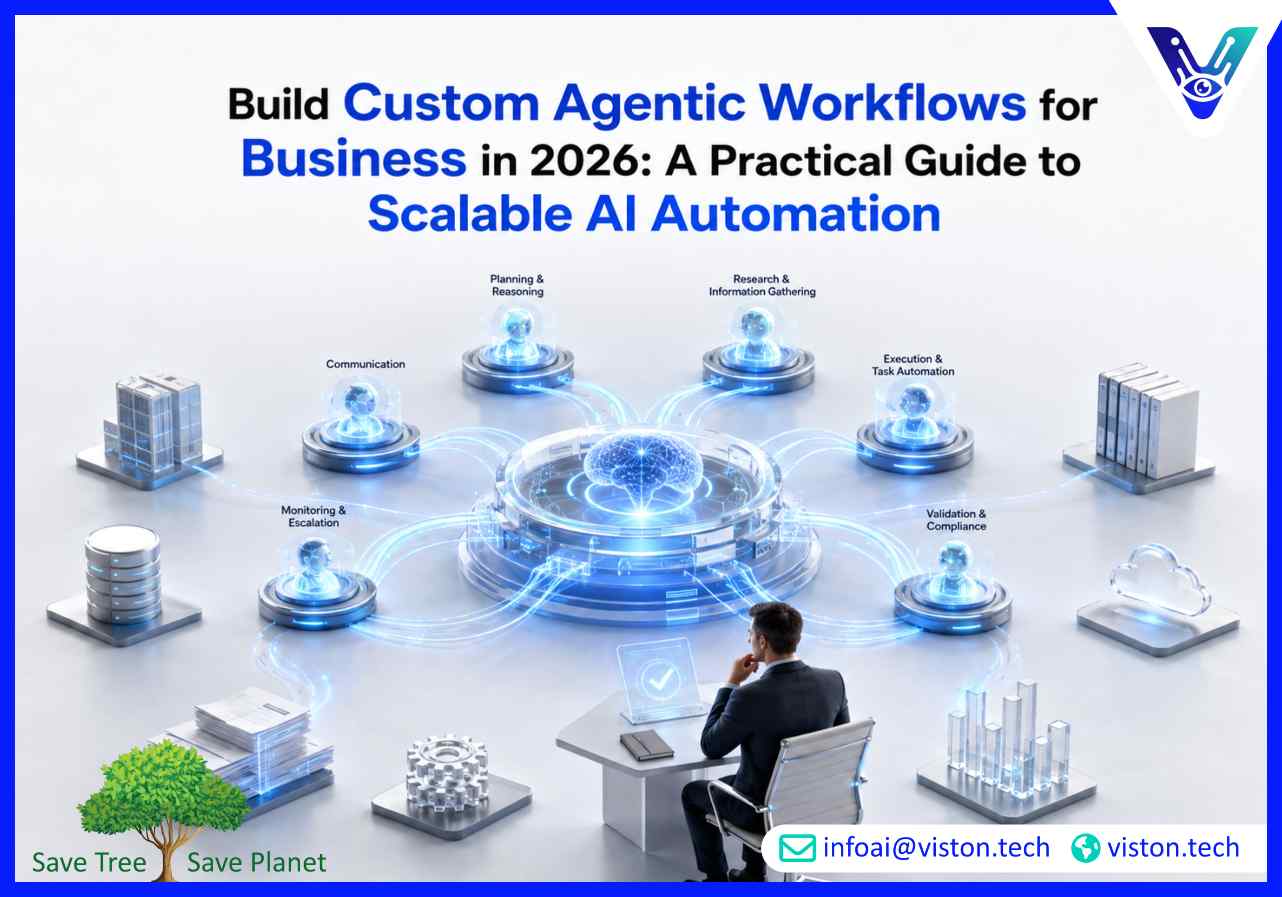
Businesses are rapidly moving beyond basic automation and chatbots toward intelligent systems that can plan, execute, adapt, and collaborate across business processes. Building custom agentic workflows allows organizations to automate complex operational tasks while maintaining control, visibility, and alignment with business goals. In 2026, custom agentic workflows are becoming a key driver of efficiency, scalability, and competitive advantage.
Custom agentic workflows are AI-powered process automation systems built around specialized AI agents that can perform tasks, make decisions within defined boundaries, interact with business systems, and collaborate with other agents or human teams
Unlike traditional automation, which follows fixed rules and predefined sequences, agentic workflows introduce contextual reasoning and adaptive execution. Each AI agent is assigned a specific responsibility and can independently perform actions while remaining aligned with business objectives and governance requirements.
A custom agentic workflow may include agents responsible for:
The result is a coordinated workflow where AI agents handle operational activities while humans maintain oversight for critical decisions and exceptions.
Organizations today operate across multiple platforms, departments, and data environments. Employees often spend significant time transferring information between systems, managing repetitive tasks, and coordinating workflows that involve multiple stakeholders.
Custom agentic workflows address these challenges by creating intelligent automation layers that connect systems, automate decision-making processes, and streamline operations.
As AI technology matures, businesses are increasingly focusing on workflow transformation rather than isolated AI deployments. Agentic systems provide a practical way to embed AI directly into day-to-day operations.
Building an effective agentic workflow requires more than connecting AI models to business systems. Successful implementations combine workflow design, orchestration, governance, integration, and monitoring.
Every agent should have a specific purpose within the workflow. Specialized agents generally perform better than broad, unrestricted agents because responsibilities remain focused and easier to manage.
Examples include:
Orchestration determines how agents interact, exchange information, trigger actions, and complete tasks. It controls workflow logic, dependencies, approvals, exception handling, and task sequencing.
Without proper orchestration, even highly capable agents can create inconsistent or unreliable outcomes.
Most valuable workflows depend on access to enterprise systems and operational data.
Common integrations include:
These integrations enable agents to perform meaningful business tasks rather than simply generating text responses.
As agentic workflows become more autonomous, governance becomes increasingly important. Businesses must establish permissions, approval processes, audit trails, monitoring mechanisms, and security safeguards to ensure reliable operation.
This is particularly important for customer-facing, financial, legal, and compliance-sensitive workflows.
Organizations often achieve the best results when they focus on business outcomes first and technology second. A structured implementation approach reduces risk and improves long-term adoption.
Start by selecting workflows that are repetitive, time-consuming, and operationally significant.
Common candidates include:
Before designing AI agents, businesses should document current workflows, decision points, approvals, exceptions, systems involved, and desired outcomes.
This process reveals opportunities where AI agents can create meaningful value.
Each workflow should be divided into manageable responsibilities assigned to dedicated agents. This improves reliability, monitoring, testing, and optimization.
Successful agentic workflows depend on secure access to data and business systems. Integration planning should account for authentication, permissions, data governance, and operational requirements.
Not every decision should be fully automated. Human-in-the-loop controls help organizations maintain accountability and reduce operational risk.
Approval checkpoints are especially valuable for:
Agentic workflows should evolve over time. Organizations should track workflow completion rates, response times, escalation frequency, operational savings, user satisfaction, and business impact.
Continuous optimization helps ensure workflows remain aligned with changing business needs.
Custom AI agents can support virtually every business function when properly integrated into operational processes.
As organizations expand their AI initiatives, custom agentic workflows increasingly serve as the foundation for enterprise-wide automation strategies.
For organizations looking to build custom agentic workflows, Viston AI provides expertise through its Custom AI Agent Solutions. The company focuses on designing AI agents that align with real business operations rather than isolated demonstrations or experimental deployments.
Building effective agentic workflows requires a combination of workflow analysis, agent architecture design, orchestration planning, system integration, governance controls, and ongoing optimization. Viston AI helps businesses identify suitable automation opportunities, define agent responsibilities, integrate AI with existing systems, and deploy scalable workflow solutions that support measurable business outcomes.
Its approach is particularly relevant for companies seeking to automate complex operational processes involving multiple systems, data sources, teams, and decision points. By combining custom AI agent development with workflow-focused implementation, organizations can create practical automation solutions that improve efficiency, support growth, and maintain operational control.
As businesses increasingly adopt agentic AI in 2026, specialized implementation expertise becomes critical to ensuring workflows remain secure, reliable, and aligned with business objectives.
A custom agentic workflow is an AI-powered business process where specialized agents perform tasks, make decisions, interact with systems, and collaborate to complete operational workflows.
Traditional automation follows fixed rules. Agentic workflows use AI agents that can reason, adapt to context, retrieve information, and coordinate actions across multiple systems.
High-volume, repetitive, data-driven workflows such as customer onboarding, lead qualification, support operations, document processing, and workflow management are often strong candidates.
Yes. Most production-ready agentic workflows depend on integrations with CRM platforms, databases, support systems, APIs, ERP software, and other operational tools.
Some tasks can be fully automated, but many organizations implement human oversight for approvals, compliance reviews, financial decisions, and high-impact business actions.
Viston AI provides Custom AI Agent Solutions that help businesses design, build, integrate, and deploy agentic workflows tailored to operational requirements and business objectives.
Businesses seeking to build custom agentic workflows in 2026 are investing in a more advanced approach to automation that combines AI reasoning, workflow orchestration, system integration, and operational governance. When designed correctly, agentic workflows can improve efficiency, reduce manual effort, accelerate decision-making, and support scalable business growth. Through Custom AI Agent Solutions, Viston AI helps organizations transform complex business processes into intelligent, coordinated workflows that deliver practical and measurable operational value.
