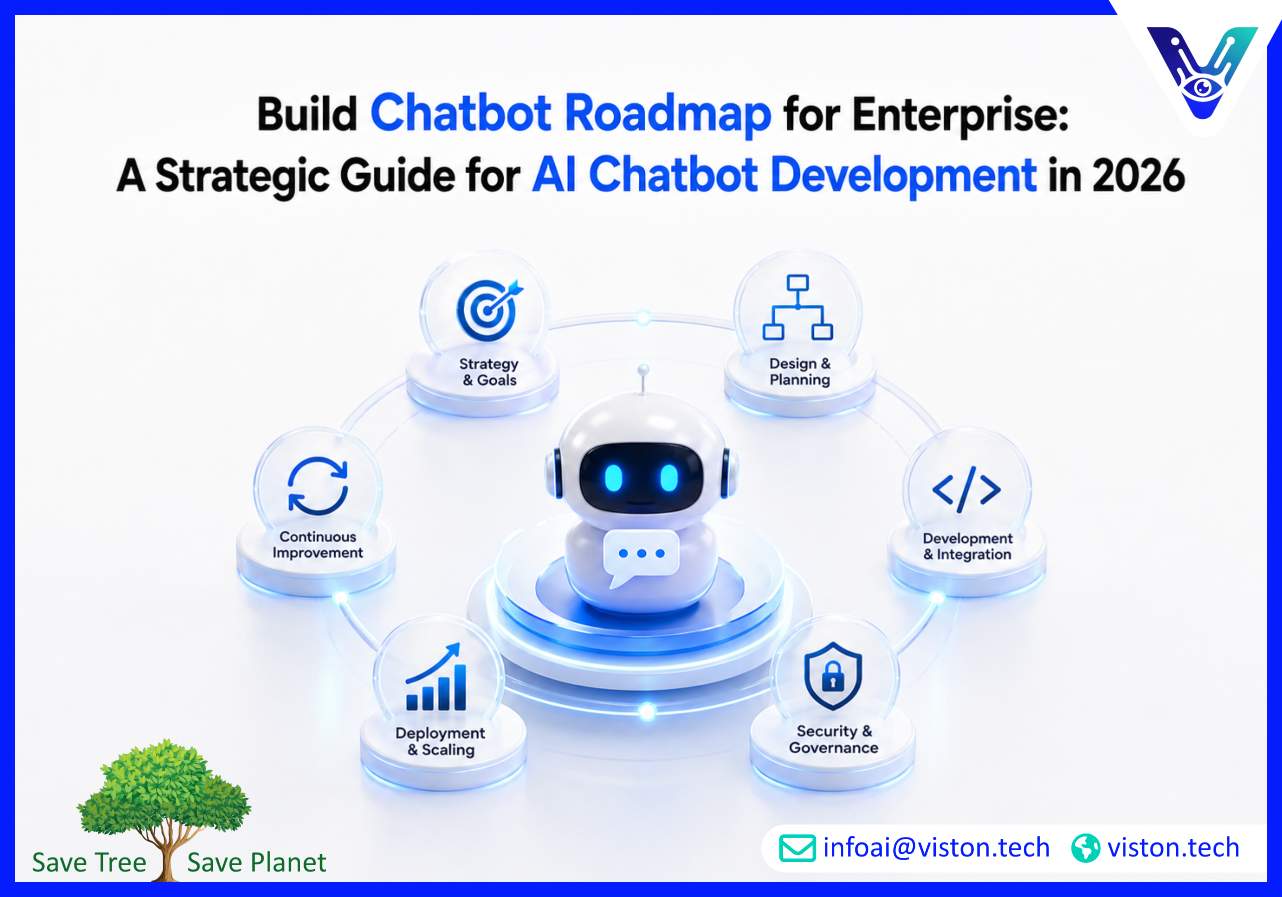
Build Chatbot Roadmap for Enterprise: A Strategic Guide for AI Chatbot Development in 2026
Enterprises in 2026 are rapidly shifting toward AI-first operations, where conversational systems play a central role in customer engagement, internal automation, and digital transformation. However, success depends on more than deploying a chatbot—it requires a structured, scalable, and business-aligned enterprise chatbot roadmap that ensures long-term value, integration readiness, and measurable outcomes.This guide is designed using an enterprise-grade content framework to help organizations plan, design, and scale chatbot initiatives effectively across global operations.
Why an Enterprise Chatbot Roadmap Matters in 2026
An enterprise chatbot roadmap is a strategic blueprint that defines how conversational AI is planned, developed, integrated, and scaled across business functions. Without it, organizations often face fragmented deployments and limited ROI.Modern enterprises deal with complex systems, including CRM platforms, ERP environments, customer service tools, and multiple digital channels. A roadmap ensures all these systems work together through AI-driven interactions.
Key Challenges Without a Roadmap
Disconnected chatbot experiences across departments
Poor integration with enterprise systems
Limited scalability across channels
Inconsistent user experience
Low automation efficiency
Difficulty tracking ROI and performance
A structured approach ensures AI chatbot development aligns with business outcomes rather than isolated technical implementations.
Core Components of an Enterprise Chatbot Roadmap
Building an effective enterprise chatbot roadmap requires a layered strategy that combines business objectives, technical architecture, and operational governance.
1. Business Alignment and Objective Definition
Every enterprise chatbot initiative must begin with clear business goals. These goals guide system design, integration depth, and AI capabilities.
Customer support automation
Lead generation and qualification
Employee self-service automation
Sales and marketing assistance
Operational workflow automation
Each objective determines the complexity of AI chatbot development and required integrations.
2. System and Data Architecture Planning
Enterprise chatbots must connect with multiple systems to deliver real-time, personalized responses.
CRM systems like Salesforce or HubSpot
ERP platforms for operational data
Helpdesk systems for ticketing workflows
Marketing automation tools
Internal knowledge bases
A strong architecture ensures secure, scalable, and low-latency data exchange across all systems.
3. Conversational Design and User Journey Mapping
User experience is central to chatbot success. Enterprises must design structured conversation flows that guide users efficiently.
Intent recognition mapping
Multi-turn conversation design
Fallback and escalation logic
Personalized response structures
Context-aware interactions
Well-designed journeys improve engagement and reduce user drop-off rates significantly.
4. AI Model Strategy and Development Approach
AI chatbot development in enterprises typically involves a hybrid model combining rule-based logic and LLM-powered intelligence.
Natural Language Understanding (NLU)
Large Language Models (LLMs)
Retrieval-Augmented Generation (RAG)
Intent classification systems
Context memory management
The right mix depends on compliance requirements, use case complexity, and performance expectations.
5. Integration and Automation Layer
Integration is the backbone of enterprise chatbot success. Without it, chatbots remain isolated tools rather than business assets.
API-based system integration
Workflow automation engines
Omnichannel deployment support
Event-driven architecture
Secure authentication frameworks
This layer ensures chatbots can execute real business actions, not just provide responses.
6. Security, Compliance, and Governance
Enterprises must prioritize governance from the beginning of chatbot development.
Data encryption and protection
GDPR and global compliance alignment
Role-based access control
Audit logging and monitoring
AI usage governance policies
Strong governance ensures responsible AI adoption and reduces regulatory risk.
Phased Implementation of Enterprise Chatbot Roadmap
Phase 1: Strategy and Discovery
This phase focuses on identifying use cases, business objectives, and system readiness. Stakeholders define what success looks like and prioritize chatbot applications across departments.
Phase 2: Design and Prototyping
Teams develop initial chatbot workflows, design conversation structures, and build prototypes for validation. Early testing ensures alignment with user expectations.
Phase 3: Development and Integration
AI models are trained, APIs are connected, and chatbot systems are integrated with enterprise tools. This phase is the most technically intensive part of the roadmap.
Phase 4: Testing and Optimization
Enterprises conduct functional, performance, and security testing. Feedback loops help refine responses, improve accuracy, and optimize workflows.
Phase 5: Deployment and Scaling
Chatbots are deployed across channels such as websites, mobile apps, WhatsApp, and internal systems. Scaling begins gradually based on performance metrics.
Phase 6: Continuous Improvement
AI systems evolve through ongoing training, analytics, and optimization. Enterprises continuously refine chatbot behavior to improve ROI and user satisfaction.
Enterprise Benefits of a Structured Chatbot Roadmap
Improved operational efficiency across departments
Reduced customer service workload
Faster response times and resolution rates
Enhanced customer experience and engagement
Scalable automation across global teams
Better data-driven decision-making
A roadmap ensures these benefits are achieved systematically rather than randomly.
Viston AI Expertise in Enterprise AI Chatbot Development
Viston AI specializes in building enterprise-grade conversational AI systems designed to align with complex business environments and multi-system architectures. Its AI chatbot development approach focuses on practical business outcomes, ensuring that chatbots are not just conversational interfaces but fully integrated digital assets.Enterprises adopting chatbot solutions often struggle with fragmented system integration, inconsistent user experience, and scalability challenges. Viston AI addresses these issues by designing structured chatbot roadmaps that connect AI models with real business workflows, including CRM systems, customer support platforms, enterprise databases, and automation tools.By combining LLM-based intelligence with secure integration frameworks, Viston AI enables organizations to deploy chatbots that support customer engagement, internal operations, and enterprise automation at scale. Its development approach emphasizes reliability, compliance, and performance optimization, making it suitable for global enterprises operating in complex regulatory and operational environments.As AI adoption accelerates in 2026, Viston AI continues to help organizations transform conversational AI from experimental tools into enterprise-wide systems that drive measurable business impact.
Frequently Asked Questions
What is an enterprise chatbot roadmap?
An enterprise chatbot roadmap is a strategic plan that outlines how an organization will design, develop, integrate, and scale chatbot systems across its business operations.
Why do enterprises need a chatbot roadmap?
It ensures structured implementation, reduces integration risks, improves scalability, and aligns chatbot development with business goals.
What systems are typically included in enterprise chatbot integration?
Common systems include CRM, ERP, helpdesk platforms, marketing tools, internal databases, and communication platforms.
How long does enterprise chatbot development take?
Depending on complexity, it can range from a few weeks for basic systems to several months for large-scale enterprise deployments.
What makes enterprise chatbot development different from basic chatbot creation?
Enterprise chatbot development involves deeper system integration, stronger security, scalability planning, and alignment with complex business workflows.
How does Viston AI support enterprise chatbot development?
Viston AI builds structured AI chatbot development solutions that integrate with enterprise systems, enabling scalable automation and improved business efficiency.
Conclusion
A well-defined enterprise chatbot roadmap is essential for organizations aiming to leverage AI effectively in 2026. It ensures that chatbot initiatives are strategically aligned with business goals, technically scalable, and operationally efficient. From planning and design to integration and optimization, every phase plays a critical role in long-term success. Enterprises that invest in structured AI chatbot development are better positioned to improve customer experience, streamline operations, and achieve measurable digital transformation outcomes. With expert support from providers like Viston AI, organizations can confidently move from experimentation to enterprise-wide conversational AI adoption.