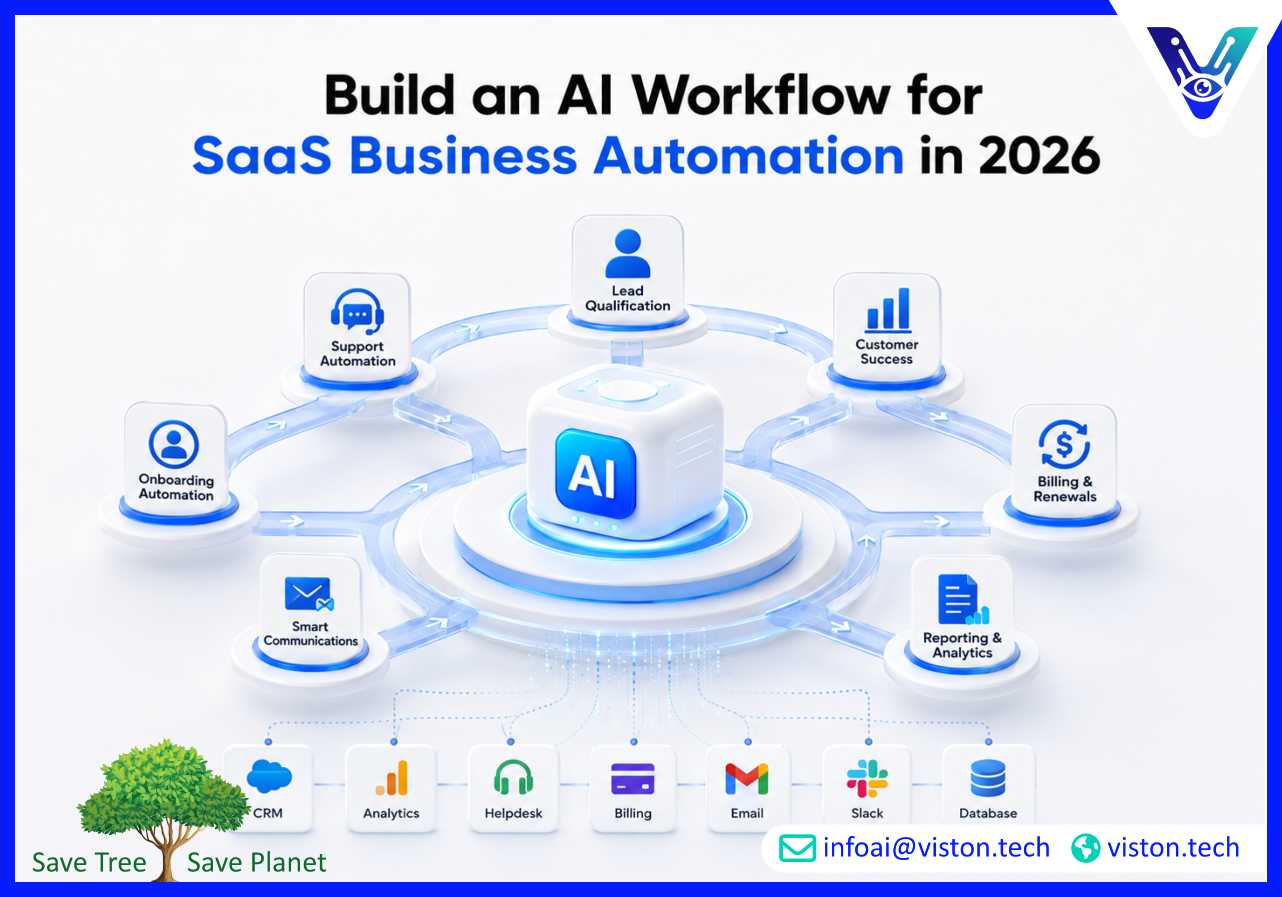
Build an AI Workflow for SaaS Business Automation in 2026
SaaS businesses run on recurring processes: onboarding, billing, support, renewals, reporting, product feedback, and customer success. Building an AI workflow for SaaS business automation helps teams reduce manual work, improve response speed, and connect decisions across systems without losing control.
What an AI Workflow for SaaS Business Automation Means
An AI workflow for SaaS business automation is a structured process where AI agents, business rules, integrations, and human approvals work together to complete operational tasks across a SaaS company. Unlike basic automation, agentic AI workflows can interpret context, make decisions, trigger actions, and adapt based on data.For SaaS companies, this can include automating lead qualification, customer onboarding, support triage, churn risk detection, renewal reminders, usage analysis, invoice follow-ups, internal reporting, and product feedback routing.The goal is not to replace every team member. The goal is to remove repetitive coordination work so sales, support, operations, product, and finance teams can focus on higher-value decisions.
Why SaaS Companies Need Agentic AI Workflows in 2026
In 2026, SaaS teams are expected to operate faster, serve customers more personally, and scale without adding unnecessary headcount. Customers expect quick onboarding, accurate support, proactive communication, and smooth renewals. Manual processes make those expectations difficult to meet.Agentic AI workflows help SaaS companies manage complexity by connecting data from CRM platforms, product analytics tools, billing systems, support desks, email, Slack, documentation, and internal databases.
Common SaaS workflow problems AI can solve
Slow lead response and inconsistent follow-up
Manual customer onboarding tasks
Unorganized support tickets and repeated queries
Poor visibility into account health and churn signals
Delayed renewal and upsell opportunities
Manual reporting across disconnected SaaS tools
Repetitive internal operations handled by overloaded teams
A well-designed workflow gives each team a clearer system for action. AI agents can collect information, summarize account context, recommend next steps, and execute approved tasks inside existing business tools.
How to Build an AI Workflow for SaaS Business Automation
1. Start with one high-value SaaS process
The best AI workflows begin with a specific business process, not a broad automation idea. For example, a SaaS company may start with customer onboarding because it directly affects activation, retention, and support volume.A strong first workflow should have clear inputs, repeatable steps, measurable outcomes, and known exceptions. This makes it easier to design, test, monitor, and improve.
2. Map the current workflow
Before adding AI agents, document how the process works today. Identify who receives the request, what systems are checked, what decisions are made, what messages are sent, and where delays happen.For a SaaS onboarding workflow, the map may include CRM deal status, payment confirmation, workspace creation, welcome emails, product setup, training resources, support assignment, and success manager alerts.
3. Define agent roles
Agentic AI workflows work best when agents have specific responsibilities. A SaaS automation system may include:
A research agent that gathers account and usage data
A decision agent that classifies priority or risk
A communication agent that drafts customer messages
An operations agent that updates systems
A monitoring agent that checks workflow completion
Each agent should have defined permissions, data access, escalation rules, and output requirements.
4. Connect the right SaaS systems
AI workflows become valuable when they integrate with the systems teams already use. Common integrations include CRM, helpdesk, billing, analytics, email, calendar, project management, data warehouse, and communication tools.The workflow should avoid unnecessary tool switching. Instead, agents should retrieve data, trigger updates, and notify the right people inside the existing operating environment.
5. Add human approval where risk is high
Not every action should be fully autonomous. SaaS teams should use human approval for pricing changes, contract decisions, cancellation responses, sensitive customer communication, refunds, account suspension, or compliance-related actions.This keeps automation useful while protecting customer trust and business control.
Practical SaaS Use Cases for Agentic AI Workflows
Lead qualification and sales routing
An AI workflow can review inbound leads, enrich company data, check fit against ideal customer profiles, score urgency, and route qualified leads to the right sales representative. It can also draft personalized follow-up emails based on company size, industry, pain point, and product interest.
Customer onboarding automation
AI agents can trigger onboarding tasks after a deal closes, generate setup checklists, send welcome messages, assign internal owners, monitor first product actions, and alert customer success teams when users are inactive.
Support ticket triage
Support automation can classify tickets by issue type, urgency, customer tier, product area, and sentiment. The workflow can suggest responses, retrieve documentation, escalate technical issues, and identify repeated problems for product teams.
Churn risk monitoring
An AI workflow can analyze product usage, support history, renewal dates, payment issues, NPS feedback, and account engagement. When risk signals appear, the workflow can notify customer success teams with recommended actions.
Finance and billing operations
SaaS billing workflows can detect failed payments, generate reminders, reconcile subscription changes, update finance records, and flag unusual account activity for review.
How Viston AI Supports SaaS Business Automation with Agentic AI Workflows
Viston AI provides AI automation and workflow bot capabilities that align closely with SaaS business automation needs. Its service focus includes intelligent automation that combines rule-based logic with generative AI to streamline operations such as emails, tasks, accounting, HR processes, and workflow execution.For SaaS businesses, this type of capability is relevant because many operational bottlenecks sit between systems rather than inside one tool. A SaaS company may have customer data in a CRM, usage signals in analytics, support tickets in a helpdesk, invoices in billing software, and team communication in Slack or email. Agentic AI workflows can connect these signals into a more coordinated operating model.Viston AI’s relevance comes from its focus on practical workflow automation rather than isolated AI experiments. For SaaS teams, this means designing workflows that can reduce manual processing, improve task accuracy, support internal teams, and create more consistent customer experiences. Its approach is especially useful for companies that want AI agents to support business operations while maintaining structured rules, integrations, and review points.
Frequently Asked Questions
What is an AI workflow for SaaS business automation?
It is a connected process where AI agents, software integrations, business rules, and human approvals automate SaaS operations such as onboarding, support, billing, reporting, sales follow-up, and customer success tasks.
How are agentic AI workflows different from traditional automation?
Traditional automation follows fixed rules. Agentic AI workflows can interpret context, choose next steps, use tools, summarize data, and adapt to different business situations while still following governance rules.
Which SaaS processes should be automated first?
Start with processes that are repetitive, high-volume, measurable, and connected to revenue or customer experience. Good starting points include lead routing, onboarding, support triage, churn alerts, and renewal workflows.
Are AI workflows safe for SaaS companies?
They can be safe when designed with access controls, data protection, audit logs, approval steps, monitoring, and clear escalation paths. Sensitive actions should not be fully automated without review.
Can Viston AI help build SaaS automation workflows?
Viston AI’s AI automation and workflow bot capabilities are relevant for SaaS companies that want to streamline operational tasks, connect business systems, and use agentic AI workflows for more efficient execution.
Conclusion
Building an AI workflow for SaaS business automation is no longer just a technical upgrade. It is an operational strategy for improving speed, accuracy, visibility, and scalability across the SaaS business model. The most effective workflows begin with clear business problems, connect the right systems, use agents with defined roles, and include human oversight where needed. With specialist support in Agentic AI Workflows, Viston AI can help SaaS businesses move from manual task handling to smarter, more connected automation.