
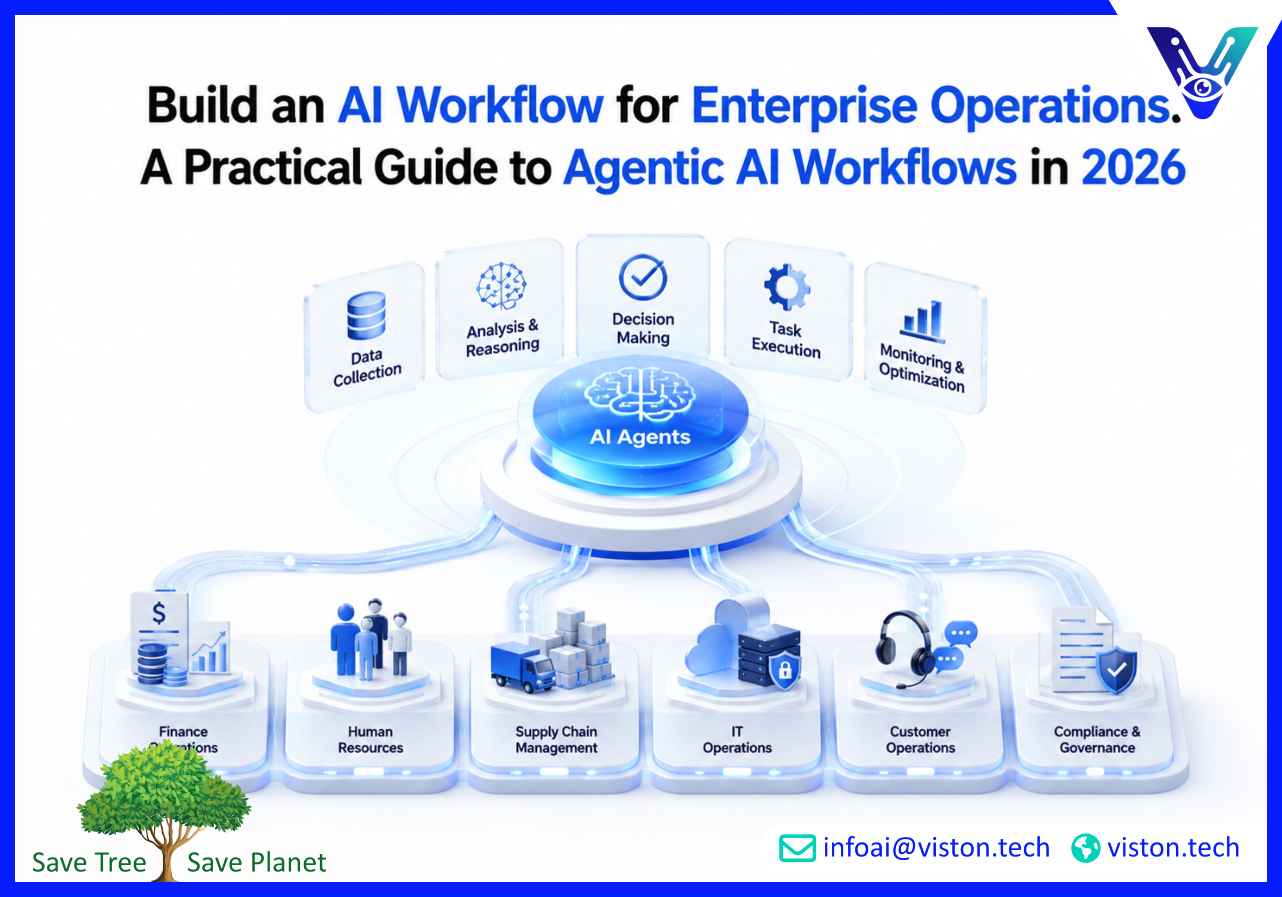
Enterprise operations have become increasingly complex as organizations manage growing volumes of data, applications, business processes, compliance requirements, and customer expectations. Traditional automation can handle repetitive tasks, but modern enterprises need intelligent systems capable of reasoning, coordinating actions, and adapting to changing conditions. This is where agentic AI workflows are transforming enterprise operations in 2026.
An AI workflow for enterprise operations is a structured system where intelligent AI agents collaborate to automate, monitor, optimize, and execute business processes across departments. Unlike conventional automation that follows predefined rules, agentic workflows can evaluate situations, make decisions, coordinate actions, and continuously improve outcomes.
Enterprise operations typically involve multiple departments, including:
Each of these functions generates data and requires coordination among people, systems, and business rules. Agentic AI workflows help unify these processes through intelligent orchestration.
Instead of employees manually transferring information between systems, reviewing reports, or triggering follow-up actions, AI agents can manage these responsibilities autonomously while maintaining oversight and accountability.
Modern enterprises face several operational challenges:
Traditional workflow automation solves only a portion of these problems because it relies heavily on predefined logic. Agentic AI workflows introduce a higher level of intelligence by combining automation, reasoning, contextual understanding, and decision support.
Organizations are increasingly adopting AI-driven operational frameworks because they help teams focus on strategic activities while intelligent agents handle repetitive and time-consuming processes.
A successful enterprise AI workflow consists of multiple interconnected components that work together to achieve operational goals.
The workflow begins by gathering information from various enterprise systems such as:
The data collection layer ensures agents have access to accurate and current information.
This serves as the central coordination system where specialized AI agents communicate and collaborate.
Examples include:
Each agent performs specific responsibilities while sharing relevant information with other agents when necessary.
The decision engine evaluates incoming information and determines the best course of action.
It may consider:
This enables workflows to make intelligent recommendations or execute approved actions automatically.
Once decisions are made, the execution layer performs tasks across connected enterprise applications.
Examples include:
Continuous monitoring allows the workflow to track outcomes, identify anomalies, and improve future performance.
This layer supports:
To understand how agentic AI workflows function, consider an enterprise procurement process.
An employee submits a procurement request through an internal portal.
An AI validation agent checks:
The risk agent evaluates:
The workflow determines whether the request can be:
The execution agent:
Operational dashboards are updated automatically, providing leadership teams with real-time procurement visibility.
What previously required multiple employees and several days can often be completed within minutes.
Agentic AI workflows are being deployed across numerous operational environments.
These applications demonstrate how agentic AI workflows can create measurable improvements across enterprise functions.
As organizations explore advanced operational automation, the success of an AI initiative often depends on the design, integration, governance, and scalability of the workflow architecture itself. This is where specialized expertise becomes critical.
Viston AI focuses on Agentic AI Workflows that help enterprises streamline complex business operations through intelligent automation and multi-agent orchestration. Rather than treating automation as a collection of isolated tasks, the approach centers on building coordinated systems where AI agents can gather information, reason through business scenarios, trigger actions, and collaborate across enterprise platforms.
For organizations managing large-scale operations, agentic workflows can connect ERP systems, CRM platforms, data environments, customer service applications, operational dashboards, and internal business processes into a unified automation framework. This creates opportunities to reduce manual intervention while improving consistency, visibility, and decision-making speed.
Enterprise leaders increasingly require solutions that support governance, security, scalability, and measurable operational outcomes. Agentic AI workflows designed with these priorities can help businesses improve process efficiency, accelerate response times, reduce operational friction, and maintain oversight across critical workflows.
As enterprise adoption of AI continues to expand throughout 2026, organizations are looking for practical implementations that align technology investments with business objectives. Specialized workflow design, integration capabilities, and operational understanding remain essential components of successful deployment strategies.
An agentic AI workflow is a system where multiple AI agents collaborate to analyze information, make decisions, execute tasks, and optimize business processes with minimal human intervention.
Traditional automation follows predefined rules. Agentic AI workflows can reason, adapt to changing situations, coordinate across systems, and make context-aware decisions.
Finance, HR, IT, customer support, procurement, operations, supply chain, and compliance teams commonly benefit from intelligent workflow automation.
When implemented correctly, they can incorporate access controls, audit trails, governance policies, compliance monitoring, and enterprise-grade security frameworks.
Implementation timelines vary depending on workflow complexity, system integrations, governance requirements, and organizational readiness. Pilot projects often begin with a single process before scaling across departments.
Viston AI specializes in Agentic AI Workflows that support operational automation, intelligent orchestration, enterprise integrations, and scalable AI-driven business process optimization.
Building an AI workflow for enterprise operations is no longer simply an automation initiative. In 2026, organizations are increasingly adopting agentic AI workflows to improve efficiency, accelerate decision-making, reduce operational complexity, and create more adaptable business processes. By combining intelligent agents, enterprise integrations, governance controls, and continuous optimization, businesses can transform how operations are managed across departments. Organizations that invest in well-designed Agentic AI Workflows are better positioned to scale efficiently, respond to changing business conditions, and achieve sustainable operational excellence. For enterprises evaluating this transition, specialized expertise from providers such as Viston AI can play an important role in successful implementation.
