
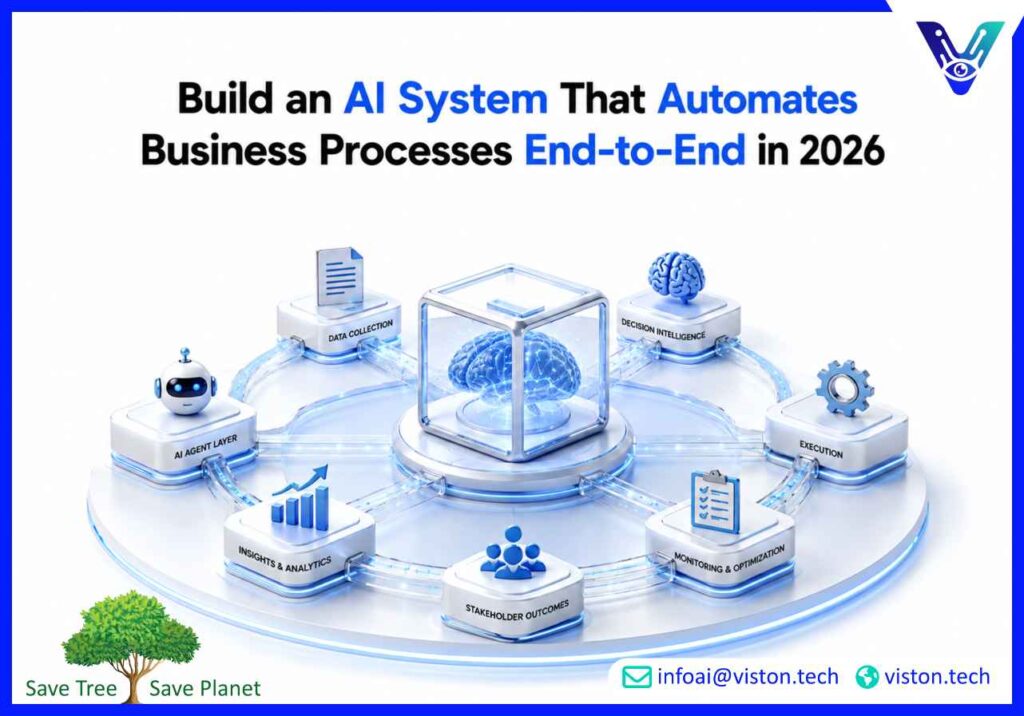
As organizations face increasing pressure to improve efficiency, reduce operational costs, and scale faster, AI-driven business process automation has become a strategic priority. Modern enterprises are no longer looking for isolated automation tools. Instead, they are investing in intelligent systems capable of managing complete workflows from data collection and analysis to decision-making and execution. This is where agentic AI workflows are transforming business operations by enabling end-to-end process automation across departments and functions.
End-to-end business process automation refers to the use of intelligent technologies to automate entire business workflows without requiring continuous human intervention. Unlike traditional automation, which typically handles repetitive tasks, modern AI systems can understand context, make decisions, coordinate actions, and optimize outcomes throughout a process lifecycle.
These systems combine artificial intelligence, machine learning, workflow orchestration, integrations, business rules, and autonomous agents to create self-operating business environments.
Examples include:
Rather than automating individual tasks, agentic AI workflows automate entire business outcomes.
Organizations today operate in highly competitive markets where speed, accuracy, and scalability directly impact growth. Manual processes often create bottlenecks that slow down operations and increase costs.
Modern AI systems address these challenges by creating intelligent operational frameworks capable of handling complex workflows autonomously.
Businesses manage increasing volumes of data, customers, vendors, and internal workflows. Traditional manual operations struggle to keep pace with growing business demands.
Agentic AI systems help organizations manage complexity by coordinating multiple tasks, systems, and stakeholders through intelligent workflow orchestration.
Business leaders need real-time insights and immediate action. AI-powered workflows can analyze information, identify opportunities, and trigger actions instantly.
Companies increasingly want employees focused on strategic work instead of repetitive administrative activities. Intelligent automation allows teams to concentrate on innovation, customer engagement, and growth initiatives.
One of the biggest advantages of end-to-end AI automation is the ability to scale operations without dramatically increasing workforce costs.
Building a fully automated business process system requires several interconnected components working together seamlessly.
Every AI workflow begins with data.
The system continuously gathers information from:
This layer ensures agents always have access to current operational information.
AI agents act as autonomous workers within the workflow.
Each agent performs specialized responsibilities such as:
Multiple agents can collaborate to achieve larger business objectives.
The orchestration layer coordinates activities between agents, systems, and business processes.
Its responsibilities include:
This layer ensures all business activities move efficiently from start to finish.
Modern AI systems must make informed decisions.
This layer uses:
These capabilities allow AI agents to select the best action based on current circumstances.
Once decisions are made, actions must be executed.
The execution layer integrates with business applications and carries out tasks such as:
To understand the value of agentic AI workflows, consider a lead management process.
New leads arrive from websites, advertising campaigns, social media, and referrals.
The AI system automatically captures and consolidates lead data.
An AI agent analyzes company size, industry, budget indicators, engagement history, and purchase intent.
The system assigns qualification scores and prioritizes opportunities.
Additional agents gather information from public sources, databases, and integrated platforms.
The lead profile becomes more comprehensive.
AI generates personalized communications based on customer characteristics and buying signals.
Messages are delivered through preferred communication channels.
The workflow tracks responses, schedules follow-ups, and adjusts engagement strategies automatically.
Once readiness thresholds are met, qualified opportunities are transferred to sales teams with complete context.
The entire process operates with minimal manual involvement.
Automated workflows eliminate repetitive manual activities that consume valuable employee time.
Organizations can process higher workloads without increasing operational costs.
Human errors often occur in repetitive processes. AI systems consistently follow predefined logic and validation procedures.
This improves data quality and operational reliability.
Tasks that previously required days can often be completed within minutes.
Reduced turnaround times improve customer experiences and internal productivity.
AI systems analyze larger datasets than humans can efficiently process.
This enables more informed and consistent business decisions.
As business volumes grow, AI systems can handle increasing workloads without proportional staffing increases.
Advanced agentic systems learn from operational data and continuously refine workflow performance.
While the benefits are significant, successful implementation requires careful planning.
Most businesses operate multiple software platforms. AI workflows must integrate effectively across these systems.
AI performance depends heavily on data quality. Poor data can lead to inaccurate outcomes and ineffective automation.
Organizations must establish clear governance frameworks to ensure responsible AI usage.
Enterprise-grade AI systems require strong access controls, encryption, monitoring, and security protocols.
Employees must understand how AI systems support their work rather than replace critical human expertise.
Organizations seeking to build end-to-end business process automation often require specialized expertise in workflow design, AI orchestration, system integration, and operational optimization. This is where Viston AI’s focus on Agentic AI Workflows becomes highly relevant.
Viston AI helps businesses design intelligent workflow architectures that connect data sources, AI agents, enterprise platforms, and operational processes into cohesive automation systems. Rather than automating isolated tasks, the approach centers on creating coordinated workflows capable of managing complete business outcomes.
Agentic AI Workflows can support organizations looking to streamline lead generation, customer service operations, internal process management, reporting workflows, and decision-support systems. Through intelligent orchestration, multiple AI agents can collaborate to perform research, analysis, execution, monitoring, and optimization functions across business environments.
As enterprises increasingly prioritize scalability, governance, security, and measurable outcomes, workflow architecture becomes a critical success factor. Specialized expertise in workflow orchestration, AI integration, business process mapping, and automation strategy helps organizations implement systems that remain reliable as operational complexity grows.
For businesses exploring large-scale automation initiatives in 2026, a structured agentic workflow approach can provide a practical path toward greater efficiency, responsiveness, and operational scalability.
An end-to-end AI automation system manages entire workflows from data collection and decision-making to execution and monitoring without requiring constant human intervention.
Traditional automation follows predefined rules for repetitive tasks. Agentic AI workflows can reason, adapt, make decisions, coordinate multiple systems, and optimize outcomes dynamically.
Common examples include customer onboarding, lead management, procurement, financial operations, HR workflows, customer support, reporting, compliance monitoring, and supply chain management.
Yes. Modern AI platforms allow businesses of various sizes to automate workflows and improve efficiency without requiring enterprise-scale infrastructure.
These systems often combine large language models, machine learning, workflow orchestration platforms, APIs, business process automation tools, analytics platforms, and enterprise integrations.
Viston AI specializes in Agentic AI Workflows that help organizations design, orchestrate, and automate complex business processes through intelligent AI-driven workflow architectures.
Building an AI system that automates business processes end-to-end is becoming a strategic advantage for organizations seeking greater efficiency, scalability, and operational agility in 2026. Agentic AI workflows go beyond traditional automation by enabling intelligent decision-making, autonomous task execution, and continuous process optimization across entire business functions. As organizations navigate increasingly complex operational environments, investing in structured workflow automation can significantly improve productivity, responsiveness, and business outcomes. For companies exploring advanced automation strategies, specialized expertise in Agentic AI Workflows can help transform fragmented processes into intelligent, scalable operational systems that support long-term growth.
