
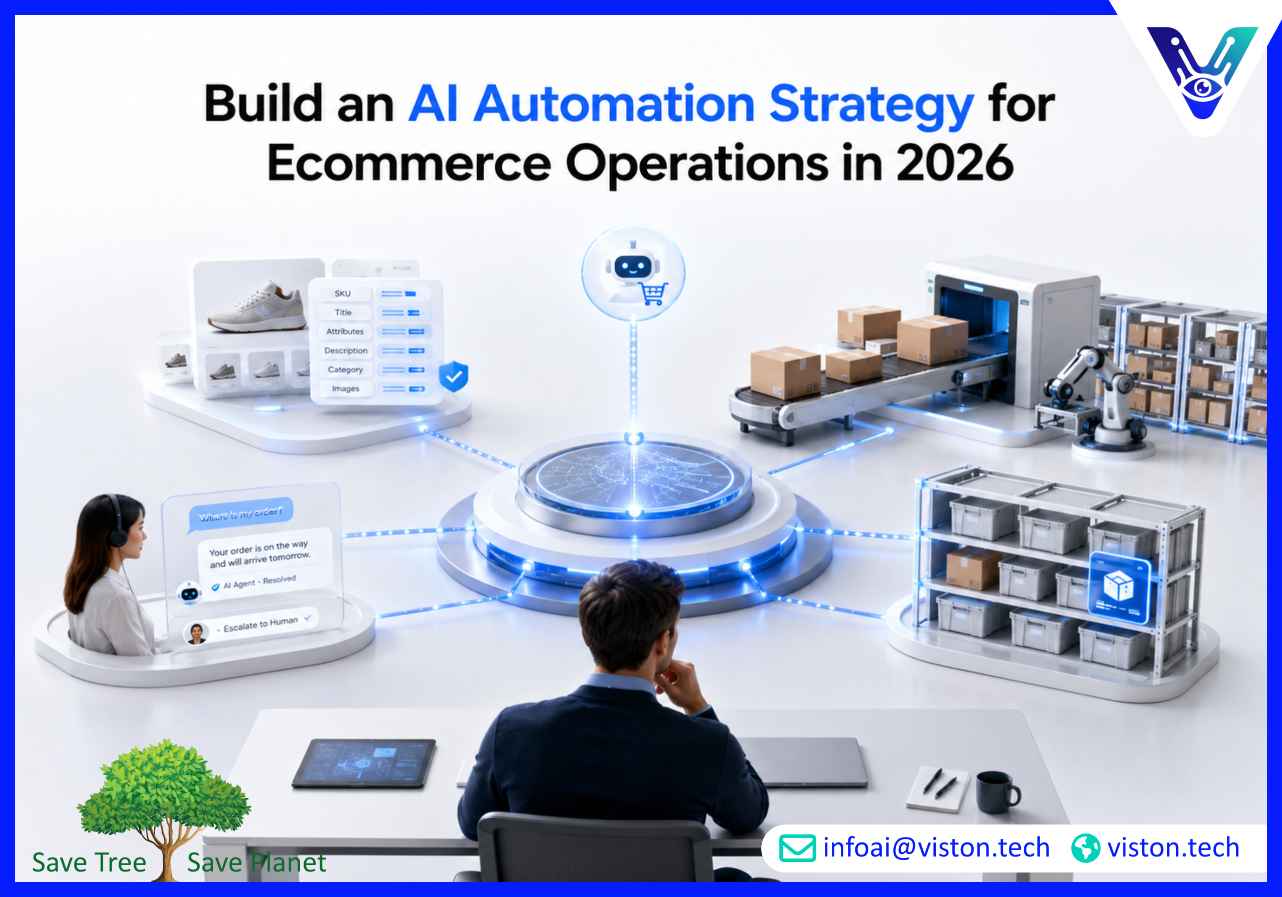
Ecommerce operations in 2026 face a fundamental challenge: AI agents now sit between your storefront and your customers, summarizing answers and completing transactions before a human ever clicks a link. For operations teams managing inventory, orders, and customer support across multiple channels, the question isn’t whether to adopt automation—it’s how to build a strategy that works with these new systems, not against them.
The structure of online retail has changed. Global retail ecommerce sales continue climbing, but discovery has moved from search engines to AI assistants, and conversion increasingly happens through agent-driven checkout rather than traditional product pages. Google’s AI Overview now intercepts top-funnel traffic, and platforms like Microsoft Copilot Checkout allow customers to complete purchases directly inside an AI interface without ever visiting a retailer’s website.
For operations teams, this shift creates three immediate pressures:
First, order volumes are fragmenting. Transactions now originate from AI assistants, conversational interfaces, marketplaces, and traditional storefronts simultaneously. Each channel has its own data format, timing, and fulfillment requirements.
Second, speed expectations have compressed. When an AI agent places an order on behalf of a customer, that customer expects near-instant confirmation and fulfillment updates. Manual review cycles that worked for human-driven checkout become unacceptable bottlenecks.
Third, data quality determines visibility. AI systems that discover your products rely on structured, machine-readable catalogs. If your product data is inconsistent or incomplete, you become invisible to the agents driving a growing share of commerce.
Building a practical automation strategy requires understanding where workflow bots deliver measurable operational value. Based on current deployments across retail and B2B commerce, four areas consistently produce the highest return.
Manual product enrichment is no longer viable at scale. AI automation for catalog management handles product onboarding, attribute extraction from images, categorization, and error correction automatically. Workflow bots can ingest product feeds from multiple sources, detect missing fields, generate SEO-friendly descriptions, and push enriched data to your storefront.
The key requirement is a validation layer. Automation should log confidence scores for each enrichment and flag low-confidence entries for human review rather than publishing potentially incorrect specifications.
Order operations involve repetitive, rules-based decisions that are ideal for automation. Workflow bots can monitor incoming orders across channels, apply routing rules based on inventory location, shipping method, and customer tier, and trigger fulfillment processes without manual intervention.
For B2B ecommerce in particular, automated order processing shortens purchasing cycles for standardized and replenishment-driven transactions. The same logic applies to returns management, where bots can validate return eligibility, generate labels, and update inventory records automatically.
Generic chatbots are being replaced by retrieval-augmented agents that pull from FAQ documents, past tickets, and product information to answer customer questions accurately. The critical feature is escalation logic: when an agent detects complex issues or negative sentiment, it routes the conversation to a human support team.
This approach reduces support load while maintaining customer satisfaction. For operations, it also creates a structured data trail that helps identify recurring issues in fulfillment, shipping, or product quality.
Dynamic inventory management and pricing optimization represent more advanced automation use cases. Workflow bots can pull cost data, sales history, competitor pricing, and inventory levels to suggest markdowns or premium adjustments that meet margin targets.
These systems require careful guardrails—rules that prevent pricing below cost or making sudden jumps that damage customer trust. The most effective implementations run simulations and generate metrics before any automated change is applied, keeping final decisions under human control.
Even well-designed automation strategies encounter predictable obstacles. Anticipating these challenges makes the difference between a successful deployment and a frustrated operations team.
Data silos between systems remain the most common barrier. Commerce platforms, warehouse management systems, and customer service tools often store overlapping but inconsistent information. The fix is to establish a unified data layer before automating workflows that depend on cross-system accuracy.
Integration complexity slows down many automation projects. Rather than building custom connectors for every workflow, focus on API-first platforms that expose clean endpoints for product, pricing, and transaction data. This approach allows AI systems to consume and act on your data without brittle point-to-point integrations.
Resistance from operations teams often stems from fear that automation will replace jobs. The actual pattern in successful organizations is different: automation handles repetitive tasks, freeing teams to focus on exception handling, supplier relationships, and process improvement. Framing automation as a tool that makes your team more effective, not smaller, changes the conversation.
Trust and verification cannot be automated away. Every workflow bot needs a review layer for critical decisions. The goal is to eliminate drudgery, not human judgment.
Operational automation should tie directly to measurable business outcomes. The most relevant metrics for 2026 include:
For B2B operations, also track order processing error rates and time to onboard new products across your catalog.
Viston AI provides enterprise AI automation and workflow bots built specifically for ecommerce operations. Based in Ahmedabad and serving global clients across retail, manufacturing, and supply chain sectors, the company focuses on practical AI adoption that delivers measurable ROI. Its offerings include AI strategy and consulting, AI/ML development and integration, predictive analytics, and computer vision solutions—capabilities directly applicable to catalog enrichment, demand forecasting, and quality inspection workflows.
For ecommerce businesses, Viston AI’s approach addresses the core operational challenges of 2026: fragmented order channels, inconsistent product data, and the need for human-review layers in automated systems. The company emphasizes security, governance, and compliance alongside faster deployment cycles, making its workflow bots suitable for organizations that cannot trade operational reliability for automation speed. Whether integrating with existing commerce platforms or building custom agents for specific use cases like inventory intelligence or customer support routing, Viston AI positions automation as a force multiplier for operations teams rather than a replacement for them.
Traditional automation follows fixed rules—if X happens, do Y. AI automation adds decision-making capability. Workflow bots can analyze context, handle exceptions, and learn from outcomes. For example, a traditional bot routes all high-value orders to expedited shipping; an AI bot evaluates inventory location, carrier performance history, and customer preferences to choose the optimal shipping method.
Start with a workflow audit. Identify repetitive tasks that follow predictable rules but consume significant staff time. Catalog enrichment, order routing, and support ticket triage are common starting points. If you have clean data and clear exception-handling processes, you’re ready. If your data is inconsistent across systems, fix that before automating.
No. The organizations winning with automation use it to handle volume and repetition while their teams focus on exceptions, supplier relationships, and process improvement. Automation changes the work—it doesn’t eliminate the need for human judgment in complex situations.
Workflow bots access sensitive data: customer information, payment details, and inventory levels. Any automation strategy must include role-based access controls, audit trails for automated decisions, and encryption for data in transit. Work with providers that prioritize security governance and compliance certifications.
Initial workflow automation for a specific function like catalog enrichment or order routing typically takes 2–4 weeks from scoping to deployment. Full operational transformation across multiple workflows takes 60–90 days, with measurable improvements in processing time and error rates appearing within the first month.
Agentic commerce refers to AI systems that autonomously discover, evaluate, and transact on behalf of consumers. For operations teams, this matters because orders increasingly originate from these agents rather than traditional checkout flows. Operations must be ready to accept and fulfill agent-driven transactions without manual intervention.
Building an AI automation strategy for ecommerce operations in 2026 requires clear priorities: start with high-volume, rules-based workflows like catalog enrichment and order routing, implement human-review layers for critical decisions, and ensure your data is structured for machine consumption before automating across systems. The companies that succeed will be those that view automation not as a cost-cutting exercise but as operational infrastructure that enables faster response, fewer errors, and better use of team expertise.
AI Automation & Workflow Bots from specialists like Viston AI provide the practical foundation for this transformation—handling the repetitive work so your operations team can focus on what actually drives competitive advantage. The question isn’t whether to automate, but which workflows to tackle first. Start with the ones that consume the most time and follow the clearest rules. The results will tell you where to go next.
