
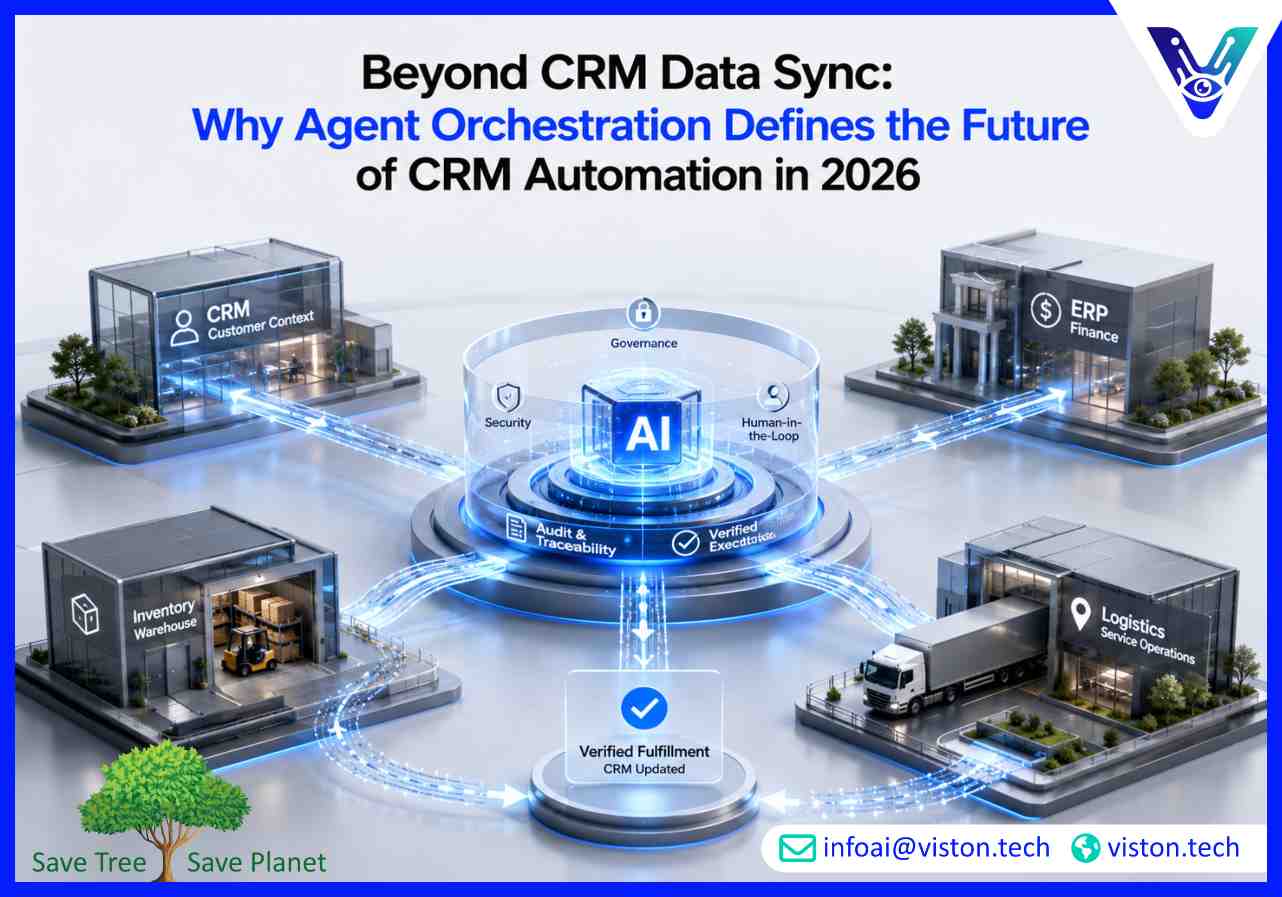
For years, businesses have been told that a “single source of truth” in their CRM was the ultimate goal. Yet, as we move through 2026, a critical gap remains: data synchronization does not equal operational execution. When a customer request—such as an order change, a complex refund, or a cross-departmental approval—requires action across billing, inventory, logistics, and CRM, traditional automation falls apart. This breakdown is where agent orchestration for CRM automation emerges as the definitive solution for enterprises looking to eliminate the “swivel-chair” workflow and finally close the loop between customer intent and fulfillment.
Most legacy CRM automation operates on a reactive, rules-based model. If a customer fills out a form, the system updates a field. If a ticket closes, a survey goes out. However, real-world business workflows are not linear. They are messy, multi-step, and require complex decision-making across disparate enterprise systems.
In 2026, the bottleneck is no longer data collection; it is the handoff between systems. According to industry analysis, complex customer journeys often break during the “messy middle”—where a request moves from a CRM interface into ERP, inventory, or legal systems for fulfillment [1]. Without agentic orchestration, human agents act as the middleware, manually copying context from a CRM ticket into a billing system, then to a shipping portal, and back again. This manual latency is the primary driver of customer friction in the modern enterprise.
Unlike standard robotic process automation (RPA) or basic API connectors, agent orchestration for CRM automation utilizes agentic AI to manage the entire lifecycle of a customer workflow. Agent orchestration involves deploying autonomous AI agents that can reason, plan, and execute multi-system tasks without step-by-step human prompts.
This requires a shift from “Integration” to “Orchestration.”
In 2026, leading platforms are moving toward a “from intent to fulfillment” architecture, where the CRM acts as the context engine, but the agentic layer acts as the central nervous system for execution [3].
A major evolution in 2026 is the understanding that not all AI processes can be probabilistic. When dealing with commercial transactions—such as order modifications, invoice adjustments, or compliance checks—businesses cannot rely on AI that “guesses.”
Current best practices emphasize that while discovery and routing can be generative, the execution layer for financial and compliance-heavy tasks must remain deterministic [1]. Agent orchestration solves this by allowing a “human-in-the-loop” or a “guardrail” architecture. The agentic system navigates the Lego bricks of the process—inventory checks, tax implications, shipping updates—but adheres to strict, verifiable logic when touching the ledger. This hybrid intelligence ensures speed without regulatory risk.
For business decision-makers, the most transformative aspect of agent orchestration is the retirement of the “UI bottleneck.” Historically, if you wanted to automate a CRM workflow, you hired developers to script APIs or relied on clunky middleware. Agent orchestration introduces a semantic layer where AI agents interact with APIs and legacy systems directly.
We are seeing a rapid adoption of cross-system agent execution. In this model, a single AI agent can traverse a CRM, an ERP, and an ITSM system to resolve a single customer query, all while maintaining a unified context [4]. This is not about building a better dashboard; it is about making the dashboard obsolete for routine execution. As companies like Asana and major CX platforms pivot toward acquiring or building cross-system workflow engines, it signals a market-wide validation that the future of work is agent-to-system, not human-to-screen [4].
As agents gain the ability to write data back to CRMs and execute financial holds, governance becomes paramount. Agent orchestration frameworks in 2026 are defined by their “Control Towers”—layers of security that monitor agent behavior, log decisioning logic, and prevent malicious prompt injection [1].
For a business to trust autonomous CRM automation, they need to see the audit trail. Why did the agent issue a refund? Why was the order rerouted? Modern agent orchestration includes version control for agents (an Agentic Development Life Cycle), ensuring that changes to automation logic are subject to the same pull-request approvals as software code [4]. This maturity curve separates experimental chatbots from enterprise-grade utility players.
Implementing agent orchestration is not a simple plug-in; it requires a fundamental re-architecture of how data flows between your CRM and your operational systems. At Viston AI, we specialize in moving beyond static data dashboards to dynamic, action-oriented AI ecosystems.
As a specialist in AI Data & Automation Solutions, Viston AI bridges the gap between customer intent and business execution. We do not just connect your CRM to your ERP; we deploy intelligent agents that autonomously execute complex workflows across finance, logistics, and service management. Our approach focuses on tangible business outcomes—reducing the manual handoffs that cause delays and errors. By leveraging advanced AI/ML development and predictive analytics, we ensure that agent orchestration aligns with your governance requirements and existing tech stack, delivering a scalable “agentic” workforce that acts as an extension of your team, not a replacement for it. We help enterprises move from reactive ticketing systems to proactive resolution engines.
RPA (Robotic Process Automation) is rule-based and follows a strict script (e.g., copy data from cell A to cell B). Agent orchestration is goal-based; an AI agent interprets the goal (e.g., “resolve the customer’s billing dispute”), plans the steps, and adapts in real-time using multiple systems, including the CRM and ERP.
Yes, provided the orchestration layer includes deterministic guardrails. In 2026, best practices involve using “dual-engine” architecture where generative AI handles planning and language, while deterministic logic handles the actual monetary execution. This ensures compliance and auditability.
Generally, no. Agent orchestration is typically an abstraction layer that sits on top of your existing systems (Salesforce, HubSpot, Microsoft Dynamics). It reads/writes data via APIs. However, legacy CRMs with poor API support may require middleware modernization to allow agents to execute tasks efficiently.
The ROI is primarily realized through “swivel-chair elimination”—reducing the labor cost of manually moving data between systems and reducing error rates in complex workflows like order-to-cash or lead-to-fulfillment. Companies report significant reductions in handling time for complex, multi-step service tickets.
It augments them. Agents handle the mechanical execution (updating fields, checking inventory, processing returns) while humans focus on relationship management, negotiation, and complex exception handling. This leads to higher employee satisfaction as teams stop being data entry clerks.
As we progress through 2026, the competitive advantage in customer experience will not belong to those with the most expensive CRM license, but to those who can orchestrate action across their enterprise most efficiently. Agent orchestration for CRM automation is the technical strategy required to unify customer data with operational reality. By moving from static data synchronization to dynamic, governed agentic execution, businesses can resolve issues in minutes instead of days. For organizations looking to capitalize on this shift, partnering with specialists like Viston AI ensures that your move toward agentic workflows is secure, scalable, and aligned with specific business outcomes, turning your CRM from a cost center into a growth engine.
