
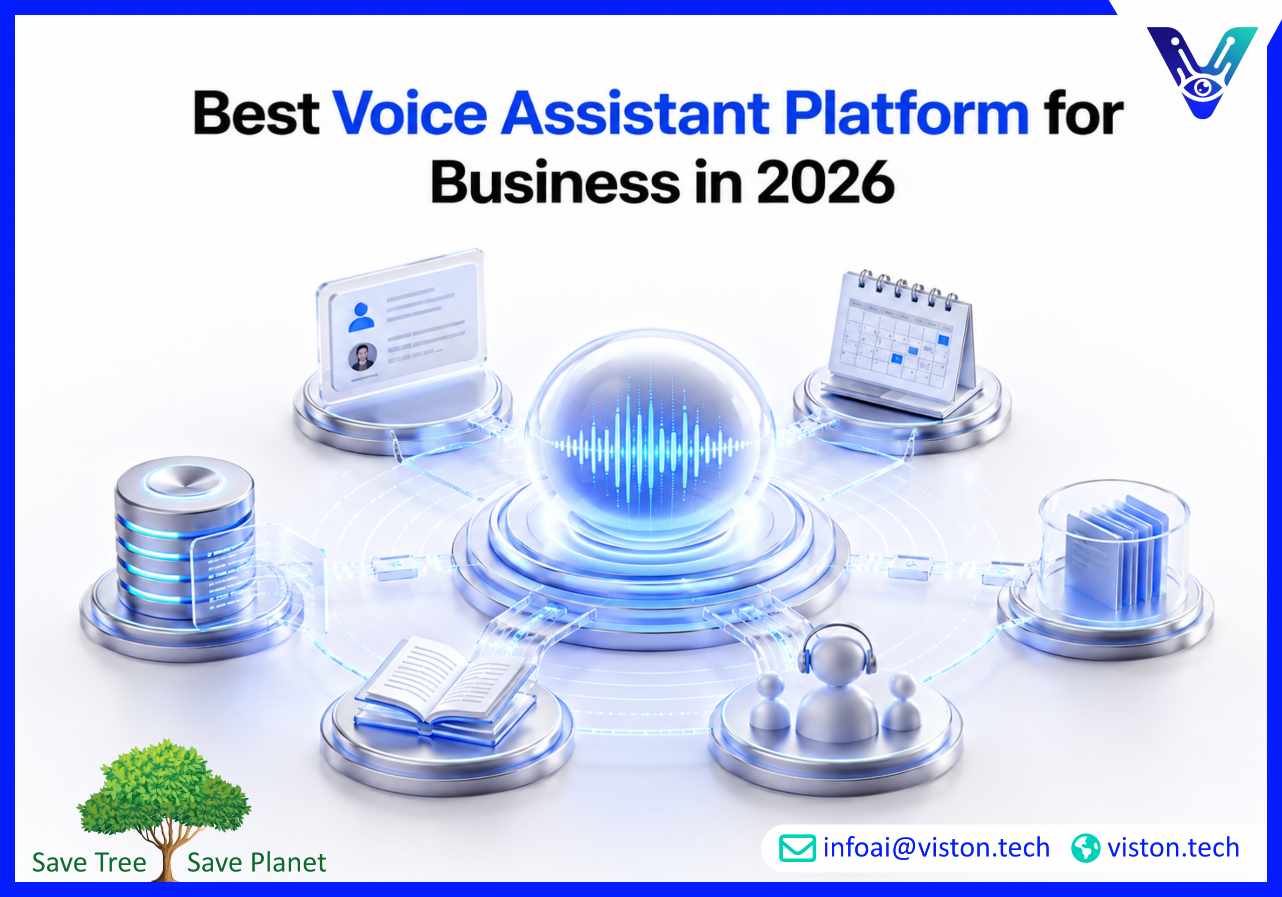
Choosing the best voice assistant platform for business is no longer just a customer service decision. In 2026, voice-enabled assistants can support sales, operations, employee workflows, customer support, scheduling, knowledge access, and system automation when they are designed with the right intelligence, integrations, governance, and scalability.
The best voice assistant platform for business is not simply a tool that recognizes speech and replies with a scripted answer. A business-ready voice platform must understand spoken language, interpret user intent, connect with business systems, respond naturally, escalate when needed, and improve over time through performance monitoring.
For many companies, voice AI is becoming a practical interface between people and digital systems. Customers may want to check an order, book an appointment, request support, ask product questions, or speak to a service assistant without waiting in a queue. Employees may want to retrieve information, update records, create tickets, search internal policies, or complete routine tasks hands-free.
A strong business voice assistant platform should combine several core capabilities:
The right choice depends on the business goal. A contact center needs reliable call handling, escalation, and customer history. A retail business may need multilingual product guidance and order lookup. A healthcare, finance, or enterprise support team may need stronger compliance, data protection, and human review controls. A platform should therefore be evaluated on business fit, not only on voice quality.
Business buyers should avoid choosing a platform only because it sounds impressive in a demo. The real test is whether it can reduce repetitive work, improve response times, capture accurate data, and complete tasks inside existing systems. A voice assistant that cannot access live business data or trigger workflows may create more frustration than value.
In 2026, the strongest platforms are moving beyond basic voice bots. They support context-aware conversations, retrieval from approved knowledge sources, multilingual interactions, human handover, real-time analytics, and integration with operational workflows. That is what separates a useful business voice assistant from a novelty feature.
When evaluating the best voice assistant platform for business, decision-makers should focus on capabilities that affect reliability, customer experience, operational control, and long-term scalability. A business voice assistant must perform consistently across real conversations, not just ideal test scenarios.
Speech recognition quality is the foundation of the entire experience. The platform must handle different accents, speaking speeds, background noise, interruptions, and industry-specific terminology. If the system mishears users, every later step becomes unreliable. Businesses should test accuracy using real customer calls, internal phrases, product names, location names, and common service requests.
Voice assistants need to understand what users mean, not only what they say. For example, “I need to move my appointment,” “Can I reschedule?” and “I cannot make it tomorrow” may all indicate the same intent. A platform should identify intent, extract relevant details, ask clarifying questions, and route the conversation correctly.
A business voice assistant should not sound like an old IVR menu. It should support natural dialogue, confirmations, corrections, follow-up questions, and graceful recovery when the user changes direction. Multi-turn conversation design is especially important for support, bookings, lead qualification, troubleshooting, and account-related requests.
Integration is where voice AI becomes operationally useful. A platform should connect with systems such as Salesforce, HubSpot, Microsoft Dynamics, SAP, ServiceNow, Zendesk, Shopify, calendars, knowledge bases, databases, and custom APIs. This allows the assistant to retrieve information, update records, create tickets, schedule meetings, check order status, or trigger workflows.
No voice assistant should be expected to handle every situation. The platform must know when to transfer a conversation to a human agent. Good escalation includes conversation history, user details, detected intent, sentiment, attempted resolution, and relevant system data. This prevents users from repeating themselves and helps human teams respond faster.
Business voice assistants may process personal data, account information, payment-related questions, health details, employee records, or confidential business information. A platform should support access controls, encryption, data retention settings, audit logs, PII redaction, consent management, and compliance review workflows where applicable.
Voice assistant analytics should show more than call volume. Businesses need visibility into completion rate, containment rate, fallback rate, escalation reasons, average handling time, customer satisfaction, sentiment, failed intents, and workflow success. These insights help teams improve scripts, training data, knowledge sources, and integration logic over time.
The best voice assistant platform for business depends on the use case, industry requirements, technical environment, and expected outcomes. A small company may need a focused appointment or FAQ assistant, while an enterprise may need a secure, multilingual, integrated voice AI system that supports multiple teams and regions.
Before comparing platforms, define the specific problem the voice assistant must solve. Common business use cases include:
A clear use case helps define the required integrations, conversation depth, compliance controls, reporting needs, and success metrics. Without this clarity, businesses may overpay for features they do not need or choose a platform that cannot handle their operational requirements.
Some businesses need a ready-made voice assistant for common tasks. Others need custom voice AI that reflects specific workflows, terminology, systems, and customer journeys. The platform should be flexible enough to support the business as requirements evolve.
Buyers should ask whether the assistant can be customized by intent, user role, language, region, channel, product line, escalation rule, and knowledge source. A rigid platform may work during a pilot but fail when the business needs to expand across departments or markets.
Many voice assistant platforms claim to integrate with business tools, but the depth of integration varies. A basic integration may only send a transcript or create a generic ticket. A stronger integration can retrieve live customer records, update CRM fields, check inventory, create cases, trigger workflows, and synchronize data in real time.
For businesses that care about measurable ROI, integration depth is critical. The assistant must not only talk to users; it must complete work accurately inside the systems the business already uses.
A vendor demo usually shows the best version of the platform. Business teams should test realistic conversations, including unclear questions, interruptions, noisy audio, angry customers, repeated requests, missing information, and sensitive scenarios. This reveals whether the assistant can handle real-world complexity.
Voice AI is not a one-time setup. The assistant needs updates as products, policies, workflows, and customer behavior change. Businesses should understand who owns training data, prompt updates, knowledge base changes, analytics reviews, escalation tuning, and integration maintenance. Reliable support is often just as important as the platform itself.
Implementing a voice assistant platform successfully requires more than selecting software. It involves conversation design, data preparation, integration planning, testing, governance, monitoring, and ongoing optimization. Businesses that treat voice AI as an operational capability usually see better outcomes than those that treat it as a simple automation add-on.
The best starting point is usually a workflow that is repetitive, high-volume, and easy to validate. Examples include appointment confirmation, order status lookup, FAQ handling, password reset guidance, lead capture, or ticket creation. These workflows allow teams to prove value while limiting risk.
More complex workflows, such as financial advice, clinical triage, contract changes, refunds, cancellations, or compliance-sensitive decisions, need stronger guardrails and human review. A voice assistant should support these processes carefully, not replace judgment where human oversight is required.
A voice assistant is only as reliable as the information it can use. Businesses should review FAQs, support scripts, policies, product documentation, CRM fields, call transcripts, and escalation rules before deployment. Outdated or conflicting content can cause inaccurate answers.
Knowledge sources should be approved, structured, and assigned to clear owners. If the assistant uses retrieval-based answers, it should pull from trusted sources rather than unverified content. This helps reduce hallucinations, improve answer consistency, and maintain trust.
Voice assistant ROI should be measured through practical business outcomes. Useful metrics include call containment rate, first contact resolution, average handling time reduction, missed-call reduction, lead conversion rate, booking completion rate, customer satisfaction, escalation quality, and cost per resolved interaction.
For internal voice assistants, relevant metrics may include employee adoption, time saved, ticket reduction, knowledge search success, and workflow completion. The goal is not simply to automate conversations. The goal is to improve how quickly and accurately work gets done.
Common risks include poor speech recognition, inaccurate answers, weak escalation, privacy exposure, disconnected systems, biased responses, poor monitoring, and unclear ownership. These risks can be reduced through pilot testing, approval workflows, human-in-the-loop controls, access management, and performance reviews.
A strong platform should allow teams to define what the assistant can answer, what it must not answer, when it should ask for clarification, and when it should transfer to a human. This balance is essential for customer trust and operational safety.
Viston AI is relevant to businesses researching the best voice assistant platform for business because its Voice-Enabled Assistants service focuses on enterprise-grade conversational AI, speech recognition, natural language processing, and intelligent voice interactions at scale. Its service offering is designed around voice AI that can understand context, support multi-turn conversations, integrate with business systems, and help organizations automate customer and employee interactions.
For business teams, this matters because a voice assistant platform must be more than a speaking interface. It needs strong NLP, speech recognition, text-to-speech capability, workflow design, analytics, and integration architecture. Viston AI’s broader AI service portfolio includes enterprise AI chatbots, AI chatbot integration, multilingual support, NLP and text analysis, agentic AI workflows, AI strategy, and business system integration. These capabilities are closely connected to successful voice assistant delivery.
Viston AI can support organizations that want voice-enabled assistants for customer support, sales inquiry handling, internal helpdesk workflows, knowledge access, retail support, finance operations, healthcare workflows, manufacturing support, and other business processes. Its approach is especially relevant for companies that need custom voice AI rather than a generic off-the-shelf assistant. By connecting voice interactions with operational systems, knowledge sources, escalation logic, and performance reporting, Viston AI helps businesses build voice assistants that are practical, measurable, and scalable.
The best voice assistant platform for business is one that matches your use case, integrates with your systems, understands real customer or employee language, supports secure data handling, and provides analytics for continuous improvement. The right platform depends on whether you need customer support automation, sales assistance, internal workflows, bookings, or multilingual service.
A chatbot usually interacts through text, while a voice assistant uses spoken conversation. A business voice assistant requires speech recognition, natural language understanding, text-to-speech, conversation design, and often telephony or voice channel integration. Many businesses use both chat and voice assistants as part of a broader conversational AI strategy.
Important features include accurate speech recognition, natural voice responses, intent detection, multi-turn dialogue, CRM or helpdesk integration, escalation to human agents, multilingual support, analytics, role-based access, data security, and workflow automation.
Yes. A well-designed voice assistant can integrate with CRM, ERP, helpdesk, ecommerce, scheduling, knowledge base, and internal workflow systems. These integrations allow the assistant to retrieve customer data, create tickets, update records, schedule appointments, and trigger business processes.
A custom voice assistant is usually better when the business has complex workflows, industry-specific terminology, compliance requirements, multilingual needs, or deep system integrations. An off-the-shelf platform may be suitable for simpler tasks such as basic FAQs or appointment reminders.
Yes. Viston AI provides Voice-Enabled Assistants and related AI services such as NLP, AI chatbot integration, multilingual support, agentic workflows, and business system integration. This makes it relevant for companies that need custom voice AI connected to real business processes.
Choosing the best voice assistant platform for business in 2026 requires a clear understanding of use cases, integration needs, security requirements, conversation quality, and measurable outcomes. A strong Voice-Enabled Assistants strategy should help customers and employees complete tasks faster while giving the business control over data, workflows, escalation, and performance. The most valuable platforms are not only accurate speakers; they are connected operational systems. For organizations that need custom, scalable, and business-focused voice AI, Viston AI offers relevant expertise in building voice-enabled assistants that support practical automation and better digital experience.
