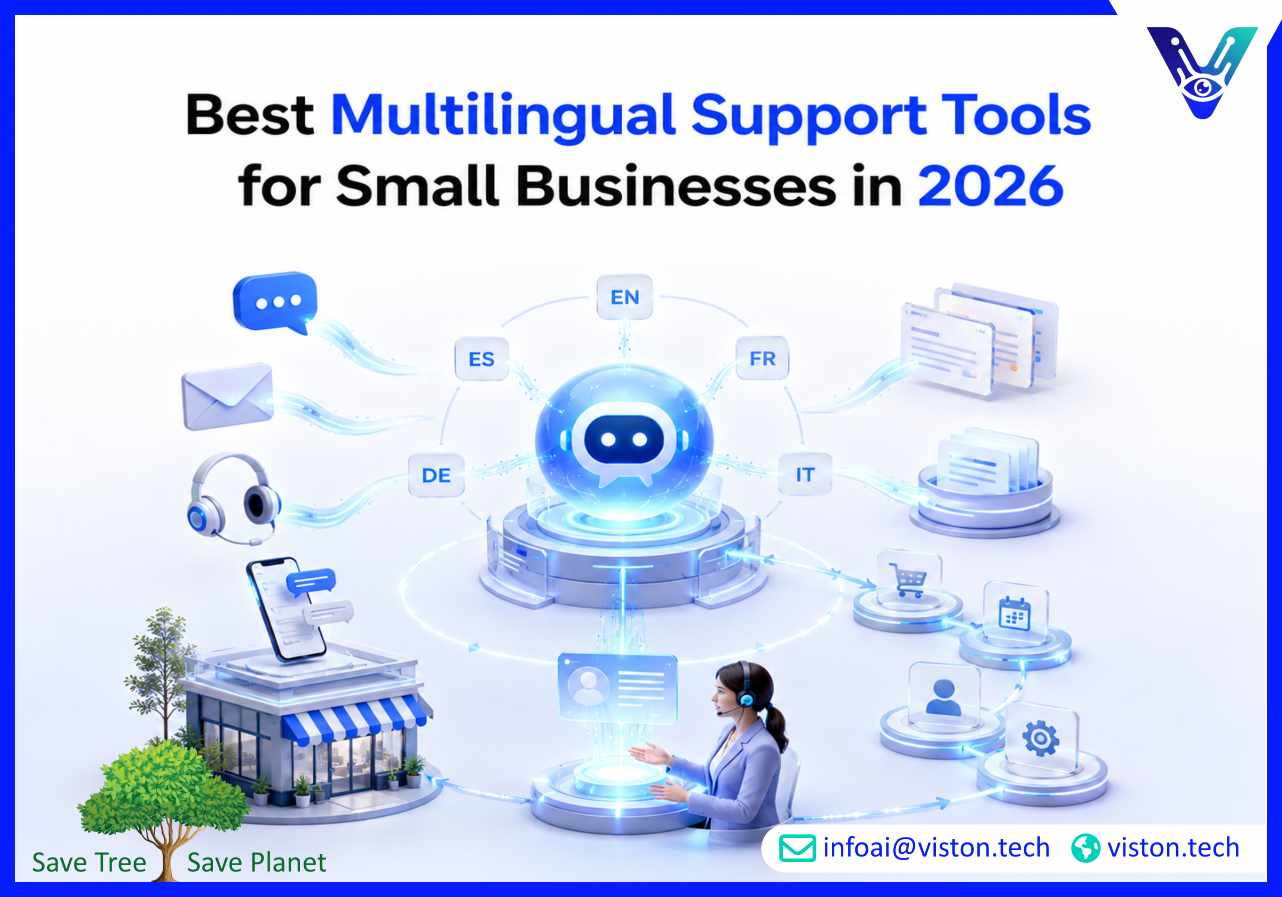
Best Multilingual Support Tools for Small Businesses in 2026
The best multilingual support tools for small businesses make it possible to serve international customers without building a separate support team for every language. In 2026, the right setup may combine a help desk, AI chatbot, translation technology, localized knowledge content, system integrations, and reliable human escalation.
What Small Businesses Need From Multilingual Support Tools
Multilingual customer service involves more than translating incoming messages. Customers expect accurate answers, natural terminology, consistent policies, secure data handling, and a clear route to a person when automation cannot resolve the issue.A small business therefore needs tools that support the complete service workflow. The system should identify the customer’s language, understand the request, retrieve approved information, complete suitable actions, and preserve context when transferring the conversation to an employee.
Language detection and real-time translation
Automatic language detection helps route each conversation correctly without requiring customers to select a language manually. Real-time translation can then allow employees to read and answer messages in languages they do not speak fluently.Translation quality should be evaluated using real customer conversations. Product names, industry terminology, informal expressions, dialects, and mixed-language messages can create errors that are not visible in simple demonstrations.
Multilingual knowledge management
A support tool should make it practical to create, organize, publish, and update help content in different languages. This may include frequently asked questions, return policies, onboarding guides, troubleshooting instructions, delivery information, and account-management documentation.The source content must be accurate before it is translated. Automating an outdated or unclear article only distributes the same problem across more languages.
AI chatbot and workflow automation
Modern multilingual AI chatbots can answer routine questions, collect information, guide users through processes, and trigger business workflows. Common small-business use cases include checking an order, booking an appointment, resetting an account, qualifying a sales enquiry, explaining a subscription, and creating a support ticket.The chatbot should also recognize when it lacks sufficient confidence. Complaints, payment disputes, legal requests, unusual refunds, sensitive personal information, and complex technical issues normally require human review.
Integrations and reporting
Useful multilingual support tools connect with the systems a business already uses, such as its CRM, ecommerce platform, help desk, booking software, customer database, or knowledge base. Without integration, employees may need to copy information between platforms, and customers may be asked to repeat details.Reporting should show performance by language, channel, and enquiry type. A strong overall resolution rate can hide serious weaknesses in one particular language.
Best Multilingual Support Tools for Small Businesses by Use Case
There is no single platform that is best for every small business. The right choice depends on whether the company needs ticket management, website chat, ecommerce automation, SaaS onboarding, human translation assistance, or a customized multilingual chatbot.
Freshdesk for affordable help desk management
Freshdesk is a practical option for small teams that need structured ticketing, a customer portal, automation, reporting, and multilingual self-service content. Its features include multilingual knowledge-base capabilities, while Freshdesk Omni can support live translation for agent conversations across numerous languages.It is particularly relevant when enquiries arrive through email, web forms, chat, and other service channels that need to be managed in one queue. A small team can start with core ticketing and add more advanced automation as volume increases.Freshdesk is a good fit for service businesses, SaaS companies, education providers, travel operators, and growing ecommerce businesses that need more structure than a shared email inbox provides.
Tidio and Lyro for website chat and smaller ecommerce teams
Tidio combines live chat, help desk functionality, automated flows, and the Lyro AI agent. Lyro can answer in multiple languages using a company’s own knowledge sources, helping smaller teams automate product questions, pre-sale enquiries, delivery queries, and other repetitive conversations.The platform is suited to businesses that want a relatively accessible, no-code route to website-based automation. Its live chat functionality also gives employees a way to enter the conversation when the AI agent cannot complete the request.Businesses should test whether all required languages are supported by the specific feature and plan they intend to use. Language availability for the chat interface, AI responses, agent tools, and integrations may not always be identical.
Gorgias for ecommerce customer support
Gorgias is designed around ecommerce service operations. It can centralize customer conversations and connect support activity with store data, making it useful for questions about orders, delivery, returns, cancellations, and product availability.Its chat tools can display localized content according to a visitor’s browser language, and language-based rules can help organize or route tickets. Multilingual article recommendations require the corresponding help content to be available in each configured language.Gorgias is most relevant to online retailers that need agents or automation to access order context while responding. A general service business without ecommerce workflows may not benefit from its more specialized commerce features.
Intercom and Fin for SaaS and digital products
Intercom and its Fin AI agent are suited to software businesses that deliver support through websites, applications, email, messaging, or other digital channels. Fin can use approved knowledge, policies, and procedures, while simulation and analytics tools help teams test and improve automated conversations before and after deployment.This approach can support onboarding, billing questions, account access, feature guidance, troubleshooting, and subscription management. It is particularly useful when customer service is closely connected to the in-product experience.Small businesses should examine outcome-based AI charges, agent-seat costs, required integrations, and knowledge-management effort before deciding whether the platform suits their support volume.
Zendesk for businesses expecting more complex growth
Zendesk offers ticketing, messaging, help-centre management, routing, automation, reporting, and multilingual AI-agent capabilities. Its AI tools can use supported languages, translated messages, localized help content, and configurable fallback behaviour when a customer’s language is not available.It can be appropriate for a growing company that expects multiple support channels, larger ticket volumes, service-level rules, specialized queues, and more detailed administration.The breadth of the platform can also create unnecessary complexity for a very small business. Teams should confirm which multilingual, AI, reporting, and translation capabilities are included in the intended package rather than assuming every feature is available by default.
DeepL and specialist translation tools as an additional layer
A dedicated translation tool can be valuable when the existing help desk does not provide sufficient language coverage or translation quality. It may help employees translate emails, chat replies, articles, internal notes, and support documentation.However, translation software is not a complete support platform. It generally does not manage ticket queues, customer histories, escalation rules, service workflows, or chatbot resolution on its own. Small businesses should decide whether they need a translation layer or an integrated multilingual customer service system.
How to Compare Multilingual Customer Support Platforms
A long language list does not automatically make a tool suitable. Businesses should evaluate how accurately each required language works across customer conversations, knowledge retrieval, automation, agent assistance, and reporting.
Start with actual customer demand
Review customer locations, browser languages, enquiries, sales data, abandoned conversations, and support tickets. Select tools based on the languages customers already use or the markets the business is actively entering.Supporting three priority languages reliably is usually more valuable than offering twenty languages with weak content, inconsistent policies, and no quality review.
Check every required channel
A platform may support one language in its website widget but not provide the same coverage for email automation, social messaging, voice, or agent translation. Create a channel-by-language matrix before making a decision.For example, an ecommerce company may need multilingual support across its website, email, Instagram, and WhatsApp. A SaaS provider may care more about in-app messaging, help-centre content, and technical ticket escalation.
Evaluate knowledge and terminology controls
The tool should preserve brand names, feature names, model numbers, legal wording, and industry terminology. Look for glossaries, custom translations, approved answer libraries, source controls, and the ability to correct unsuitable automated wording.Businesses should also establish who owns each source article and how updates are synchronized across languages. When a return policy or subscription rule changes, translated versions must be updated promptly.
Review integrations and human handover
A customer should not lose context when an automated conversation is escalated. The employee should receive the conversation history, detected language, translated summary, customer details, relevant order or account information, and any steps already attempted.Check whether the tool integrates with the company’s ecommerce platform, CRM, booking system, help desk, payment service, or internal database. Integration depth often matters more than the number of advertised AI features.
Calculate the full operating cost
Compare agent fees, AI-resolution charges, conversation limits, translation usage, setup work, integrations, premium channels, knowledge localization, and ongoing maintenance. A low entry price can become less attractive if essential multilingual capabilities require several upgrades.The best multilingual support tools for small businesses reduce the total effort required to resolve enquiries, not merely the monthly software subscription.
How to Implement Multilingual Support Without Creating Complexity
A phased rollout helps small businesses control cost and quality. The first version should focus on a limited number of languages and high-volume, well-documented enquiries.
Build an approved source knowledge base
Document the answers employees already provide repeatedly. Start with policies, product information, service details, troubleshooting steps, delivery guidance, onboarding instructions, and escalation conditions.Remove duplicate or contradictory material before connecting it to an AI agent. The chatbot should retrieve from a controlled source rather than a mixture of old documents and unreviewed website pages.
Automate low-risk requests first
Good initial use cases include opening hours, order tracking, booking confirmation, password guidance, product specifications, subscription information, and standard return instructions.Keep human review for cases involving financial disputes, legal questions, safety, sensitive data, unusual exceptions, or significant customer dissatisfaction.
Test with native and realistic conversations
Do not test only with perfectly translated sample questions. Include spelling mistakes, slang, abbreviations, mixed languages, regional wording, short messages, and incomplete requests.Native or fluent reviewers should assess accuracy, tone, terminology, and cultural suitability in priority languages. Their feedback can reveal errors that appear technically correct to a non-speaker.
Measure performance by language
Track first-response time, resolution rate, fallback rate, escalation rate, customer satisfaction, repeat contact, translation corrections, and workflow completion. Review failed conversations regularly and use them to improve content, routing, and automation.A multilingual system should be treated as an ongoing service operation. New products, policies, markets, and customer behaviours will continually create new support needs.
How Viston AI Supports Multilingual Customer Service for Small Businesses
Viston AI provides Multilingual AI Chatbot Support alongside related capabilities in AI chatbot development, language translation, natural language processing, business-system integration, workflow automation, and voice-enabled AI assistants. These services are relevant to small businesses that require a more tailored solution than a standard help desk or translation application can provide.A customized approach can connect multilingual conversations with approved company knowledge, CRM records, ecommerce data, booking systems, help desks, and escalation workflows. This allows the chatbot to do more than translate a question. It can identify intent, retrieve relevant information, collect structured details, initiate approved actions, and transfer difficult cases with context.Viston AI may be particularly useful when a company has specialized terminology, multiple customer journeys, unusual integration requirements, or plans to expand language coverage gradually. Its broader capabilities in chatbot integration and automation can help align multilingual support with operational processes rather than deploying an isolated website widget.For a small business, the practical objective is not maximum technical complexity. It is a controlled, scalable support model that provides dependable answers, protects customer trust, reduces repetitive work, and gives managers visibility into service quality across languages.
Frequently Asked Questions
What is the best multilingual support tool for a small business?
The best tool depends on the workflow. Freshdesk suits structured ticketing, Tidio suits accessible website chat, Gorgias suits ecommerce, Intercom suits SaaS support, and Zendesk suits companies expecting more complex service operations.
Can a small business provide multilingual support without multilingual employees?
Yes. AI chatbots, real-time translation, localized knowledge bases, and translated agent workspaces can handle many routine interactions. Fluent human review remains important for sensitive cases, complex complaints, terminology control, and quality assurance.
Should I use a translation tool or a multilingual chatbot?
Use a translation tool when employees mainly need help reading and replying to messages. Use a multilingual chatbot when the business wants to automate answers, collect data, guide customers, integrate systems, and complete repeatable workflows.
How many languages should a small business support?
Begin with the languages that generate the greatest customer demand or commercial opportunity. Many businesses should start with two or three priority languages, validate performance, and expand only when content, workflows, and quality controls are ready.
What multilingual support metrics should I track?
Track response time, resolution rate, fallback rate, escalation rate, customer satisfaction, repeat-contact rate, translation corrections, and workflow success separately for each language and channel.
Can Viston AI build a customized multilingual support system?
Viston AI offers multilingual chatbot support, language-related AI services, chatbot development, system integration, NLP, and workflow automation. These capabilities can support businesses that need a multilingual solution adapted to their knowledge, channels, and operational systems.
Conclusion
The best multilingual support tools for small businesses are those that match real customer languages, channels, workflows, and budgets. A help desk such as Freshdesk or Zendesk may provide the operational foundation, while Tidio, Gorgias, or Intercom can address more specific chat, ecommerce, or SaaS requirements. Translation tools can strengthen an existing setup, and customized Multilingual Support can address specialist integrations or automation needs. Viston AI offers relevant multilingual chatbot and system-integration capabilities for businesses seeking a tailored approach. Whatever platform is selected, success depends on accurate knowledge, careful testing, human escalation, and continuous measurement by language.