
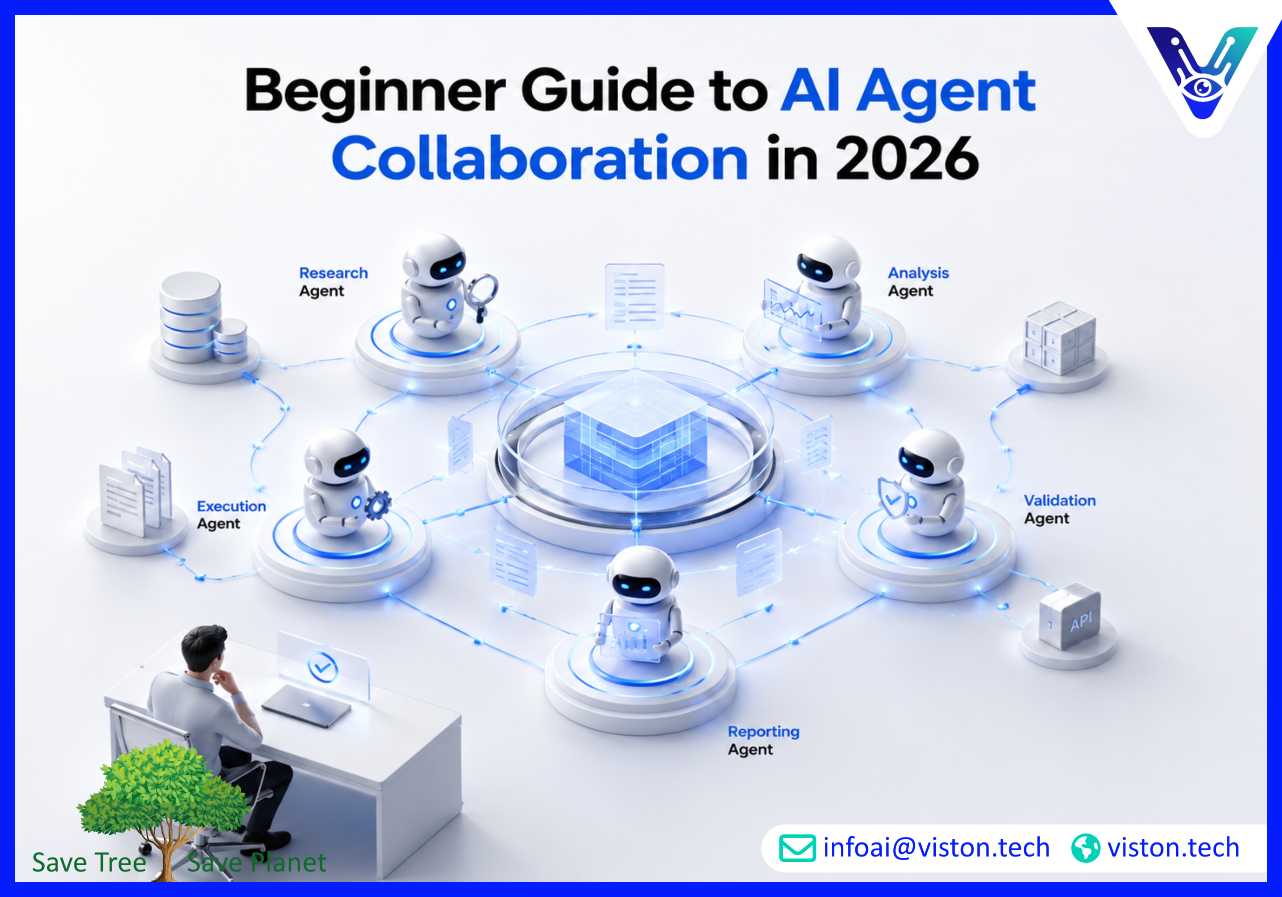
AI agent collaboration is becoming a practical business capability rather than an experimental concept. As organizations look beyond standalone AI assistants, collaborative AI agents are helping teams automate complex workflows, improve decision-making, and coordinate tasks across multiple systems. Understanding how AI agent collaboration works is an important first step for businesses evaluating AI Agent Development & Deployment initiatives in 2026.
AI agent collaboration refers to multiple AI agents working together to achieve a shared business objective. Instead of relying on a single AI system to perform every task, organizations deploy specialized agents that communicate, exchange information, and coordinate actions within a workflow.
Each agent is designed for a specific responsibility. One agent may gather information, another may analyze data, a third may generate recommendations, and a fourth may validate outputs before actions are taken.
The collaborative approach mirrors how human teams operate. Different specialists contribute expertise to complete a larger objective more effectively than a single generalist working alone.
Consider a sales lead qualification process:
Together, these agents create an automated process that would traditionally require several employees and multiple software tools.
Businesses today manage increasingly complex operations involving multiple platforms, departments, and data sources. Traditional automation works well for predictable tasks but often struggles when workflows require context, judgment, adaptation, and coordination.
AI agent collaboration addresses these limitations by enabling multiple intelligent systems to work together while sharing context and responsibilities.
Key business drivers include:
As AI technology continues to mature, collaborative agent systems are becoming a foundational component of enterprise automation strategies.
Successful AI agent collaboration requires more than deploying multiple AI models. Businesses need a structured framework that enables agents to work together effectively.
Each agent should have a clearly defined responsibility. Specialization improves reliability, reduces confusion, and simplifies performance monitoring.
Common agent types include:
Agents must be able to exchange information efficiently. Communication frameworks determine how information is shared, when handoffs occur, and how workflow progress is tracked.
Collaborative agents need access to relevant business context. Shared memory systems help maintain consistency across interactions and ensure that all agents work from the same information.
Orchestration manages task sequencing, dependencies, approvals, exception handling, and agent coordination. It acts as the control layer that ensures all agents work toward the same objective.
Many business processes still require human review. Human-in-the-loop controls help organizations maintain accountability, manage risk, and ensure quality outcomes.
Organizations new to AI agent collaboration should begin with clearly defined business objectives rather than focusing solely on technology.
Choose a workflow that involves repetitive activities, multiple decision points, and coordination across systems or teams.
Examples include:
Document every step of the workflow. Understanding the current process helps identify where AI agents can contribute and where human involvement remains necessary.
Break workflows into logical tasks and assign specific responsibilities to each agent. Clear ownership improves performance and simplifies troubleshooting.
Most collaborative agent systems require access to business applications such as CRM platforms, ERP systems, document repositories, communication tools, databases, and APIs.
Organizations should define approval processes, security controls, access permissions, monitoring standards, and escalation procedures before deployment.
AI agent collaboration systems should be tested against real-world business scenarios. Continuous monitoring helps improve accuracy, efficiency, and reliability over time.
Organizations that address these challenges through proper planning and implementation are more likely to achieve sustainable results from AI agent collaboration initiatives.
Businesses exploring AI agent collaboration often need more than access to AI models. They require a structured approach to AI Agent Development & Deployment that aligns technology with operational goals.
Viston AI focuses on helping organizations design, build, integrate, and deploy AI agent solutions that support real business workflows. This includes defining agent responsibilities, establishing orchestration logic, integrating business systems, implementing governance controls, and creating scalable deployment frameworks.
As AI agent collaboration becomes increasingly important for operational efficiency, organizations need solutions that are reliable, secure, and aligned with measurable business outcomes. Effective deployment requires careful planning around workflow design, system integrations, monitoring, performance evaluation, and ongoing optimization.
For businesses seeking to move beyond isolated AI tools toward coordinated automation, AI Agent Development & Deployment services can provide the expertise needed to create practical and scalable collaborative agent ecosystems.
AI agent collaboration is a system where multiple AI agents work together, communicate, and coordinate tasks to complete a shared business objective.
A single AI assistant performs multiple tasks independently, while collaborative AI systems use specialized agents that work together and share responsibilities within a workflow.
Organizations of all sizes can benefit, particularly those managing complex workflows involving multiple systems, departments, and repetitive processes.
Most implementations are designed to augment human teams by automating repetitive work, supporting decisions, and improving operational efficiency rather than fully replacing employees.
The complexity depends on workflow requirements, system integrations, governance needs, and organizational objectives. Starting with a focused use case often leads to better outcomes.
Yes. Viston AI’s AI Agent Development & Deployment services align closely with designing, integrating, orchestrating, and deploying collaborative AI agent systems for business operations.
AI agent collaboration represents a significant step forward in business automation. By enabling specialized AI agents to work together, organizations can automate more complex workflows, improve operational efficiency, and scale processes more effectively. As adoption continues to grow throughout 2026, businesses that understand the fundamentals of collaborative AI systems will be better positioned to evaluate opportunities and make informed technology decisions. For organizations pursuing AI Agent Development & Deployment initiatives, working with experienced specialists such as Viston AI can help transform AI agent collaboration from concept to practical business value.
