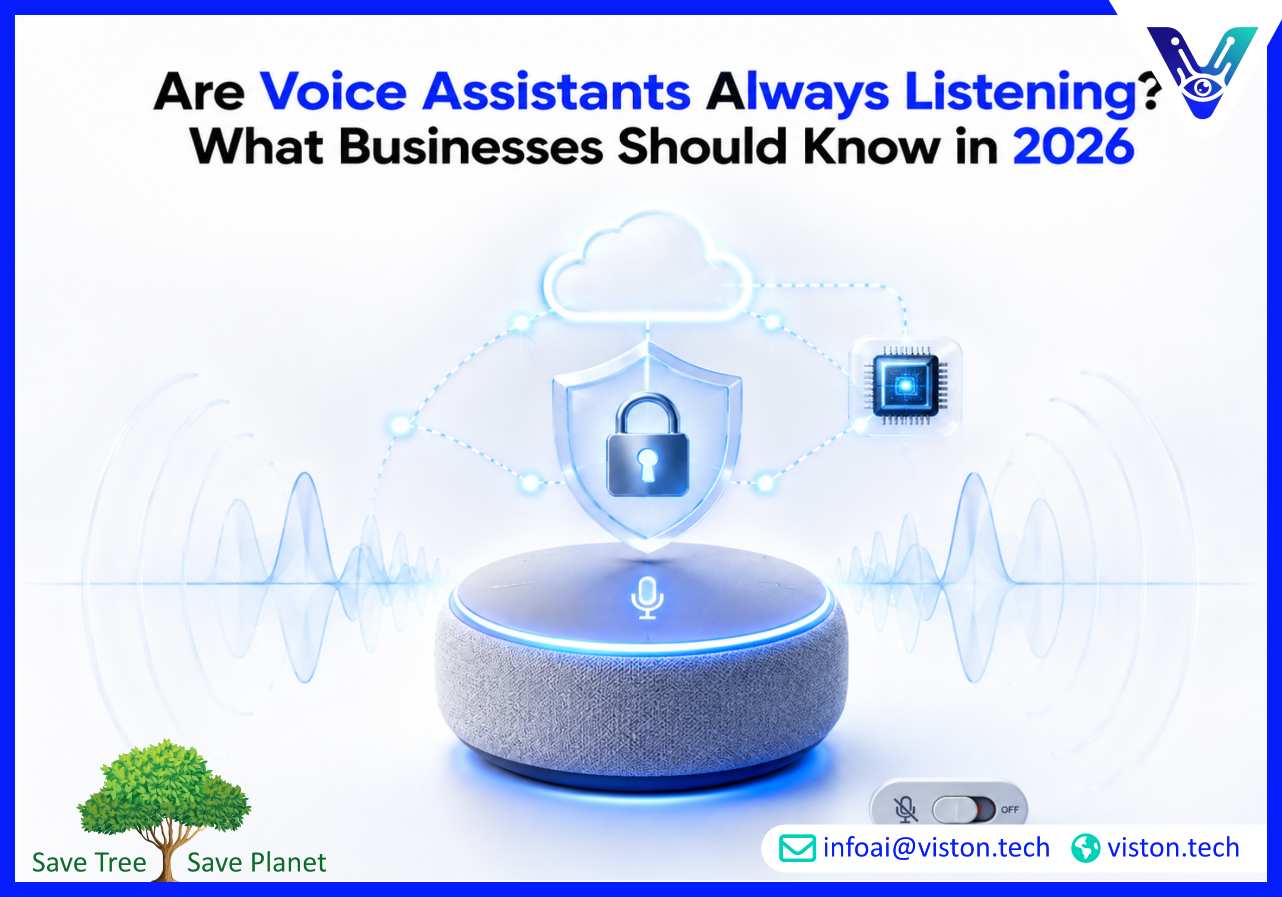
Are Voice Assistants Always Listening? What Businesses Should Know in 2026
Are voice assistants always listening? In many cases, they continuously monitor nearby audio for a wake word, but that does not necessarily mean they are recording, storing, or transmitting every conversation. For businesses deploying Voice-Enabled Assistants, understanding this distinction is essential for protecting privacy, meeting compliance obligations, and earning user trust.
Are Voice Assistants Always Listening? The Practical Answer
The most accurate answer is that some voice assistants are always listening for an activation signal when their microphones and wake-word features are enabled. However, “listening” can describe several different technical activities, and treating them as the same creates unnecessary confusion.A typical smart speaker or hands-free assistant continuously processes short segments of sound to identify a phrase such as “Hey Assistant.” This wake-word detection may happen locally on the device. When no activation is detected, the temporary audio segments are usually discarded rather than saved as complete recordings.Once the wake word is detected, the system enters an active state. It may record the user’s request, convert speech into text, send data to cloud infrastructure, retrieve information, trigger a workflow, and generate a spoken response. The exact process depends on the device, platform, configuration, and privacy settings.
Listening, recording, and transmitting are different
Businesses should distinguish between three separate activities:
Listening for activation: The microphone monitors sound for a wake word, button press, call connection, or other trigger.
Recording an interaction: Audio is captured after activation so the assistant can understand and process the request.
Transmitting or storing data: Audio, transcripts, metadata, or conversation results are sent to another system or retained for operational, security, analytics, or model-improvement purposes.
A voice assistant can listen for a wake word without permanently recording everything it hears. It can also process commands locally without transmitting all audio to the cloud. Conversely, a poorly configured system may retain more data than users expect, especially when logging, analytics, call recording, or model-training options are enabled.
Not every voice assistant uses an always-on microphone
Voice-Enabled Assistants can be activated in several ways. Consumer smart speakers commonly use wake-word activation because users expect hands-free access. Business voice systems may operate differently.A contact centre voice assistant normally begins processing only after a customer places or receives a call. A mobile application may require the user to tap a microphone icon. An in-vehicle assistant may use a steering-wheel button. A warehouse assistant may rely on a push-to-talk headset, while an internal desktop assistant may accept both typed and spoken instructions.For business deployments, always-on listening is therefore a design choice rather than a universal requirement. Organizations can select activation methods according to the environment, privacy risk, accessibility needs, user expectations, and operational purpose.
How Wake-Word Voice Assistants Work and Where Privacy Risks Arise
Wake-word detection allows an assistant to remain ready without continuously uploading a full audio stream. A lightweight model evaluates short audio buffers and looks for acoustic patterns that resemble the chosen activation phrase. When confidence exceeds a defined threshold, the assistant activates the wider speech-processing system.After activation, automatic speech recognition converts the request into text. Natural language processing or a language model identifies the user’s intent, relevant entities, and conversation context. The assistant may then query a knowledge base, access an approved business system, perform an action, or route the user to a human representative.
Accidental activation is a genuine risk
Wake-word systems are not perfect. Television dialogue, background conversations, similar-sounding phrases, accents, noise, or overlapping speakers can cause false activations. When this happens, the assistant may capture audio that was not intended as a command.False activation does not automatically mean a provider is deliberately monitoring private conversations. It does, however, show why organizations need visible or audible activation indicators, conservative wake-word sensitivity, reliable deletion controls, and clear policies for unintended recordings.Businesses should test wake-word performance in the actual deployment environment. A model that works accurately in a quiet office may behave differently in a shop, factory, vehicle, hospital, hotel, restaurant, or shared workspace.
Cloud processing changes the risk profile
Cloud-based speech processing can provide stronger language models, broader vocabulary coverage, scalable computing power, centralized analytics, and easier integration with enterprise systems. It also means that audio or transcripts may leave the device.Decision-makers should understand what information is transmitted, where it is processed, how long it is retained, and whether it can be used for service improvement or model training. They should also identify any subcontractors, speech-processing providers, analytics platforms, or third-party applications that can access conversation data.Local or edge processing can reduce the amount of audio transferred to external infrastructure. It may be appropriate for wake-word detection, simple commands, data redaction, authentication checks, or environments with unreliable connectivity. Many enterprise deployments use a hybrid architecture in which sensitive processing occurs locally while approved requests are sent to secure cloud services.
Transcripts may be as sensitive as audio
Deleting an audio file does not necessarily remove every record of an interaction. The system may retain a transcript, intent classification, call summary, customer identifier, workflow result, or analytics event.These records can contain names, account details, health information, financial data, employee information, addresses, contract terms, or other personal and confidential content. A responsible data strategy must therefore cover the entire voice-processing lifecycle, not only raw recordings.
What Businesses Should Consider Before Deploying Voice-Enabled Assistants
A business voice assistant should not be designed around technology alone. Its activation model, data access, integrations, and retention rules must reflect the purpose of the service and the sensitivity of the environment.
Define when the assistant should be active
Start by identifying the exact situations in which audio processing is necessary. A customer service bot may only need access during an active phone call. A hands-free industrial assistant may need wake-word activation during a shift. An executive meeting assistant may require explicit consent before transcription begins.The narrower the activation window, the easier it is to limit unnecessary data collection. Businesses should avoid continuous ambient monitoring when a button, call event, scheduled session, or visible user action would meet the same operational need.
Identify the data the assistant can access
A voice assistant often becomes more useful when connected to CRM, ERP, ticketing, scheduling, payment, inventory, HR, or knowledge management systems. These integrations also increase risk.Access should follow the principle of least privilege. The assistant should retrieve only the information needed for the current task. A customer checking an order should not gain access to another customer’s account. An employee assistant should not reveal restricted HR records. Administrative actions should require stronger verification than general information requests.
Choose suitable identity and authentication controls
Voice recognition alone should not automatically be treated as reliable authentication for high-risk transactions. Background speakers, recordings, synthetic voices, shared devices, and changing acoustic conditions can affect identity checks.Actions involving payments, account changes, confidential records, medical information, or contractual decisions may require additional verification. This could include a one-time password, authenticated application session, customer security question, device confirmation, or transfer to an authorized employee.
Evaluate applicable privacy and recording rules
Voice data can be personal data, and voiceprints used for identification may be treated as biometric data in some jurisdictions. Call-recording, employee-monitoring, healthcare, financial services, and children’s privacy rules may also apply depending on the use case and location.Organizations should establish a lawful basis for processing, provide meaningful privacy information, define retention periods, support applicable user rights, and document why voice data is required. Consent should not be treated as a generic checkbox when users do not understand when recording begins or how their information will be used.
How to Design a Privacy-First Voice Assistant in 2026
A privacy-first assistant does not eliminate data use. It makes data collection purposeful, proportionate, visible, secure, and controllable. These principles should be included in architecture and conversation design from the beginning rather than added after launch.
Use clear activation signals
Users should know when the system moves from standby to active processing. Appropriate signals may include a light, screen indicator, sound, spoken notice, application animation, or call-recording announcement. The signal should be easy to understand and difficult to disable accidentally.
Offer practical microphone controls
Where the hardware supports ambient activation, provide a physical microphone switch or an equally clear software control. Users should be able to disable voice activation without navigating a complex settings process.Business administrators may also need centralized controls for particular locations, departments, working hours, or device groups. For example, ambient listening could be disabled in conference rooms while remaining available on approved warehouse devices.
Minimize data collection and retention
Collect only the audio, transcript, metadata, and identifiers needed to complete the task. Avoid retaining recordings indefinitely “just in case.” Retention periods should be linked to a defined operational, contractual, security, or legal purpose.Where possible, redact payment details, passwords, identification numbers, medical information, and other sensitive content before storage. Provide deletion workflows that address recordings, transcripts, backups, analytics records, and downstream systems.
Protect integrations and conversation records
Voice assistant security should include encryption, access control, secure API authentication, audit logging, secret management, environment separation, vulnerability testing, and monitoring for unusual activity. Integration permissions should be reviewed regularly, particularly when third-party voice, telephony, or automation services are involved.Conversation logs should not be broadly available simply because they are useful for quality assurance. Access should be limited to authorized teams, and review processes should avoid exposing identifiable data unnecessarily.
Test accuracy, false activations, and safe failure
Testing should cover accents, dialects, background noise, interruptions, code-switching, uncommon names, industry terminology, and low-quality audio. Teams should measure wake-word false acceptance, missed activations, speech recognition accuracy, task completion, escalation quality, and user complaints.The assistant should fail safely. When it cannot confirm a request, identity, or required information, it should ask a clarifying question or transfer the interaction rather than guessing. Sensitive actions should have confirmation steps and human oversight where appropriate.
How Viston AI Supports Privacy-Conscious Voice-Enabled Assistants
Viston AI provides Voice-Enabled Assistants that combine speech recognition, natural language processing, conversational AI, and enterprise integration capabilities. Its service is relevant to businesses that want voice interactions connected to practical workflows rather than operating as isolated audio interfaces.The company’s published capabilities include automatic speech recognition, text-to-speech, intent classification, context management, multilingual support, analytics, model monitoring, and integration with business platforms and custom APIs. These elements can support use cases such as customer service, internal assistance, scheduling, information retrieval, and hands-free operational workflows.Privacy-conscious delivery requires more than selecting a speech model. Organizations need to decide when microphones activate, which systems the assistant can access, how data moves through the architecture, when human intervention is required, and how performance is monitored after deployment. Viston AI’s broader experience in AI integration, workflow automation, NLP, LLMOps, access controls, auditability, and enterprise deployment aligns with these requirements.For organizations evaluating Voice-Enabled Assistants, this implementation-focused approach can help balance conversational quality with security, scalability, data governance, and operational reliability. The result should be a voice system that remains useful without collecting or exposing more information than the business purpose requires.
Frequently Asked Questions
Are voice assistants recording everything all the time?
Usually not. Wake-word-enabled assistants may continuously process short audio segments to detect an activation phrase, but they generally begin recording or transmitting a full request only after activation. Exact behavior depends on the device, settings, and provider.
Can a voice assistant activate accidentally?
Yes. Similar-sounding words, television audio, background speech, noise, or accidental button presses can trigger an assistant. Activation indicators, sensitivity settings, testing, and deletion controls help reduce the impact of false activations.
Can voice assistants work without always-on listening?
Yes. Voice assistants can use push-to-talk buttons, microphone icons, call-based activation, scheduled sessions, keyboard commands, or other explicit triggers. Many business systems do not require continuous ambient monitoring.
Do voice assistants send every conversation to the cloud?
Not necessarily. Some systems perform wake-word detection or other processing on the device. After activation, cloud-based assistants may transmit audio or transcripts to process the request. Businesses should verify the architecture and data flow of their chosen solution.
How can companies make voice assistants more private?
Companies can use clear recording notices, local wake-word processing, microphone controls, minimal permissions, short retention periods, encryption, redaction, role-based access, secure integrations, and reliable deletion procedures.
Can Viston AI build a voice assistant with business-specific privacy controls?
Viston AI’s Voice-Enabled Assistants service includes enterprise integration, NLP, speech technologies, monitoring, and governance-related capabilities. Privacy requirements should be defined for each deployment based on its users, data, workflows, industry, and applicable regulations.
Conclusion
So, are voice assistants always listening? Some systems continuously monitor audio for a wake word, but this is different from permanently recording or transmitting every conversation. Other assistants activate only during calls, button presses, or user-initiated sessions. For businesses, the important question is not simply whether a microphone is active, but how audio is processed, stored, secured, and connected to business systems. A well-designed Voice-Enabled Assistant should use transparent activation, limited data access, appropriate retention, secure integrations, and clear user controls. Viston AI offers relevant technical capabilities for organizations seeking practical voice automation with enterprise-focused deployment and governance considerations.