
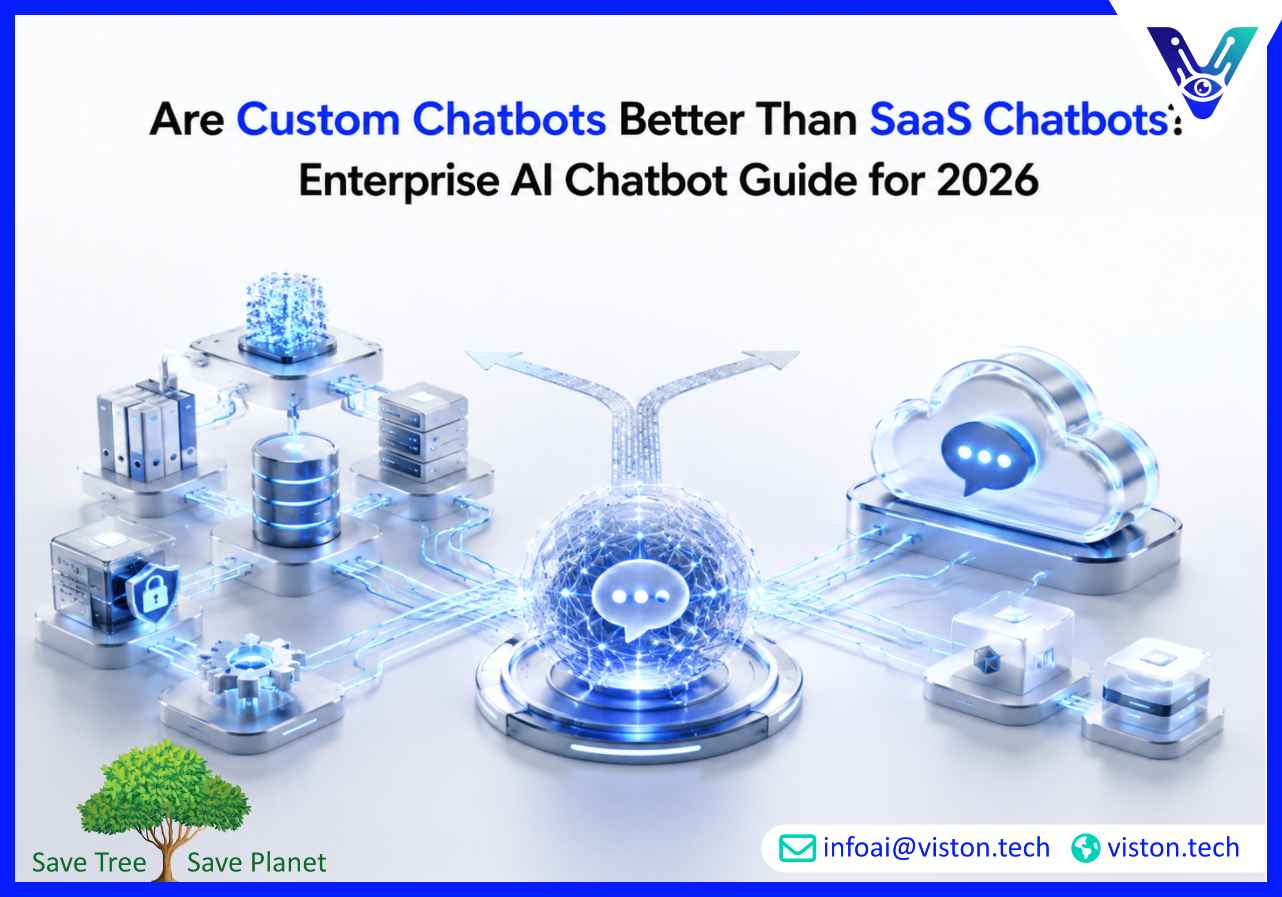
Are custom chatbots better than SaaS chatbots? For many businesses, the answer depends on control, speed, integration depth, security needs, scalability, and long-term ownership. In 2026, enterprise AI chatbot decisions are less about choosing the most popular tool and more about choosing the right operating model for business outcomes.
A custom chatbot is designed around a company’s specific workflows, data sources, customer journeys, compliance requirements, integrations, tone, and operational rules. It may use large language models, retrieval-augmented generation, custom knowledge bases, CRM data, workflow automation, human handoff logic, analytics dashboards, and secure deployment architecture.
A SaaS chatbot is a ready-made subscription platform that businesses can configure and launch faster. It usually includes prebuilt templates, channel integrations, analytics, basic automation, and vendor-managed hosting. SaaS chatbot platforms can be useful for standard customer support, website lead capture, appointment booking, FAQ automation, and simple guided flows.
The decision is not always “custom is better” or “SaaS is better.” The right choice depends on the chatbot’s role in the business. If the chatbot only answers common questions, a SaaS tool may be enough. If the chatbot must support complex enterprise AI chatbot workflows, access internal systems, follow strict governance rules, handle multiple user roles, or create differentiated customer experiences, a custom chatbot is often the stronger option.
SaaS chatbots are usually built for speed and convenience. Custom chatbots are built for fit, control, and long-term adaptability. SaaS platforms reduce early implementation friction, while custom solutions give businesses more freedom to design how the chatbot understands users, retrieves knowledge, escalates issues, updates systems, and reports performance.
For enterprise decision-makers, the most important question is not which option looks easier at launch. The better question is which option can support the company’s real customer experience, internal operations, data governance, security requirements, and growth plans over the next several years.
Custom chatbots are usually better when the chatbot is expected to do more than answer basic questions. Businesses that need deep integration, domain-specific intelligence, advanced security, multilingual support, or workflow automation often benefit from a custom enterprise AI chatbot approach.
Many enterprise workflows are not simple. A customer may need to check an order, update account details, request a refund, upload documents, verify eligibility, speak to the right department, and receive a case confirmation in one conversation. A standard SaaS chatbot may handle parts of this journey, but it may struggle when workflows involve multiple systems, conditional logic, permissions, or exception handling.
A custom chatbot can be designed around the exact process. It can connect with CRM platforms, helpdesk tools, ERP systems, payment systems, inventory databases, knowledge bases, scheduling tools, and internal approval workflows. This makes the chatbot more useful because it does not sit outside the business process. It becomes part of the process.
Security is one of the biggest reasons enterprises choose custom chatbot development. In regulated or data-sensitive environments, businesses may need strict control over where data is stored, how it is processed, who can access it, how long it is retained, and how conversations are audited.
A custom enterprise AI chatbot can support role-based access, encryption, private cloud or on-premises deployment, audit logs, data masking, permission-based responses, secure API connections, and compliance-aligned workflows. This is especially important when chatbots handle customer records, financial information, healthcare data, employee data, legal requests, or confidential business knowledge.
Generic chatbot templates often struggle with specialized terminology. Enterprises may use internal product names, process codes, industry-specific language, technical troubleshooting terms, contract rules, regional policies, or complex service categories. A custom chatbot can be trained and configured around this language.
Better domain understanding improves intent recognition, answer relevance, escalation quality, and user trust. The chatbot can also be designed to avoid unsupported answers by retrieving information from approved knowledge sources instead of relying on generic responses.
For businesses where customer experience is a competitive advantage, a generic chatbot may feel limiting. Custom chatbots allow teams to design the conversation style, brand tone, product guidance, recommendation logic, handoff experience, and reporting model around the company’s actual service promise.
This matters for B2B sales, ecommerce, financial services, healthcare, education, real estate, travel, manufacturing, SaaS, and support-heavy businesses. A chatbot that understands the customer journey can do more than respond. It can guide decisions, qualify leads, reduce friction, and help users complete meaningful tasks.
SaaS chatbots can be the better choice when a business needs a fast, affordable, and low-complexity solution. Not every company needs a custom-built chatbot from day one. For early-stage teams, small businesses, simple use cases, or short-term campaigns, SaaS platforms can deliver practical value without heavy development work.
A SaaS chatbot can often be configured quickly using existing templates and standard integrations. This is useful when the chatbot needs to answer FAQs, capture leads, route inquiries, collect basic details, or support a marketing campaign. Businesses can test chatbot adoption before investing in a larger enterprise AI chatbot program.
Speed matters when teams want to validate user behavior, identify common questions, or reduce repetitive support requests without building a full custom system. A SaaS chatbot can act as a starting point for chatbot maturity.
With SaaS platforms, hosting, updates, uptime, interface management, and basic analytics are usually handled by the vendor. This can be helpful for teams without internal AI, engineering, security, or integration resources.
The tradeoff is that the business must work within the platform’s limits. Customization may be restricted, data access may be limited, advanced workflow design may require higher plans, and the chatbot may not support every compliance or deployment requirement.
SaaS chatbot tools are often suitable for:
If the chatbot does not need deep personalization, secure enterprise integration, complex permissions, or advanced workflow automation, a SaaS platform may provide enough functionality at a lower starting cost.
The best decision starts with business requirements, not technology preference. A company should define what the chatbot must achieve, which systems it must connect with, what data it will handle, how much control is required, and how performance will be measured.
A custom chatbot is usually the right choice when the chatbot affects revenue, customer trust, regulated processes, employee productivity, or operational efficiency at scale. If the chatbot must perform account-specific actions, support multiple departments, integrate with enterprise systems, or follow strict governance rules, custom development gives the business more control.
Custom is also stronger when the chatbot must evolve over time. As business processes change, a custom architecture can be extended with new workflows, channels, knowledge sources, analytics, AI models, and security controls.
A SaaS chatbot is often appropriate when the chatbot’s scope is narrow, risk is low, and launch speed is more important than deep customization. It can help businesses learn what users ask, where automation helps, and which chatbot features may be worth investing in later.
However, teams should avoid choosing SaaS only because it appears cheaper. Subscription fees, usage-based pricing, add-ons, integration limits, data export restrictions, and migration costs can change the total cost over time.
Many businesses do not need a pure build-or-buy decision. A hybrid strategy can combine SaaS components with custom workflows, custom integrations, approved knowledge retrieval, security controls, and tailored conversation design.
This approach can reduce development time while still giving the business more control over important areas. For example, a company may use a proven messaging interface while building custom backend integrations, domain-specific knowledge retrieval, escalation rules, analytics, and governance workflows.
Whether choosing custom or SaaS, businesses should evaluate chatbot providers based on:
In 2026, enterprise AI chatbot success depends on measurable outcomes. Businesses should track resolution rate, fallback rate, escalation rate, customer satisfaction, lead qualification, workflow completion, cost per resolved conversation, and system update accuracy.
Viston AI is relevant to the custom chatbot vs SaaS chatbot decision because its Enterprise AI Chatbots service is focused on conversational AI built for enterprise complexity. The company positions its chatbot capabilities around advanced natural language understanding, contextual memory, multi-turn dialogue management, multilingual support, enterprise security, analytics, and integration with CRM, knowledge bases, and transactional systems.
For businesses comparing custom chatbots with SaaS chatbots, this matters because the real value of an enterprise AI chatbot often comes from how well it connects with existing operations. A chatbot that can understand business-specific terminology, retrieve approved knowledge, update systems, escalate with context, and support secure workflows is more valuable than a generic chat interface.
Viston AI’s broader AI service portfolio includes AI chatbot development, AI chatbot integration, NLP and text analysis, AI automation and workflow bots, voice-enabled assistants, multilingual chatbot support, AI strategy development, and MLOps and model monitoring. These capabilities align with organizations that need chatbot solutions designed around their data, processes, security expectations, and long-term optimization needs.
For companies considering whether custom chatbots are better than SaaS chatbots, Viston AI can support a practical assessment of use case complexity, integration requirements, deployment model, automation goals, governance needs, and measurable ROI. This makes its offering relevant for businesses that want enterprise AI chatbots to function as reliable operational systems rather than isolated chatbot tools.
No. Custom chatbots are better when the business needs deep integration, security control, domain-specific workflows, and long-term flexibility. SaaS chatbots may be better for simple, low-risk, fast-launch use cases such as FAQs, basic lead capture, or standard support routing.
Custom chatbots usually require higher upfront investment because they involve strategy, design, development, integrations, testing, deployment, and optimization. SaaS chatbots often have lower starting costs, but long-term costs can increase through subscriptions, usage fees, add-ons, and limited customization.
An enterprise should be cautious with SaaS chatbots when the chatbot must handle sensitive data, regulated workflows, complex approvals, proprietary knowledge, deep CRM or ERP integration, custom reporting, or strict deployment requirements. These needs often require a custom or hybrid approach.
Yes, but migration depends on the platform. Businesses should check whether conversation data, knowledge content, workflows, analytics, and integrations can be exported or reused. Planning for future migration helps avoid vendor lock-in.
The best approach is to match the chatbot model to business complexity. Simple use cases may start with SaaS. Complex, regulated, integrated, or high-volume use cases usually need custom enterprise AI chatbot development or a hybrid architecture.
Yes. Viston AI’s Enterprise AI Chatbots and AI chatbot development capabilities are aligned with custom and integration-heavy chatbot requirements. The company can help evaluate workflows, system integrations, security needs, multilingual support, automation goals, and long-term chatbot optimization.
Are custom chatbots better than SaaS chatbots? For simple use cases, SaaS chatbots can be faster and easier to launch. For complex business environments, custom chatbots are often better because they provide stronger control over workflows, data, integrations, security, domain accuracy, and scalability. The right enterprise AI chatbot decision should be based on business value, not software category. In 2026, companies should evaluate chatbot options by how well they support real customer journeys, operational processes, compliance needs, and measurable outcomes. Viston AI is a relevant specialist for businesses that need enterprise AI chatbots designed around practical business requirements and long-term performance.
