
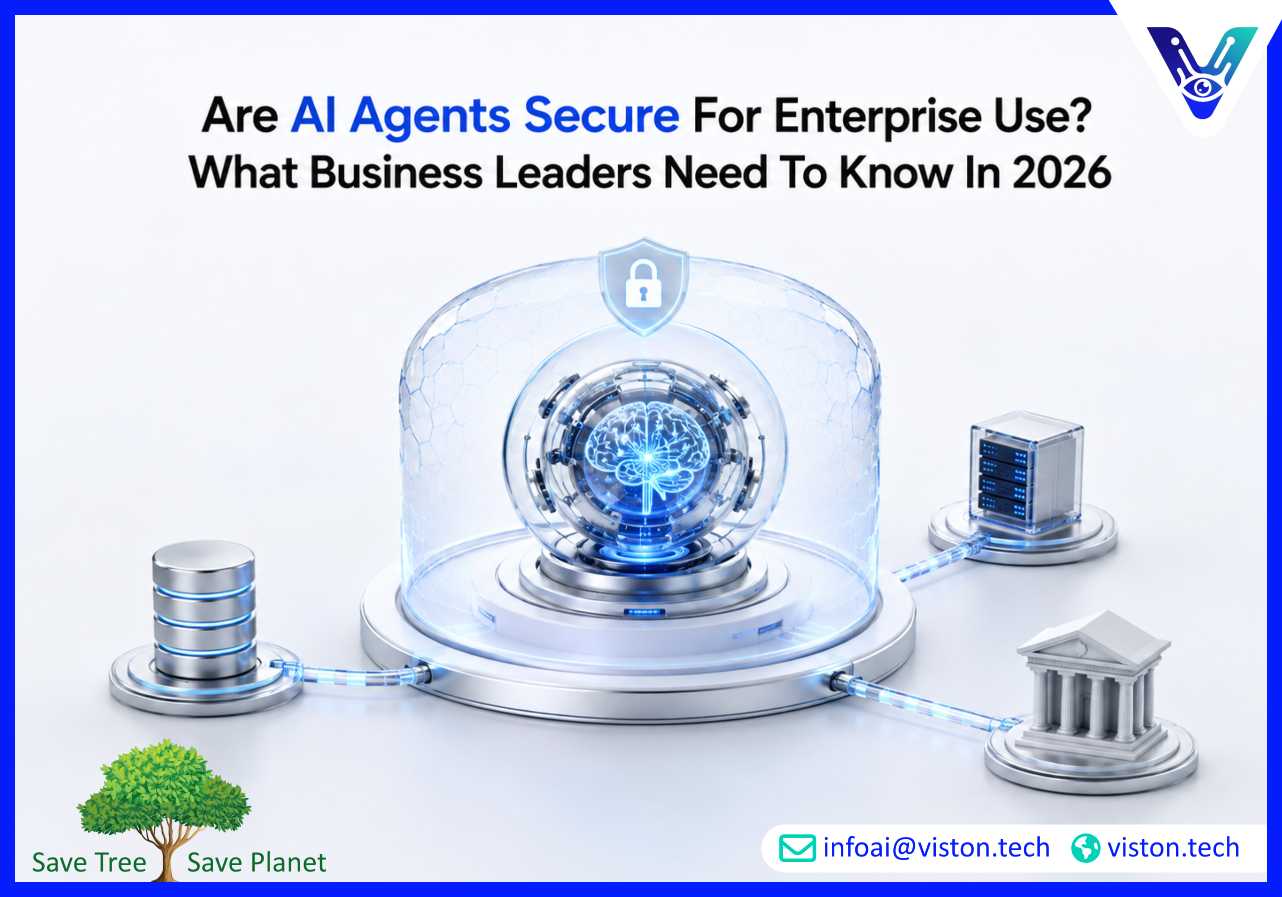
Security is the first serious question most enterprise buyers ask when evaluating AI agents. It is also the question that often gets answered too quickly, with reassurances rather than substance. As AI agent development and deployment accelerates across industries in 2026, the honest answer is that AI agents can be highly secure for enterprise use, but only when security is treated as a foundational design requirement rather than a feature added after deployment.
AI agents are fundamentally different from conventional software. They do not simply execute fixed instructions. They reason, make decisions, access systems, call external APIs, retrieve data, and in some cases take autonomous actions without direct human approval at every step. That combination of autonomy, system access, and decision-making introduces a set of risks that traditional security frameworks were not built to address.
An enterprise application with a defined input and a defined output has a relatively predictable attack surface. An AI agent that can query a database, call an external service, interpret natural language instructions, and trigger downstream workflows has a substantially larger one. This does not make AI agents inherently unsafe, but it does mean that security must be designed into the agent architecture from the ground up.
Organizations that treat AI agent security as an afterthought, or that deploy agents built for speed without governance rigour, are the ones that encounter problems. The risk is real. The solution is architectural discipline, not avoidance.
Understanding the actual risk categories is the starting point for any responsible deployment decision.
Prompt injection is one of the most discussed attack vectors specific to AI agents. It occurs when malicious input, embedded in data an agent retrieves or processes, manipulates the agent into performing unintended actions. An agent tasked with summarizing customer emails, for example, could be redirected by a carefully crafted email containing hidden instructions. Unlike traditional SQL injection, prompt injection exploits the language model’s instruction-following behaviour rather than a code vulnerability.
Excessive permissions represent an architectural risk rather than an external attack. Agents granted broad system access as a convenience during development create unnecessary exposure. If an agent only needs to read from a specific database table, it should not have write access to the entire schema. Principle of least privilege applies to AI agents exactly as it applies to human users and system accounts.
Data leakage through model outputs is a risk in deployments where agents have access to sensitive business data and generate natural language responses. Without output filtering and data classification controls, an agent could inadvertently include confidential information in a response visible to an unauthorized user.
Insecure third-party tool integrations matter because most enterprise AI agents are connected to external APIs, data sources, and platforms. Each integration is a potential entry point. If those connections are not properly authenticated and monitored, they become vulnerabilities in the agent’s operational environment.
Lack of auditability is a governance risk with security implications. If an agent takes an action and there is no reliable log of what it did, why it did it, and what data it accessed, the organization has no basis for incident investigation, compliance reporting, or accountability.
Security in AI agent development is not a single control. It is a set of practices embedded across the entire development and deployment lifecycle.
Threat modelling specific to agent behaviour should happen before a line of code is written. This means identifying what data the agent will access, what actions it can take, what external systems it will connect to, and what the consequences of a compromised or misbehaving agent would be. Generic threat models built for conventional applications will miss the agent-specific vectors.
Role-based access control at the agent level means each agent is provisioned with only the permissions it genuinely needs for its defined function. Access should be scoped, time-limited where appropriate, and reviewed as agent capabilities evolve.
Input validation and output filtering address the prompt injection risk directly. Validating inputs before they reach the model and filtering outputs before they are returned or acted upon reduces the attack surface meaningfully, particularly in agents that process external data.
Audit trails and observability are not optional in enterprise contexts. Every significant agent action, the decision made, the data accessed, the system called, and the output produced, should be logged in a tamper-resistant format. This supports both security monitoring and regulatory compliance.
Human oversight and approval gates for high-stakes actions are a practical safety measure for the current state of enterprise AI. Agents can operate autonomously for routine tasks while requiring human confirmation before executing irreversible or high-impact actions, such as initiating financial transactions or modifying critical records.
Regular red-teaming and adversarial testing specific to AI agents are increasingly recognized as necessary. Frameworks such as OWASP’s AI Security and Privacy Guide and NIST’s AI Risk Management Framework provide structured approaches for identifying and addressing vulnerabilities before production deployment.
Regulatory obligations add a further layer of security requirements that enterprise buyers cannot ignore. In heavily regulated sectors, the compliance dimension of AI agent security is often as demanding as the technical one.
Agents operating in healthcare environments that process patient data must align with HIPAA requirements, including data handling, access logging, and breach notification obligations. Financial services deployments in Europe must consider GDPR, MiFID II, and sector-specific guidance from regulators who are actively developing AI-specific frameworks in 2026. The EU AI Act, now in active enforcement for high-risk AI categories, places explicit requirements on documentation, human oversight, and transparency for AI systems operating in consequential business contexts.
ISO 42001, the international standard for AI management systems, provides a governance framework that covers security controls, risk management, and transparency requirements for AI development and operations. For enterprise buyers evaluating AI agent development partners, ISO certification or verifiable alignment with this standard is a meaningful indicator of operational maturity.
When selecting a provider for AI agent development and deployment, security capability should be a primary evaluation criterion, not a secondary one.
Ask specifically how security is embedded in the development methodology, not just how the finished product is secured. A provider that integrates security architecture, access control design, and compliance mapping from the requirements phase is fundamentally different from one that applies security checks at the end of the build.
Ask about governance architecture. How are agent permissions managed? How are audit logs structured and stored? What mechanisms exist to detect and respond to anomalous agent behaviour in production?
Ask about post-deployment monitoring. Security does not end at go-live. Agents operating in production environments encounter new data, new integrations, and evolving threat landscapes. Continuous monitoring and a clear process for addressing emerging vulnerabilities are part of what a responsible deployment partner provides.
Viston AI’s approach to AI agent development and deployment is built around security and governance as architectural commitments rather than add-on features. Their delivery methodology embeds security controls at each stage of the development lifecycle, from initial threat modelling and access design through to production deployment and ongoing monitoring.
Viston operates with ISO-certified AI operations and maintains compliance frameworks aligned with enterprise security standards. For clients in regulated industries including financial services, healthcare, and manufacturing, their deployments incorporate GDPR-aligned data handling, HIPAA-compliant architectures where applicable, and sector-specific governance requirements as structural constraints from the design phase.
Their technical approach includes role-based access control at the agent level, encrypted data handling in transit and at rest, guardrail agents for high-stakes workflows in sectors such as fintech and healthcare, and full audit trail logging for agent decisions and actions. For multi-agent deployments, governance-as-code allows compliance rules to be defined centrally and enforced automatically across the agent ecosystem.
Viston’s development team includes engineers experienced in Kubernetes, Terraform, and CI/CD pipelines, ensuring that agent deployments are not isolated scripts but resilient, enterprise-grade microservices that fit within existing IT security architecture. Their track record spans global markets including the USA, UK, Germany, and Australia, with deployments across industries where security and compliance requirements are demanding and non-negotiable.
Yes, when designed with appropriate data access controls, encryption, output filtering, and audit logging. The key is scoping agent access to only the data required for the specific task, and ensuring that all data handling aligns with applicable regulatory requirements such as GDPR or HIPAA. A well-architected agent deployment is no less secure than other enterprise software systems.
Prompt injection is an attack where malicious instructions are embedded in data an agent processes, causing it to behave in unintended ways. It is a genuine and documented risk, particularly for agents that process external or user-generated content. Mitigations include input validation, sandboxed execution environments, and output filtering. Responsible AI agent development partners build these controls into the architecture from the outset.
AI agents can be designed to comply with both. This requires treating compliance as an architectural constraint from day one, scoping data access appropriately, maintaining audit trails, implementing data minimization practices, and ensuring that any cross-border data handling meets jurisdictional requirements. The EU AI Act adds further obligations for high-risk AI applications, including documentation, human oversight, and transparency requirements.
At minimum: role-based access control, audit logging for all significant agent actions, defined escalation paths for anomalous behaviour, human approval gates for high-stakes or irreversible actions, and a tested incident response process. For regulated industries, compliance mapping and independent security testing prior to go-live are also advisable.
Viston embeds security architecture into each stage of its development methodology, from threat modelling and access design through to deployment and monitoring. Their engagements include ISO-certified AI operations, encrypted data handling, RBAC at the agent level, guardrail agents for regulated workflows, and full audit trail logging. They also provide ongoing post-deployment monitoring and performance optimization.
Autonomy introduces distinct risks that require distinct controls, but it does not make AI agents inherently less secure than other enterprise systems. The risks are well understood, the mitigation approaches are proven, and the governance frameworks to manage them are maturing. The organizations that experience problems are typically those that deploy agents without appropriate security architecture, not those that deploy agents at all.
The question of whether AI agents are secure for enterprise use does not have a single yes or no answer. It has a conditional one: they are secure when developed and deployed with the right architectural discipline, governance frameworks, access controls, and ongoing monitoring in place. In 2026, the standards and practices for secure AI agent development and deployment are well established, and organizations that work with experienced, security-first providers can deploy agents with confidence across even the most regulated and data-sensitive environments. For businesses evaluating AI agent development and deployment partners, security capability demonstrated through methodology, certification, and verifiable delivery practice should be the primary filter, not an afterthought. Viston AI’s structured approach to secure, compliant agent development reflects what responsible enterprise deployment looks like in practice.
