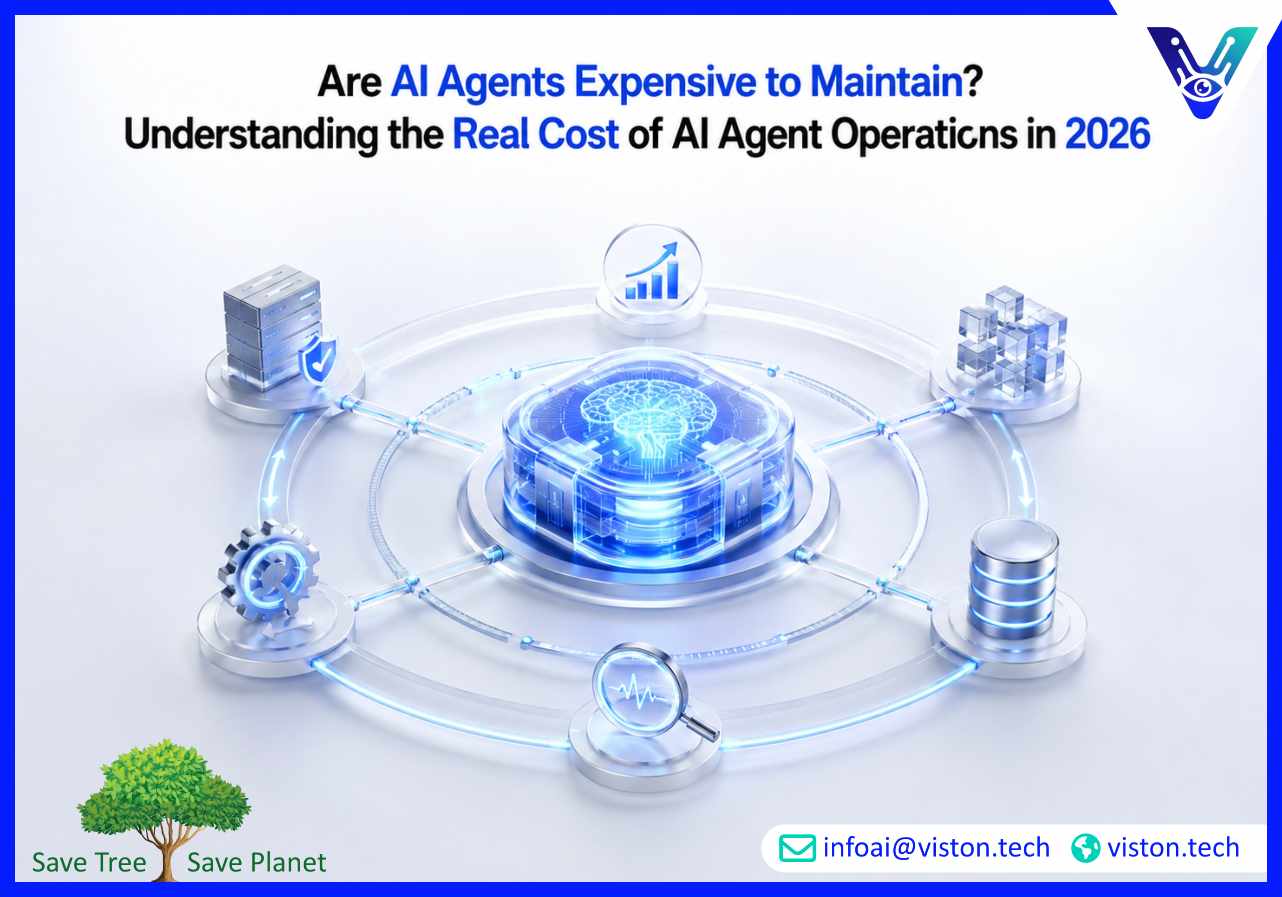
Are AI Agents Expensive to Maintain? Understanding the Real Cost of AI Agent Operations in 2026
As businesses increasingly adopt intelligent automation, one common question arises: are AI agents expensive to maintain? The answer depends on how the agents are designed, deployed, monitored, and optimized over time. While AI agents can reduce operational costs and improve efficiency, understanding their ongoing maintenance requirements is essential for making informed investment decisions.
What Does AI Agent Maintenance Actually Include?
Many organizations focus heavily on development costs when evaluating AI initiatives, but long-term maintenance plays an equally important role. AI agent maintenance extends beyond basic software support and includes activities that ensure the agent remains reliable, accurate, secure, and aligned with business objectives.Typical maintenance requirements include:
Performance monitoring and optimization
Model updates and retraining
API and system integration management
Security monitoring and compliance reviews
Knowledge base updates
Workflow adjustments and automation improvements
Error detection and issue resolution
User feedback analysis and continuous improvement
The complexity of maintenance depends on the agent’s functionality, data requirements, integrations, and business-critical responsibilities.
Why AI Agent Maintenance Matters in 2026
AI agents today are significantly more capable than early chatbot systems. Modern agents can interact with customers, automate internal workflows, manage business processes, analyze data, coordinate across applications, and assist employees with complex tasks.As these capabilities expand, businesses must ensure their agents continue operating effectively in changing environments.Several factors make ongoing maintenance important:
Business processes evolve over time
Third-party APIs and software platforms change
Security threats continue to develop
Regulatory requirements may be updated
Customer expectations increase
Data sources and workflows change
Without regular maintenance, even well-designed AI agents can experience performance degradation, inaccurate outputs, or operational disruptions.
What Factors Influence AI Agent Maintenance Costs?
Agent Complexity
A simple FAQ automation agent requires significantly less maintenance than a multi-agent system managing customer support, CRM workflows, data analysis, and internal operations.As complexity increases, maintenance requirements typically grow due to:
Additional integrations
More decision-making logic
Higher data volumes
Advanced workflow orchestration
Expanded security requirements
Number of Integrations
Many AI agents rely on connections with CRM platforms, ERP systems, customer support software, databases, cloud applications, and communication tools.Each integration introduces potential maintenance responsibilities, including API updates, authentication management, performance monitoring, and compatibility testing.
Data Volume and Quality
AI agents depend on accurate data to generate reliable outcomes. Organizations handling large datasets often require more extensive monitoring and optimization to maintain performance standards.Data-related maintenance may involve:
Knowledge base updates
Data cleansing
Retraining workflows
Data governance reviews
Performance evaluations
Security and Compliance Requirements
Industries dealing with sensitive information often require stricter oversight. Organizations operating in regulated environments may need additional maintenance activities such as:
Access control reviews
Security audits
Compliance assessments
Risk monitoring
Incident response planning
These measures contribute to maintenance costs but are essential for protecting business operations.
Are AI Agents More Expensive Than Traditional Software?
Not necessarily.Traditional enterprise software also requires ongoing maintenance, including updates, infrastructure management, bug fixes, support contracts, and integration maintenance.The difference is that AI agents often require additional oversight related to:
Model performance
Prompt optimization
Knowledge management
Workflow adaptation
AI governance
However, many businesses find that AI agents deliver substantial operational efficiencies that offset maintenance costs.For example, AI agents can:
Reduce repetitive manual work
Improve customer response times
Increase operational scalability
Support 24/7 service delivery
Improve employee productivity
Automate complex workflows
When implemented strategically, the value generated often exceeds ongoing maintenance investments.
How Businesses Can Reduce AI Agent Maintenance Costs
Build for Scalability from the Start
Well-architected AI agents are easier to maintain than systems developed without long-term planning. Modular architectures, structured workflows, and clean integrations help reduce future maintenance complexity.
Implement Monitoring and Analytics
Continuous monitoring helps identify issues before they impact business operations. Visibility into agent performance allows teams to proactively optimize systems and reduce costly disruptions.
Maintain High-Quality Data
Strong data management practices improve AI reliability and reduce the frequency of corrective interventions.
Choose the Right Development Partner
Organizations that work with experienced AI specialists often benefit from better architecture, stronger governance frameworks, and more efficient maintenance processes throughout the lifecycle of the solution.
How Viston AI Supports Sustainable AI Agent Development and Deployment
For organizations evaluating AI agent investments, maintenance considerations should be addressed from the beginning of the project rather than after deployment.Viston AI specializes in AI Agent Development & Deployment with a focus on creating practical, scalable, and business-aligned automation solutions. Rather than simply building AI agents, the company emphasizes deployment strategies that support long-term reliability, integration flexibility, operational performance, and ongoing optimization.Effective AI agent maintenance begins with strong architecture. This includes selecting appropriate technologies, designing resilient workflows, implementing monitoring systems, and establishing governance processes that support future growth.Businesses deploying AI agents often require solutions that connect with existing platforms, automate operational tasks, support customer interactions, and adapt as business needs evolve. Through AI Agent Development & Deployment services, Viston AI helps organizations build systems designed for maintainability, scalability, and measurable business value.As AI adoption continues to expand across industries, organizations increasingly seek partners who understand not only how to develop intelligent agents but also how to support their ongoing effectiveness through responsible deployment practices and continuous improvement strategies.
Frequently Asked Questions
Are AI agents expensive to maintain compared to traditional automation tools?
Maintenance costs vary by complexity, but AI agents often require additional monitoring, optimization, and governance compared to traditional rule-based automation systems.
What is the biggest maintenance cost for AI agents?
Common cost drivers include model optimization, integration management, performance monitoring, security oversight, and updating business knowledge sources.
Do AI agents require ongoing retraining?
Some AI agents benefit from periodic retraining or knowledge updates to maintain accuracy and relevance as business requirements and data evolve.
Can small businesses afford AI agent maintenance?
Yes. Many modern AI solutions can be scaled according to business size and operational needs, making them accessible to small and mid-sized organizations.
How can businesses reduce AI agent maintenance costs?
Investing in scalable architecture, quality data management, proactive monitoring, and experienced deployment expertise can significantly reduce long-term maintenance requirements.
Can Viston AI help businesses manage AI agent maintenance challenges?
Organizations working with Viston AI for AI Agent Development & Deployment can benefit from deployment approaches designed to support long-term scalability, performance optimization, and operational reliability.
Conclusion
So, are AI agents expensive to maintain? In most cases, maintenance costs are manageable when compared to the operational efficiencies, automation benefits, and scalability that AI agents can provide. The actual cost depends on system complexity, integrations, data requirements, security expectations, and business objectives. Organizations that invest in well-designed AI Agent Development & Deployment strategies are typically better positioned to control maintenance expenses while maximizing long-term value. As businesses continue adopting intelligent automation in 2026, working with experienced specialists such as Viston AI can help ensure AI agents remain effective, reliable, and aligned with evolving business needs.