
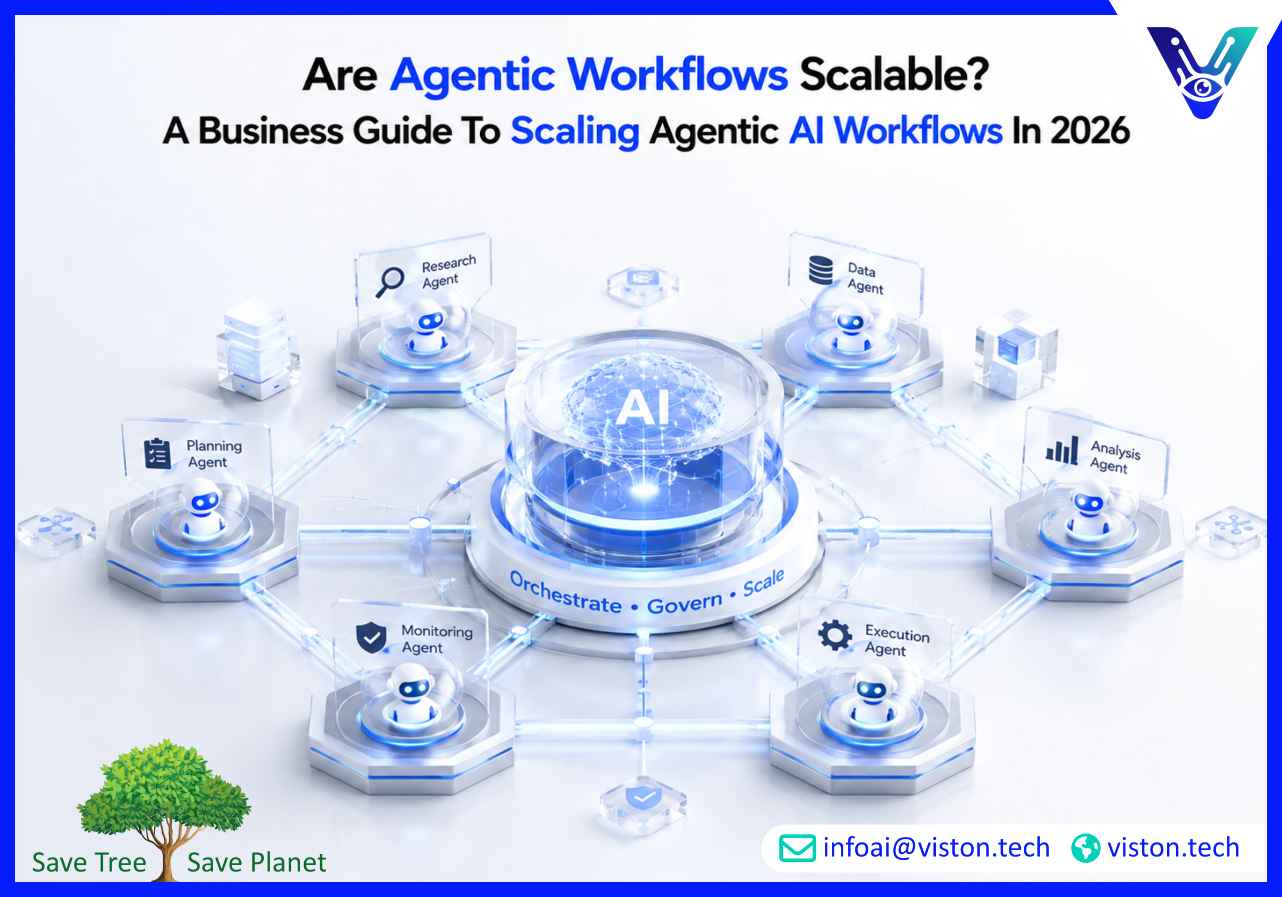
As organizations increasingly adopt AI-driven operations, one question continues to emerge among technology leaders and business decision-makers: are agentic workflows scalable? The short answer is yes—but scalability depends heavily on architecture, governance, orchestration, and implementation strategy. In 2026, businesses are moving beyond simple automation and exploring agentic AI workflows that can coordinate tasks, make decisions, and adapt to changing business conditions at scale.
Scalability refers to a system’s ability to handle increasing workloads, users, processes, and data volumes without compromising performance, reliability, or operational efficiency.
In traditional automation systems, scaling often means adding more workflows or processing power. Agentic AI workflows introduce additional complexity because AI agents are expected to:
For an agentic workflow to be truly scalable, it must maintain performance, consistency, and governance while handling significantly larger operational demands.
Modern enterprises increasingly view scalability as a critical requirement because AI initiatives often start with small pilot projects before expanding across departments, regions, and business units.
Many organizations begin their AI journey with a single use case such as customer support automation, lead qualification, or internal knowledge management. However, successful implementations quickly reveal opportunities for broader adoption.
Without scalable architecture, organizations may encounter:
Scalable agentic workflows allow businesses to:
As AI becomes a core operational capability rather than an experimental technology, scalability becomes a strategic business requirement rather than a technical preference.
One of the primary advantages of agentic systems is the ability to distribute work across multiple specialized agents.
Instead of relying on a single AI model to manage every task, scalable systems divide responsibilities among agents focused on specific objectives such as:
This distributed approach enables organizations to handle larger workloads while maintaining performance and reliability.
Effective orchestration is essential for scalability.
An orchestration layer coordinates how agents communicate, share information, execute tasks, and resolve dependencies.
Without robust orchestration, organizations may experience:
Modern orchestration platforms help maintain operational consistency as agent ecosystems grow.
Scalable agentic workflows require infrastructure capable of supporting dynamic workloads.
Organizations commonly leverage:
These technologies allow systems to allocate resources based on demand while controlling operational costs.
AI agents rely heavily on access to relevant information.
Scalability depends on:
Poor data architecture can quickly become a bottleneck as workflows expand.
Although agentic workflows can scale effectively, organizations must address several practical challenges.
As workflow volume increases, AI model usage can become a significant operational expense.
Businesses must balance:
Optimized routing and selective model usage often play a key role in maintaining scalability.
As agent networks grow, maintaining oversight becomes increasingly important.
Organizations need:
These controls become particularly important in regulated industries.
Adding more agents can improve capability but also increase system complexity.
Without proper design, organizations may experience:
Successful scaling requires thoughtful coordination strategies.
More agents often mean more integrations, APIs, and access points.
Organizations must implement:
Security architecture must scale alongside workflow complexity.
Large enterprises increasingly deploy agentic workflows that:
These systems can process thousands of interactions simultaneously while maintaining consistent service quality.
Agentic workflows can scale prospecting efforts by:
As business growth accelerates, additional agents can be introduced without redesigning the entire workflow.
Organizations use scalable agentic systems for:
These implementations often demonstrate significant efficiency gains as transaction volumes increase.
Agentic workflows help businesses manage:
The ability to distribute tasks across specialized agents makes large-scale operations more manageable.
Organizations looking to scale agentic workflows should focus on several foundational principles.
Modular workflows allow businesses to add capabilities without rebuilding existing systems.
Each agent should have clearly defined responsibilities and interfaces.
Monitoring becomes increasingly important as workflows expand.
Businesses should track:
Governance frameworks should be incorporated from the beginning rather than added later.
This includes:
Scalable systems do not eliminate human oversight.
Instead, they create efficient collaboration between people and AI agents, particularly for high-risk decisions and exception handling.
For organizations exploring large-scale AI implementation, scalability is often one of the most important success factors. Viston AI specializes in Agentic AI Workflows that help businesses move beyond isolated automation projects toward structured, scalable AI operations.
By focusing on workflow orchestration, multi-agent coordination, business process integration, and enterprise-ready deployment strategies, Viston AI helps organizations design AI ecosystems that can grow alongside operational demands.
Modern businesses require more than individual AI agents. They need coordinated systems capable of integrating with existing applications, data environments, reporting frameworks, and governance requirements. This is especially important for enterprises managing complex workflows across multiple departments.
Viston AI’s approach emphasizes practical implementation, operational visibility, scalability planning, and long-term maintainability. Rather than treating AI as a standalone technology initiative, agentic workflows are designed as business systems that support measurable operational outcomes.
As organizations continue adopting AI across customer service, operations, sales, analytics, and internal processes, scalable architecture becomes a critical differentiator. Businesses seeking sustainable AI adoption increasingly focus on workflow design, orchestration strategy, and governance models that can support future growth.
In many cases, yes. Agentic workflows can adapt to changing conditions, coordinate multiple tasks, and make contextual decisions, allowing them to support more complex and dynamic business processes.
Scalability depends on architecture, orchestration, infrastructure, governance, monitoring, and efficient resource management.
Yes. Many organizations start with a single workflow and expand gradually as business needs evolve.
Not always, but multi-agent architectures often improve scalability by distributing responsibilities across specialized agents.
Customer service, healthcare, finance, manufacturing, logistics, SaaS, retail, and professional services organizations frequently benefit from scalable agentic systems.
Yes. Viston AI focuses on designing and implementing agentic AI workflows that support business growth, operational efficiency, integration requirements, and long-term scalability.
The question is no longer whether agentic workflows are scalable, but how organizations can scale them responsibly and effectively. With the right architecture, orchestration strategy, governance framework, and operational oversight, agentic AI workflows can support growing business demands across multiple departments and use cases. As AI adoption accelerates in 2026, businesses that invest in scalable agentic workflow design will be better positioned to improve efficiency, enhance decision-making, and build sustainable competitive advantages. For organizations seeking expert support, Viston AI provides specialized expertise in designing scalable agentic AI workflows that align technology capabilities with real business outcomes.
