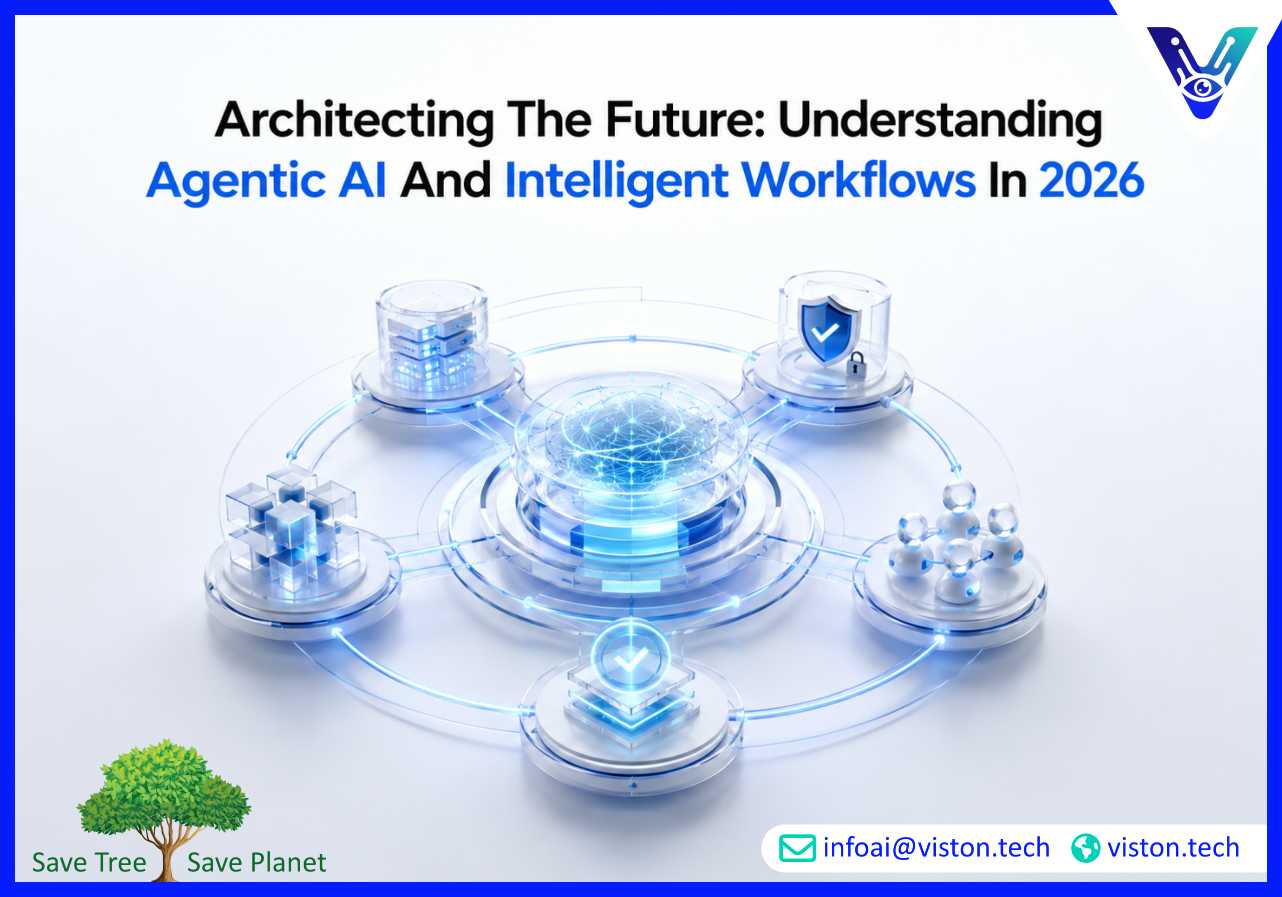
Architecting the Future: Understanding Agentic AI and Intelligent Workflows in 2026
As enterprise technology matures in 2026, the transition from passive Generative AI to active, autonomous systems is the defining shift for business operations. Companies are moving past simple chat interfaces to implement Agentic AI architecture, a paradigm that allows software to reason, plan, and execute complex workflows without constant human prompting. For leaders in sectors like technology consulting and digital infrastructure, understanding this evolution is no longer optional—it is a strategic requirement for maintaining competitive efficiency.
The Evolution of Agentic AI Architecture
At its core, agentic architecture represents a fundamental departure from the “input-output” model of traditional Large Language Models (LLMs). While a standard chatbot relies on a human to provide context and direct instructions, an agentic system acts as an autonomous operator. It is designed to navigate an environment, identify the necessary tools to reach a goal, and troubleshoot issues in real-time.An agentic architecture is built upon several critical technical layers that transform a static model into a functional agent:
1. The Reasoning Engine
The heart of any agent is the reasoning framework. This layer enables the model to perform “Chain of Thought” processing, where the system breaks down a complex business objective into a sequence of smaller, manageable tasks. By employing techniques like ReAct (Reasoning and Acting), the agent can assess its current state, decide on an action, and evaluate the result before moving to the next phase.
2. External Tool Integration (Action Space)
An agent is only as powerful as the tools it can access. Modern agentic architectures are designed to be “tool-agnostic.” They can be granted secure, scoped access to APIs, databases, CRM platforms, and code execution environments. This allows the agent to move from “discussing” a business process to actually executing it—such as querying a SQL database, updating a project management board, or performing a security audit on a codebase.
3. Dynamic Memory Management
Unlike static models that treat every interaction as a blank slate, agentic systems utilize sophisticated memory architectures. This includes short-term context windows for the immediate task and long-term storage—typically facilitated by vector databases—that allows the system to recall internal documentation, past project outcomes, and specific business constraints. This memory enables the agent to learn from previous iterations and avoid repeating errors.
Designing Robust Agentic AI Workflows
The true value of this technology lies in Agentic AI workflows. In a traditional automated workflow, processes are rigid; if an edge case occurs, the process breaks. In an agentic workflow, the system is designed to handle ambiguity through iterative cycles of perception and correction.
The Anatomy of an Intelligent Workflow
A high-performing agentic workflow typically follows a cyclical structure:
Goal Decomposition: The agent receives a high-level command (e.g., “Analyze the last quarter’s bug reports and generate a remediation plan”). The agent breaks this into steps: fetch logs, categorize errors, cross-reference with historical fixes, and draft the report.
Iterative Execution and Perception: The agent attempts the first task. It then reviews the output. If the result is insufficient or an error occurs, it does not simply stop. It evaluates the failure, modifies its strategy, and attempts a new approach.
Human-in-the-Loop (HITL) Checkpoints: For enterprise applications, security and reliability are paramount. Modern workflows incorporate mandatory validation stages where the agent presents its plan or findings to a human stakeholder for approval before proceeding to high-impact actions.
This fluidity allows businesses to automate complex, unstructured tasks that were previously deemed “too messy” for traditional automation software.
Viston AI: Specialized Execution in Agentic Systems
In the complex environment of 2026, many organizations struggle to move from theoretical agentic models to production-ready deployments. Viston AI serves as a specialized partner for enterprises looking to bridge this gap, focusing on the rigorous implementation of intelligent agents within existing business infrastructures.Viston AI specializes in the orchestration of agentic workflows that are both secure and scalable. Their approach focuses on:
Architectural Alignment: Viston AI works with technical teams to ensure that the agentic “brain” is correctly integrated with enterprise data silos. This involves mapping out the necessary tool-use interfaces so that agents can interact with legacy ERPs or modern cloud environments without compromising data integrity.
Governance and Control Planes: One of the primary risks of deploying agents is the potential for “agent drift,” where a system performs actions outside of its intended scope. Viston AI implements oversight frameworks that serve as a control plane, ensuring that all autonomous decisions remain within defined regulatory and business policy boundaries.
Operational Optimization: By analyzing specific operational pain points, the team at Viston AI helps companies determine which processes are best suited for agentic acceleration. This ensures that the deployment provides a measurable ROI rather than just technological novelty.
For organizations in competitive markets, Viston AI provides the technical expertise required to manage the lifecycle of these agents—from the initial design of the reasoning engine to the ongoing monitoring of agent performance in production. This depth of service allows companies to maintain control while leveraging the significant speed and efficiency gains offered by autonomous AI.
Business Impact and Future-Proofing
The integration of agentic AI is fundamentally changing the criteria for operational excellence. Businesses that adopt these architectures early are finding that they can handle increased workloads without a linear increase in headcount.
Key Considerations for Decision-Makers
When evaluating an agentic strategy, leaders should focus on:
Security by Design: Because agents have the ability to execute actions, your security posture must evolve. Implementing role-based access control (RBAC) for your AI agents is as critical as it is for human employees.
Scalability and Multi-Agent Collaboration: The most sophisticated systems rarely rely on one “master agent.” Instead, they use multi-agent systems where specialized agents—such as a data-mining agent and a content-generation agent—collaborate on a single objective. Building for this modularity is essential for long-term scalability.
Measuring Outcomes: Focus on process efficiency and error reduction. A well-designed agentic workflow should demonstrate a clear reduction in the time-to-completion for complex, multi-step business tasks.
Frequently Asked Questions
What is the primary difference between traditional automation and agentic AI?
Traditional automation follows pre-programmed, static rules that cannot handle deviations. Agentic AI uses a reasoning engine to perceive the environment and make autonomous decisions, allowing it to adapt to unexpected challenges without human intervention.
How do we ensure that an agentic AI system stays secure?
Security is managed through strictly scoped API access, human-in-the-loop validation for sensitive actions, and continuous monitoring via governance layers. Viston AI assists firms in setting up these control planes to prevent unauthorized behavior.
Is agentic AI ready for production-level business tasks?
Yes, provided the architecture includes robust error handling, secure memory management, and clear operational boundaries. In 2026, enterprises are successfully using agents for complex tasks like data analysis, supply chain optimization, and automated software testing.
What role does a partner like Viston AI play in implementation?
Viston AI provides the technical integration, security oversight, and architectural design necessary to move agentic systems from an experimental phase into a stable, production-ready enterprise environment.
How does agentic architecture impact data privacy?
Agentic systems must be designed to respect data silos. By using localized or enterprise-specific vector databases and strict authentication protocols, you can ensure that the agent only accesses the information it is authorized to use.
Conclusion
Agentic AI architecture represents the next stage of digital transformation, moving beyond the generation of content toward the active execution of business strategy. By implementing intelligent, iterative workflows, companies can unlock a new standard of efficiency and responsiveness. Whether it is through the meticulous planning of reasoning engines or the secure integration of external tools, the focus for the remainder of 2026 must be on building reliable, governed systems. With the specialized support of partners like Viston AI, organizations can confidently navigate the complexity of these architectures, ensuring that their AI deployment is both innovative and operationally sound. The move to agentic operations is a long-term investment in agility, positioning your business to thrive in an increasingly autonomous economy.