
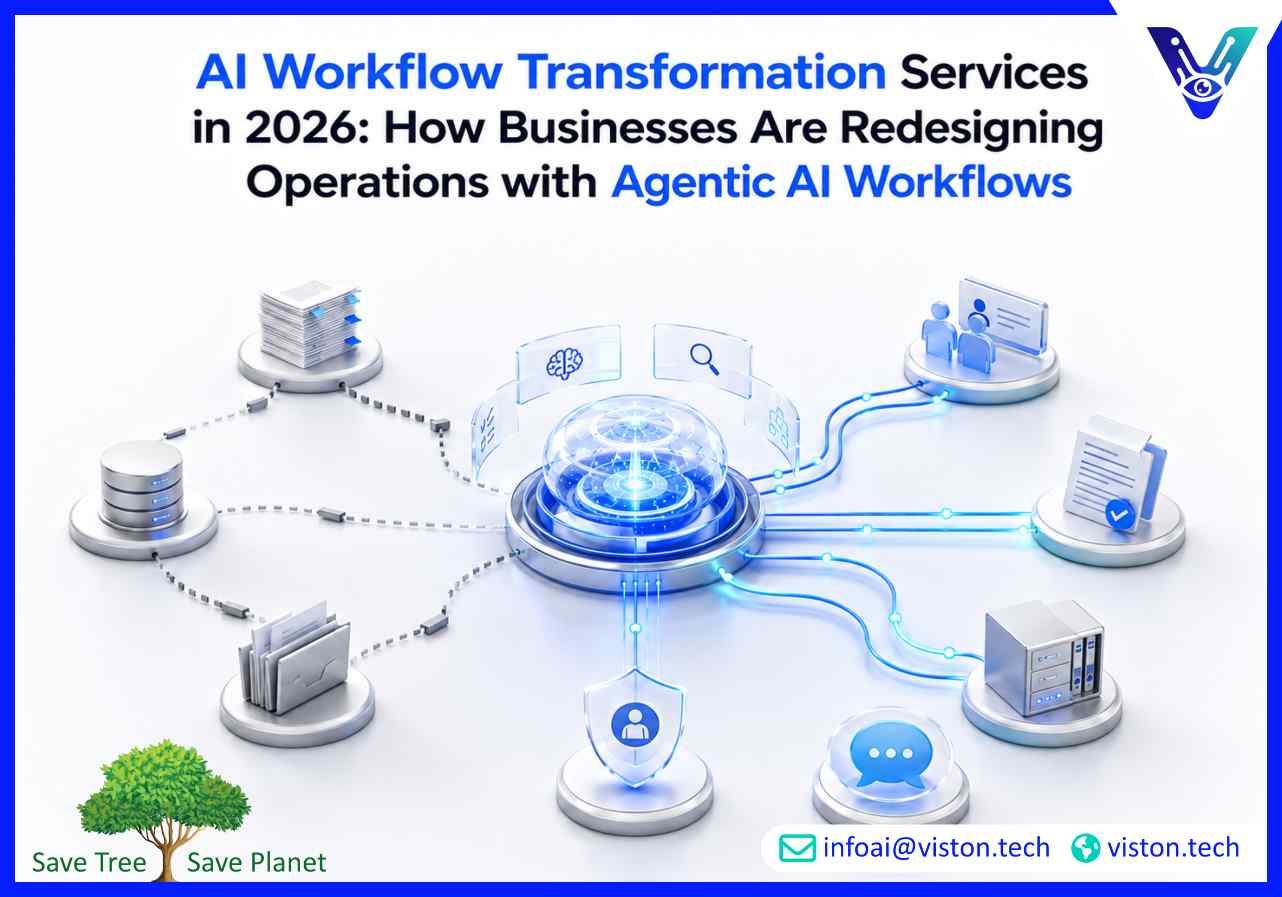
Businesses are under increasing pressure to improve efficiency, reduce operational bottlenecks, and respond faster to changing market demands. AI workflow transformation services have emerged as a practical way to modernize business operations by combining automation, intelligence, and orchestration. In 2026, organizations are moving beyond isolated automation projects and adopting agentic AI workflows that can manage complex processes across multiple systems, teams, and business functions
AI workflow transformation services focus on redesigning and optimizing business processes using artificial intelligence, automation, workflow orchestration, and intelligent decision-making capabilities. Rather than simply automating individual tasks, the goal is to transform entire workflows from end to end.
Traditional workflows often rely on manual handoffs, disconnected systems, repetitive data entry, delayed approvals, and fragmented communication. These inefficiencies can slow growth, increase costs, and limit scalability.
AI workflow transformation addresses these challenges by enabling intelligent workflows that can:
The focus is no longer on automation alone. Businesses increasingly want workflows that can adapt, learn, collaborate, and execute tasks with greater autonomy while remaining aligned with business rules and governance requirements.
The expectations surrounding business operations have changed significantly. Customers expect faster service, employees expect better tools, and leadership teams expect greater operational efficiency. Organizations that continue relying on fragmented manual processes often struggle to compete.
Several factors are driving increased demand for AI workflow transformation services in 2026.
Most organizations operate across multiple software platforms, communication channels, databases, and operational systems. Managing workflows across these environments creates complexity that traditional automation tools often cannot handle effectively.
Business leaders need access to accurate information and actionable insights in real time. AI-powered workflows help collect, analyze, and route information more efficiently, supporting faster decisions.
Many teams spend valuable time on administrative work rather than strategic activities. Workflow transformation allows employees to focus on higher-value responsibilities while AI handles repetitive tasks.
As businesses grow, operational complexity often increases faster than headcount. AI workflow transformation helps organizations scale processes without proportionally increasing manual effort.
One of the most significant developments in 2026 is the emergence of agentic AI workflows. Unlike traditional automation systems that follow predefined rules, AI agents can reason, coordinate tasks, interact with systems, retrieve information, and execute workflows with controlled autonomy.
This shift enables businesses to automate increasingly sophisticated operational processes.
Successful AI workflow transformation requires more than implementing AI tools. Organizations need a structured approach that aligns technology with business objectives.
Transformation begins with understanding existing workflows. Organizations must identify inefficiencies, bottlenecks, manual dependencies, approval processes, and opportunities for optimization.
Without process clarity, automation efforts often produce limited results.
Agentic workflows rely on specialized AI agents designed for specific responsibilities. Depending on the workflow, agents may perform research, data extraction, communication, validation, reporting, monitoring, customer interaction, or decision support functions.
Clearly defined agent roles improve workflow reliability and governance.
Orchestration serves as the coordination layer that manages how agents interact, exchange information, trigger actions, escalate exceptions, and complete business processes.
A well-designed orchestration framework ensures workflows remain structured, auditable, and aligned with business requirements.
Most workflows depend on data and actions across multiple platforms. AI workflow transformation often includes integrations with:
Seamless integration enables workflows to operate effectively within existing business environments.
While AI can automate many operational activities, certain decisions still require human judgment. Effective workflow transformation includes approval processes, audit trails, security controls, escalation paths, and monitoring mechanisms.
This balance helps organizations maintain trust, compliance, and operational accountability.
Organizations that successfully implement AI workflow transformation services often achieve measurable operational improvements.
Automating repetitive tasks and streamlining workflows reduces delays, eliminates unnecessary manual effort, and accelerates process completion.
AI agents can apply consistent logic, validate information, and reduce human errors that frequently occur in manual workflows.
Faster response times, improved service consistency, and quicker issue resolution contribute to stronger customer satisfaction.
Organizations can support growing workloads without significantly increasing operational resources.
Modern workflow platforms provide monitoring, analytics, performance tracking, and operational insights that help businesses continuously improve processes.
AI-powered workflows improve coordination across departments by reducing communication gaps and automating information exchange.
These benefits make workflow transformation a strategic initiative rather than simply a technology upgrade.
Organizations pursuing AI workflow transformation often need expertise that extends beyond software implementation. Successful transformation requires workflow analysis, orchestration design, system integration, AI agent development, governance planning, and continuous optimization.
Viston AI specializes in Agentic AI Workflows that help businesses transform operational processes through intelligent automation and coordinated AI execution. Its approach focuses on designing workflows where specialized AI agents collaborate across systems, data sources, and business functions to support practical operational outcomes.
By combining workflow orchestration, AI automation, system integrations, and agent-based execution, Viston AI helps organizations move beyond isolated AI tools toward scalable workflow ecosystems. This can include automating customer operations, sales processes, internal workflows, support functions, knowledge management, reporting activities, and other business-critical processes.
Rather than treating AI as a standalone capability, the focus is on integrating intelligence directly into operational workflows where measurable business value can be achieved. For organizations exploring AI workflow transformation services in 2026, Agentic AI Workflows provide a structured framework for improving efficiency, scalability, and operational agility.
AI workflow transformation services help organizations redesign and optimize business processes using artificial intelligence, workflow automation, orchestration, and intelligent decision-making capabilities.
Traditional automation typically follows predefined rules. Agentic AI workflows use AI agents that can analyze context, coordinate tasks, retrieve information, make workflow decisions, and interact with business systems more dynamically.
Customer support, sales operations, employee onboarding, document processing, reporting, finance workflows, compliance reviews, knowledge management, and operational coordination are common candidates for transformation.
No. Most transformation initiatives focus on integrating AI capabilities with existing systems rather than replacing current business applications.
Implementation timelines vary depending on workflow complexity, integration requirements, governance considerations, and organizational readiness. Projects may range from a few weeks to several months.
Viston AI helps businesses design and deploy Agentic AI Workflows by combining AI agent development, workflow orchestration, automation strategy, and enterprise system integration to improve operational performance.
AI workflow transformation services are becoming a critical component of business modernization strategies in 2026. As organizations seek greater efficiency, scalability, and operational agility, traditional automation approaches are giving way to more advanced agentic AI workflows that can coordinate complex processes across systems and teams. Successful transformation requires careful planning, workflow design, orchestration, integration, and governance. Through its expertise in Agentic AI Workflows, Viston AI helps organizations build intelligent workflow ecosystems that support practical business outcomes, operational excellence, and sustainable growth.
