
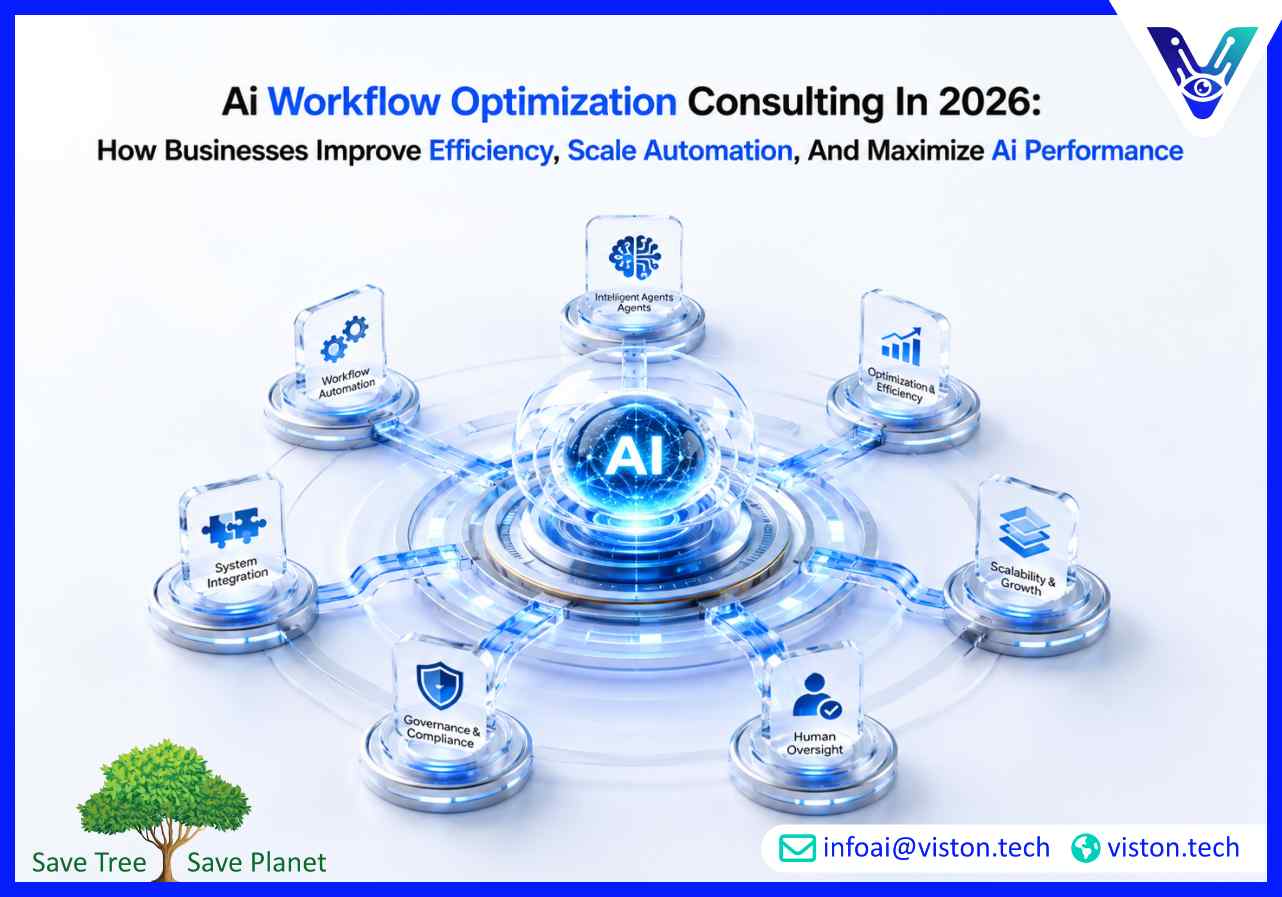
As organizations invest more heavily in artificial intelligence, many discover that deploying AI is only the first step. The real challenge is ensuring AI workflows operate efficiently, consistently, and at scale. AI workflow optimization consulting helps businesses improve performance, eliminate bottlenecks, increase automation value, and ensure AI systems deliver measurable business outcomes in 2026
AI workflow optimization consulting focuses on evaluating, improving, and scaling AI-powered business processes. While many organizations successfully deploy AI tools, they often encounter challenges related to workflow design, system integration, process inefficiencies, data quality, governance, and operational scalability.
Optimization consulting addresses these issues by analyzing how AI workflows function across business operations and identifying opportunities for improvement.
Typical optimization initiatives include:
The objective is not simply to automate more tasks but to ensure AI workflows support business goals efficiently, reliably, and sustainably.
AI adoption has matured significantly. Businesses are no longer evaluating whether AI should be used; they are focused on how to maximize value from existing AI investments.
Organizations frequently encounter situations where AI workflows work well in pilot programs but struggle when deployed across larger teams, departments, or enterprise environments.
Several factors make optimization increasingly important:
Modern AI workflows often connect multiple systems, APIs, data sources, applications, and AI agents. As complexity increases, inefficiencies can become harder to identify and resolve without structured analysis.
Business leaders expect AI initiatives to contribute to measurable outcomes such as faster processing times, improved productivity, enhanced customer experiences, and reduced operational costs.
Agentic AI workflows introduce autonomous decision-making, task delegation, and orchestration capabilities. Optimization ensures these systems remain controlled, transparent, and aligned with business objectives.
As organizations expand AI adoption, workflows must handle larger workloads without creating operational risks or performance degradation.
Optimization consulting helps organizations move from isolated AI success stories to enterprise-wide operational effectiveness.
Many organizations encounter similar obstacles after deploying AI-powered processes.
AI workflows often depend on multiple business platforms, including CRM systems, ERP solutions, customer support software, databases, analytics tools, and document repositories. Poor integration can create delays, data inconsistencies, and workflow failures.
AI systems perform best when they have access to accurate and relevant information. Incomplete, outdated, or fragmented data frequently reduces workflow effectiveness.
Some automation processes still require excessive manual intervention. Approval delays, repetitive validation steps, and poorly designed handoffs can limit overall efficiency.
Without monitoring and reporting capabilities, organizations may struggle to understand where workflows fail, how AI agents perform, or which processes require optimization.
Businesses increasingly need clear oversight regarding how AI workflows operate, what decisions agents can make, and how sensitive information is handled.
Optimization consulting addresses these challenges through structured assessment and continuous improvement initiatives.
Effective optimization requires a comprehensive view of technology, processes, data, and operational goals.
Consultants evaluate workflow structures to identify inefficiencies, duplicated tasks, unnecessary approvals, and automation opportunities. Process mapping helps determine how AI can support more streamlined operations.
Organizations increasingly use multiple AI agents to perform specialized tasks. Optimization focuses on improving communication between agents, reducing redundancy, enhancing task coordination, and ensuring reliable workflow execution.
Workflow optimization often involves improving integrations between AI systems and business applications. Better integrations support faster processing, improved data access, and more reliable automation outcomes.
Not every business decision should be fully automated. Optimization helps determine where human oversight is required and how approvals can be incorporated without creating unnecessary delays.
Organizations need visibility into workflow performance. Optimization initiatives commonly include KPI development, workflow analytics, performance dashboards, and operational reporting.
AI workflows should support future growth. Optimization helps businesses prepare for increased transaction volumes, additional integrations, expanding datasets, and evolving AI capabilities.
Organizations seeking to improve AI-driven operations often require more than technical implementation. They need workflows designed around business outcomes, operational efficiency, scalability, and governance.
Viston AI specializes in Agentic AI Workflows that help businesses move beyond isolated automation and build coordinated AI systems capable of supporting real operational processes. This includes designing workflows where AI agents can collaborate, exchange information, execute tasks, validate outputs, and integrate with business systems while maintaining appropriate oversight.
AI workflow optimization aligns naturally with agentic workflow development because successful optimization depends on workflow architecture, orchestration logic, integration design, and performance monitoring. Viston AI helps organizations evaluate existing workflows, identify inefficiencies, improve agent coordination, strengthen system integrations, and create scalable automation strategies that support business growth.
Rather than focusing solely on AI deployment, the approach emphasizes operational effectiveness. Businesses can benefit from workflows that are easier to manage, more reliable in production environments, and better aligned with measurable objectives such as productivity improvements, process efficiency, customer experience enhancement, and operational scalability.
For organizations exploring advanced automation in 2026, optimized agentic workflows provide a practical path toward sustainable AI adoption and long-term business value.
AI workflow optimization consulting helps organizations improve the efficiency, performance, scalability, and reliability of AI-powered business processes through workflow analysis, system improvements, and operational refinement.
Businesses should consider optimization when workflows experience bottlenecks, inconsistent results, poor integration performance, limited visibility, scalability issues, or lower-than-expected business outcomes.
Implementation focuses on deploying AI solutions. Optimization focuses on improving existing workflows to increase efficiency, reliability, governance, scalability, and business impact.
Yes. Optimization can enhance agent coordination, task orchestration, context sharing, workflow reliability, monitoring, and overall system performance.
Sales operations, customer service, finance, HR, marketing, procurement, compliance, knowledge management, and operational workflows commonly benefit from optimization initiatives.
Through its Agentic AI Workflows expertise, Viston AI helps organizations design, improve, orchestrate, and scale AI-driven workflows that support operational efficiency, automation maturity, and long-term business objectives.
AI workflow optimization consulting has become an essential part of successful AI adoption in 2026. As organizations deploy increasingly sophisticated automation and agentic systems, optimizing workflow design, integrations, orchestration, governance, and scalability becomes critical for achieving measurable business value. Businesses that continuously refine AI workflows are better positioned to improve efficiency, reduce operational friction, and maximize the return on their AI investments. For organizations exploring advanced Agentic AI Workflows, Viston AI offers expertise that helps connect AI capabilities with practical, scalable business operations.
