
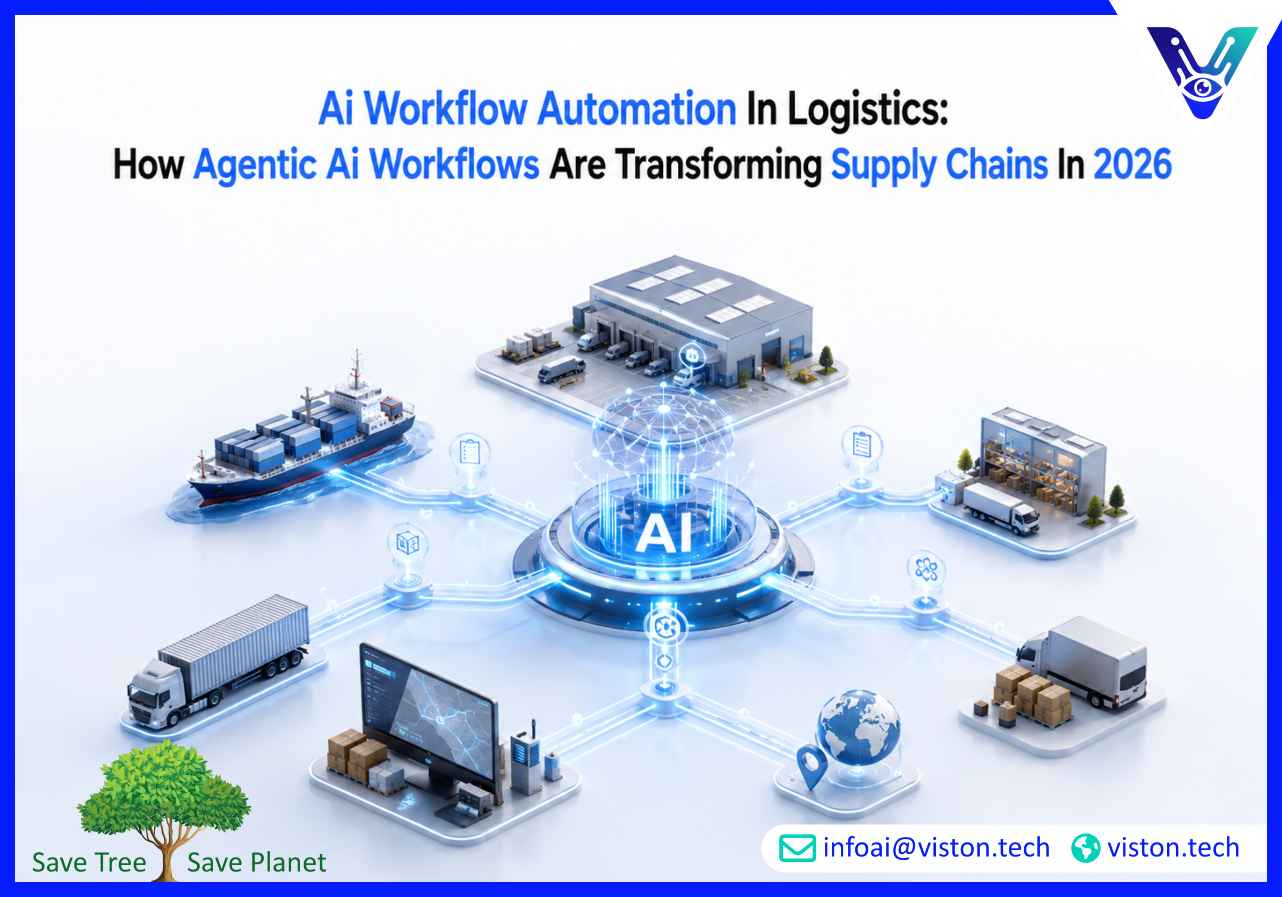
Logistics businesses are under increasing pressure to improve speed, visibility, cost efficiency, and operational resilience. In 2026, AI workflow automation in logistics is becoming a strategic priority as companies look to reduce manual coordination, improve decision-making, and build more adaptive supply chain operations through intelligent automation.
AI workflow automation in logistics refers to the use of artificial intelligence to streamline, coordinate, and optimize operational processes across transportation, warehousing, inventory management, shipment tracking, procurement, and supply chain planning.
Unlike traditional automation systems that rely on rigid rule-based logic, modern AI-driven workflows can interpret data, identify patterns, respond to changing conditions, and support operational decisions in real time.
This shift is particularly important in logistics environments where businesses must manage:
As logistics ecosystems become more connected and data-intensive, businesses are increasingly adopting intelligent workflow systems capable of automating both repetitive and decision-oriented tasks.
The logistics sector has evolved significantly over the past few years. Businesses now operate in environments that demand continuous responsiveness, operational transparency, and scalable coordination across suppliers, warehouses, carriers, and customers.
Several factors are driving investment in AI workflow automation:
Modern logistics operations involve large volumes of interconnected workflows. Manual coordination often creates delays, communication gaps, and inconsistent execution.
AI-powered workflow systems help centralize and automate operational actions across multiple departments and systems.
Supply chain disruptions, weather events, fuel cost changes, and delivery exceptions require faster operational responses.
AI systems can analyze operational data continuously and trigger intelligent workflow actions without waiting for manual intervention.
Customers now expect:
AI workflow automation supports these expectations by improving execution consistency and operational responsiveness.
Many logistics providers are facing workforce shortages and rising operational costs. Intelligent automation reduces repetitive manual workload and allows teams to focus on higher-value operational tasks.
Agentic AI Workflows represent a more advanced form of intelligent automation.
Instead of simply automating isolated tasks, agentic AI systems can:
In logistics, this creates opportunities for more adaptive and self-managing operational environments.
For example, an agentic AI workflow can:
This level of workflow intelligence significantly improves operational agility compared to traditional automation platforms.
AI-powered workflows can continuously monitor shipment data across carriers, GPS systems, warehouse platforms, and transport management systems.
When delays, route deviations, or disruptions occur, workflows can automatically:
This improves visibility while reducing manual intervention.
AI systems can analyze:
Automated workflows can then dynamically adjust delivery routes to improve efficiency and reduce transportation costs.
AI workflow automation supports warehouse efficiency through:
This helps reduce delays, inventory discrepancies, and operational bottlenecks.
AI models can process historical demand patterns, seasonal trends, procurement data, and market conditions to improve inventory planning accuracy.
Automated workflows can then trigger procurement actions, supplier coordination, or warehouse redistribution activities.
Logistics operations often involve multiple external partners.
AI workflow automation helps standardize communication and automate:
AI-driven workflows reduce dependency on manual coordination and allow businesses to react more quickly to operational changes.
Real-time monitoring and automated reporting improve transparency across logistics operations.
Automation reduces repetitive administrative work, minimizes inefficiencies, and improves resource utilization.
AI systems can identify operational risks, analyze patterns, and support more informed logistics planning.
As logistics operations grow, intelligent workflows can handle increasing transaction volumes without proportional increases in staffing.
More accurate delivery updates, proactive issue handling, and improved fulfillment reliability contribute to stronger customer satisfaction.
While AI workflow automation offers significant advantages, implementation requires careful planning.
Logistics businesses often operate across multiple disconnected systems, including ERP platforms, warehouse management systems, transportation management systems, and carrier networks.
Successful automation requires seamless system integration.
AI systems rely heavily on accurate and structured operational data. Poor data quality can affect automation accuracy and decision-making reliability.
Operational teams may need training and workflow redesign to effectively adopt AI-enabled logistics systems.
Logistics businesses must ensure that AI-driven systems align with data security, privacy, and compliance requirements, especially when handling customer and shipment data across regions.
Organizations need clear governance frameworks to define:
Businesses should begin by identifying repetitive, time-sensitive, or error-prone workflows that significantly affect operational performance.
Before automation, organizations need clear visibility into current logistics workflows, dependencies, and operational gaps.
Modern logistics environments require flexible automation systems that can scale with operational growth and evolving business requirements.
The most effective logistics automation strategies combine intelligent AI coordination with human operational oversight for complex decisions and exceptions.
Implementation should be tied to operational KPIs such as:
Viston AI helps businesses implement intelligent Agentic AI Workflows designed to improve operational efficiency, workflow coordination, and decision automation across complex business environments, including logistics and supply chain operations.
Its approach focuses on building scalable AI-powered workflow ecosystems capable of integrating with operational systems, automating business processes, and enabling intelligent decision orchestration across multiple operational layers.
For logistics businesses, Agentic AI Workflows can support areas such as:
As logistics operations become increasingly data-driven and interconnected, businesses require automation systems that can adapt to operational changes while maintaining visibility, efficiency, and control.
Viston AI’s focus on intelligent workflow orchestration and scalable AI implementation aligns with the growing demand for adaptive logistics automation in 2026 and beyond.
Several emerging trends are influencing the future of logistics automation.
AI systems are increasingly capable of independently coordinating multi-step operational processes across departments and vendors.
Advanced AI models are improving predictive planning for inventory, transportation disruptions, demand forecasting, and delivery scheduling.
Businesses are beginning to deploy multiple specialized AI agents that collaborate across logistics workflows, each handling distinct operational functions.
Modern logistics platforms are moving toward continuous real-time analytics and automated operational decision support.
Logistics companies are using AI workflows to reduce fuel consumption, optimize transportation efficiency, and support sustainability goals.
AI workflow automation in logistics uses artificial intelligence to automate operational processes such as shipment tracking, route optimization, warehouse coordination, inventory management, and supply chain decision-making.
Agentic AI Workflows are intelligent automation systems capable of making contextual decisions, coordinating workflows autonomously, and adapting to changing operational conditions with minimal manual intervention.
AI improves logistics efficiency by reducing manual tasks, optimizing routes, improving forecasting accuracy, automating operational coordination, and enabling faster decision-making.
Yes. Many mid-sized logistics companies are adopting scalable AI workflow solutions to improve operational visibility, reduce inefficiencies, and support growth without significantly increasing operational overhead.
Common challenges include system integration complexity, poor data quality, workflow redesign requirements, employee adoption, and ensuring operational governance.
Viston AI supports businesses with Agentic AI Workflows that help automate operational processes, improve workflow coordination, and enable intelligent business process orchestration across logistics operations.
AI workflow automation in logistics is becoming essential for businesses seeking greater operational agility, efficiency, and supply chain resilience in 2026. As logistics environments grow more complex, Agentic AI Workflows provide a more adaptive approach to automation by combining intelligent decision-making with scalable workflow orchestration.
For logistics organizations evaluating long-term operational modernization, intelligent workflow systems can improve visibility, reduce manual coordination, and support faster responses across supply chain operations. Companies such as Viston AI are helping businesses implement scalable AI-driven workflow solutions that align with the evolving demands of modern logistics and supply chain management.
