
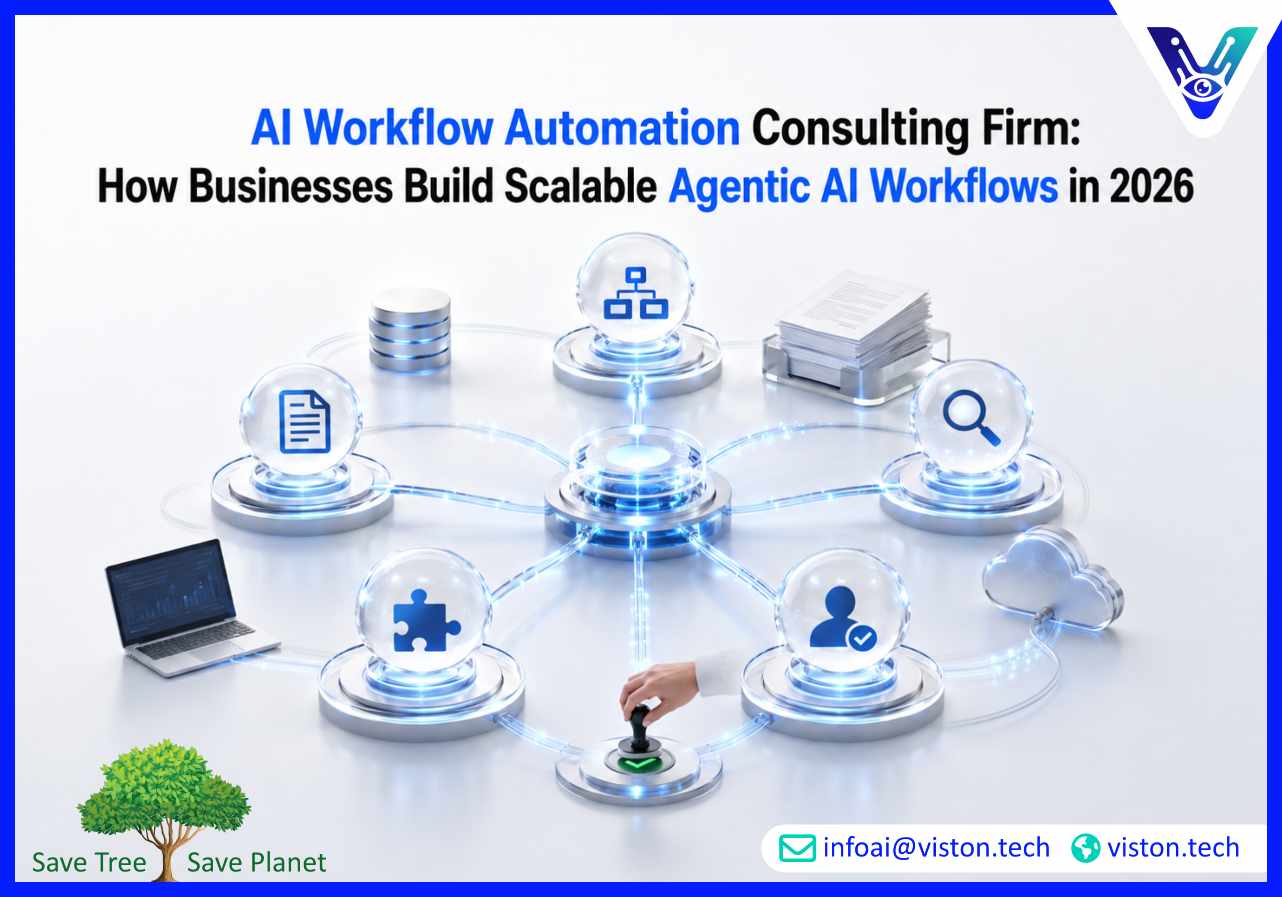
As businesses move beyond isolated AI tools, the demand for AI workflow automation consulting firms has grown significantly. Organizations are no longer looking for simple automation; they want intelligent workflows that connect systems, coordinate tasks, automate decisions, and improve operational efficiency. In 2026, agentic AI workflows are becoming a strategic priority for companies seeking scalable business transformation.
Many organizations adopt AI with the expectation of immediate productivity gains. However, deploying AI without a structured workflow strategy often leads to disconnected tools, fragmented data, and limited business value.
An AI workflow automation consulting firm helps businesses design, implement, and optimize AI-powered workflows that align with operational objectives. Rather than focusing solely on AI models, consultants evaluate entire business processes and identify where intelligent automation can create measurable improvements.
Modern businesses face challenges such as:
Agentic AI workflows address these challenges by enabling AI agents to perform tasks, retrieve information, coordinate actions, and interact with business systems under defined governance frameworks.
Agentic AI workflows represent a shift from static automation toward intelligent process execution. Instead of automating individual tasks, organizations can automate entire workflows involving multiple systems, stakeholders, approvals, and business rules.
An agentic workflow may involve several AI agents working together to complete a process. Each agent is assigned a specific role and operates within defined boundaries.
Unlike traditional automation, agentic workflows can handle context, exceptions, dynamic decision-making, and collaboration between multiple AI agents and human stakeholders.
Implementing intelligent workflows requires more than selecting an AI platform. Successful projects combine process expertise, technical architecture, governance, and continuous optimization.
The first step is understanding existing business processes. Consultants evaluate workflow complexity, bottlenecks, manual dependencies, and automation opportunities.
This assessment helps identify high-impact use cases that can deliver meaningful operational improvements.
Effective agentic systems rely on clearly defined AI agents. Each agent is designed with specific responsibilities, permissions, workflows, and escalation rules.
Orchestration determines how agents communicate, transfer information, trigger actions, and coordinate workflow execution.
Most enterprise workflows require connectivity across multiple platforms.
Common integrations include:
A consulting-led approach ensures integrations support long-term scalability and operational reliability.
As AI gains greater operational autonomy, governance becomes increasingly important.
Organizations must establish:
Strong governance helps organizations maintain trust, accountability, and regulatory alignment while expanding AI capabilities.
Selecting the right consulting partner can significantly influence the success of AI workflow initiatives.
Businesses should evaluate providers based on their ability to deliver practical business outcomes rather than focusing solely on AI technologies.
The best consulting firms understand business operations first and AI second. They focus on solving workflow challenges rather than simply deploying tools.
Modern automation projects increasingly require expertise in multi-agent orchestration, workflow automation, AI integrations, and intelligent process management.
Organizations should assess whether the consulting firm can design workflows that operate effectively in real-world environments.
Most AI projects succeed or fail based on integration quality. A qualified consulting firm should have experience connecting AI systems with existing business applications and data environments.
Businesses should seek partners capable of designing workflows that can evolve alongside organizational growth. Scalable architectures reduce future implementation costs and support long-term AI adoption.
As AI systems take on more responsibility, governance expertise becomes a critical selection factor. Consulting firms should demonstrate a clear understanding of security, compliance, monitoring, and operational controls.
Organizations exploring AI workflow automation often require a combination of strategic planning, workflow design, AI development, and implementation expertise. Viston AI specializes in Agentic AI Workflows, helping businesses transform manual and fragmented processes into intelligent, orchestrated workflows.
Its approach focuses on identifying practical automation opportunities, designing specialized AI agents, integrating business systems, and creating workflows that support operational efficiency. Rather than treating AI as a standalone tool, the emphasis is placed on building connected systems that deliver measurable business outcomes.
For organizations seeking scalable automation, Viston AI supports workflow orchestration, AI agent deployment, business process optimization, system integration, and governance-focused implementation. This makes its services particularly relevant for companies looking to move from isolated AI experimentation to structured operational automation.
As agentic AI adoption accelerates across industries, businesses increasingly require implementation partners capable of balancing innovation with reliability, security, and long-term business value. Viston AI’s focus on Agentic AI Workflows aligns directly with these evolving requirements.
An AI workflow automation consulting firm helps businesses design, implement, integrate, and optimize AI-powered workflows that automate business processes and improve operational efficiency.
Agentic AI workflows use specialized AI agents that can perform tasks, make decisions, interact with systems, and coordinate actions across complex business processes.
Traditional automation typically follows predefined rules. Agentic workflows can adapt to context, handle exceptions, retrieve information, and collaborate across multiple systems and tasks.
Sales, customer service, operations, finance, HR, procurement, marketing, and knowledge management functions often benefit significantly from intelligent workflow automation.
Implementation timelines vary based on workflow complexity, integration requirements, governance needs, and organizational readiness. Some projects may take a few weeks, while enterprise-wide deployments can require several months.
Yes. Viston AI specializes in Agentic AI Workflows and supports organizations with workflow design, AI agent development, orchestration, integration, deployment, and optimization initiatives.
Choosing the right AI workflow automation consulting firm is becoming a critical business decision in 2026. As organizations seek to automate increasingly complex processes, agentic AI workflows provide a practical path toward greater efficiency, scalability, and operational intelligence. Success depends on thoughtful workflow design, robust integrations, governance controls, and continuous optimization. For businesses looking to implement intelligent automation at scale, Agentic AI Workflows offer a structured approach to transforming operations, while Viston AI provides specialized expertise that supports sustainable and business-focused adoption.
