
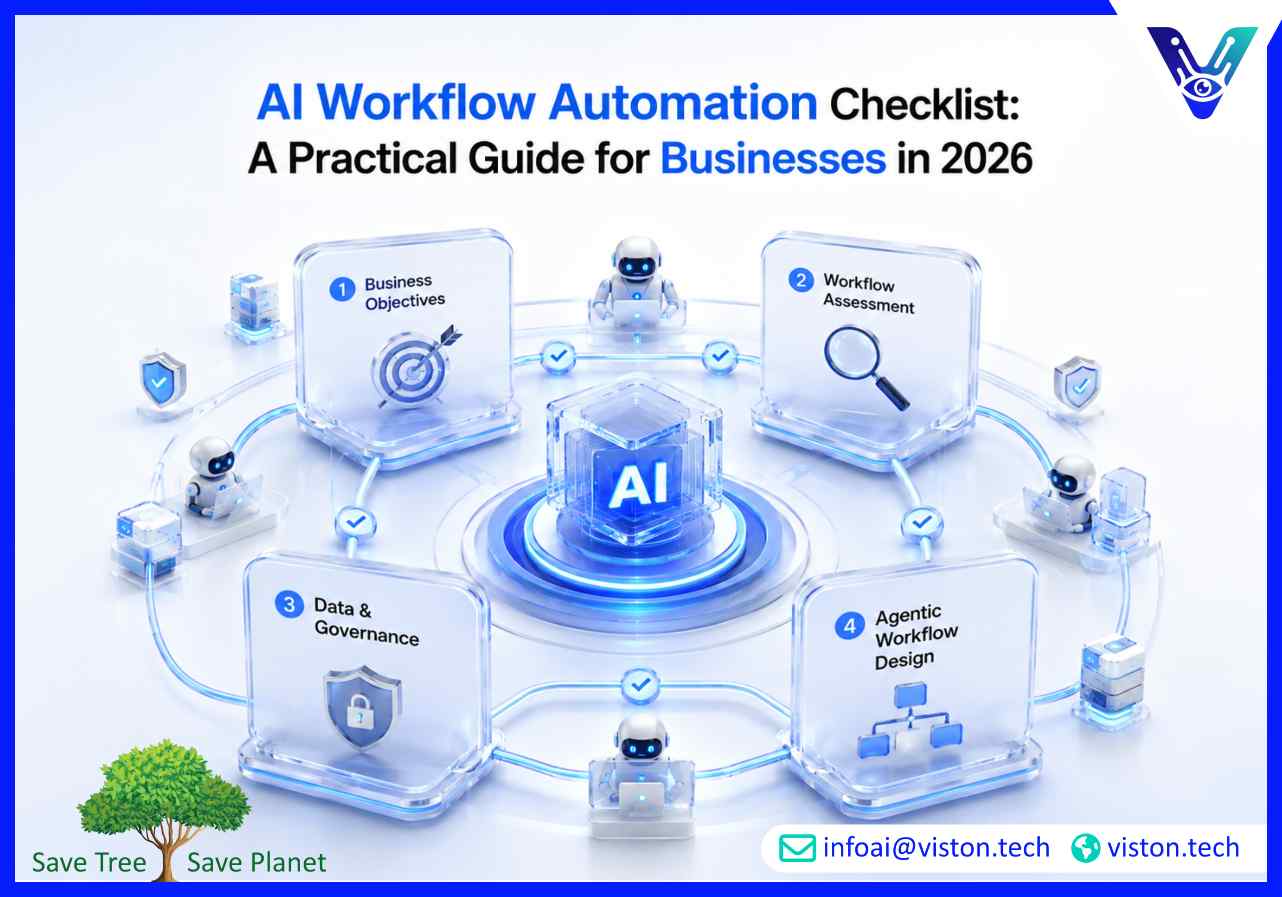
AI workflow automation has moved from experimentation to operational necessity. Businesses are increasingly using agentic workflows to automate repetitive processes, improve decision-making, and connect systems across departments. However, successful implementation requires more than selecting an AI tool. A structured checklist helps organizations avoid common mistakes and build automation that delivers measurable business value
Many organizations begin AI automation initiatives with high expectations but struggle during implementation because workflows, data, governance, and operational requirements are not properly planned. An AI workflow automation checklist provides a framework for evaluating readiness, identifying risks, and ensuring workflows are designed for long-term scalability.
In 2026, businesses are expected to manage increasing volumes of data, customer interactions, operational tasks, and compliance requirements. Agentic AI workflows can support these demands, but only when automation is built around clear business objectives and reliable execution processes.
A structured checklist helps organizations:
Before selecting AI platforms, businesses should clearly define why automation is being implemented.
Common objectives include reducing manual workloads, improving response times, increasing accuracy, lowering operational costs, enhancing customer experiences, and improving data visibility.
Organizations that begin with technology instead of business goals often struggle to achieve meaningful results.
Not every process should be automated. The most successful AI workflow automation projects focus on workflows that are repetitive, data-driven, time-consuming, and operationally important.
The goal is to automate processes where AI can consistently create value without introducing unnecessary operational risk.
Workflow automation depends heavily on data quality and system connectivity. Even advanced AI agents cannot perform effectively if underlying information is incomplete, inaccurate, or inaccessible.
Organizations that address governance early typically experience smoother deployments and greater confidence in automation outcomes.
Modern AI workflow automation increasingly relies on agentic AI systems rather than isolated automation scripts. Agentic workflows use specialized AI agents that can perform tasks, retrieve information, make recommendations, communicate with systems, and collaborate across processes.
A well-designed agentic workflow should balance automation efficiency with operational control.
For organizations exploring Agentic AI Workflows, successful implementation often requires expertise that combines workflow design, AI automation strategy, system integration, and operational optimization. Viston AI specializes in Agentic AI Workflows that help businesses transform manual processes into coordinated AI-driven operations.
Rather than focusing solely on automation tools, the approach centers on identifying high-value business workflows, designing agent-based systems, integrating existing business platforms, and establishing governance frameworks that support reliable execution.
Organizations evaluating AI workflow automation frequently require support with process mapping, workflow orchestration, AI agent design, API integrations, data readiness assessments, monitoring frameworks, and scalability planning. These elements are critical for moving beyond isolated automation experiments and building workflows that deliver measurable operational improvements.
As businesses increasingly adopt AI-powered operations in 2026, practical workflow design, controlled automation, and continuous optimization have become essential components of successful implementation strategies.
An AI workflow automation checklist is a structured framework used to evaluate readiness, plan implementation, manage risks, and optimize business processes before deploying AI-powered automation.
Workflow assessment helps identify whether a process is suitable for automation, highlights potential risks, and ensures AI is applied where it can create measurable business value.
Agentic AI workflows use specialized AI agents that can collaborate, retrieve information, perform actions, and complete tasks across systems while following predefined workflow rules and governance controls.
Common metrics include time savings, process completion rates, operational efficiency improvements, error reduction, customer satisfaction improvements, and cost optimization.
Governance helps ensure security, compliance, accountability, approval management, auditability, and responsible use of AI throughout business operations.
Yes. Viston AI provides expertise in Agentic AI Workflows, helping organizations design, integrate, deploy, and optimize AI-powered workflow automation aligned with operational objectives.
An effective AI workflow automation checklist provides the foundation for successful automation initiatives in 2026. By focusing on business objectives, workflow suitability, data readiness, governance, and agentic workflow design, organizations can reduce implementation risks and improve operational outcomes. As AI continues to reshape business operations, structured planning becomes increasingly important. For companies exploring Agentic AI Workflows, Viston AI offers expertise that helps transform automation opportunities into scalable, practical, and business-focused solutions.
